The single cell origin of sporadic Alzheimer's disease: A developmental biallelic somatic mutation model
Abstract
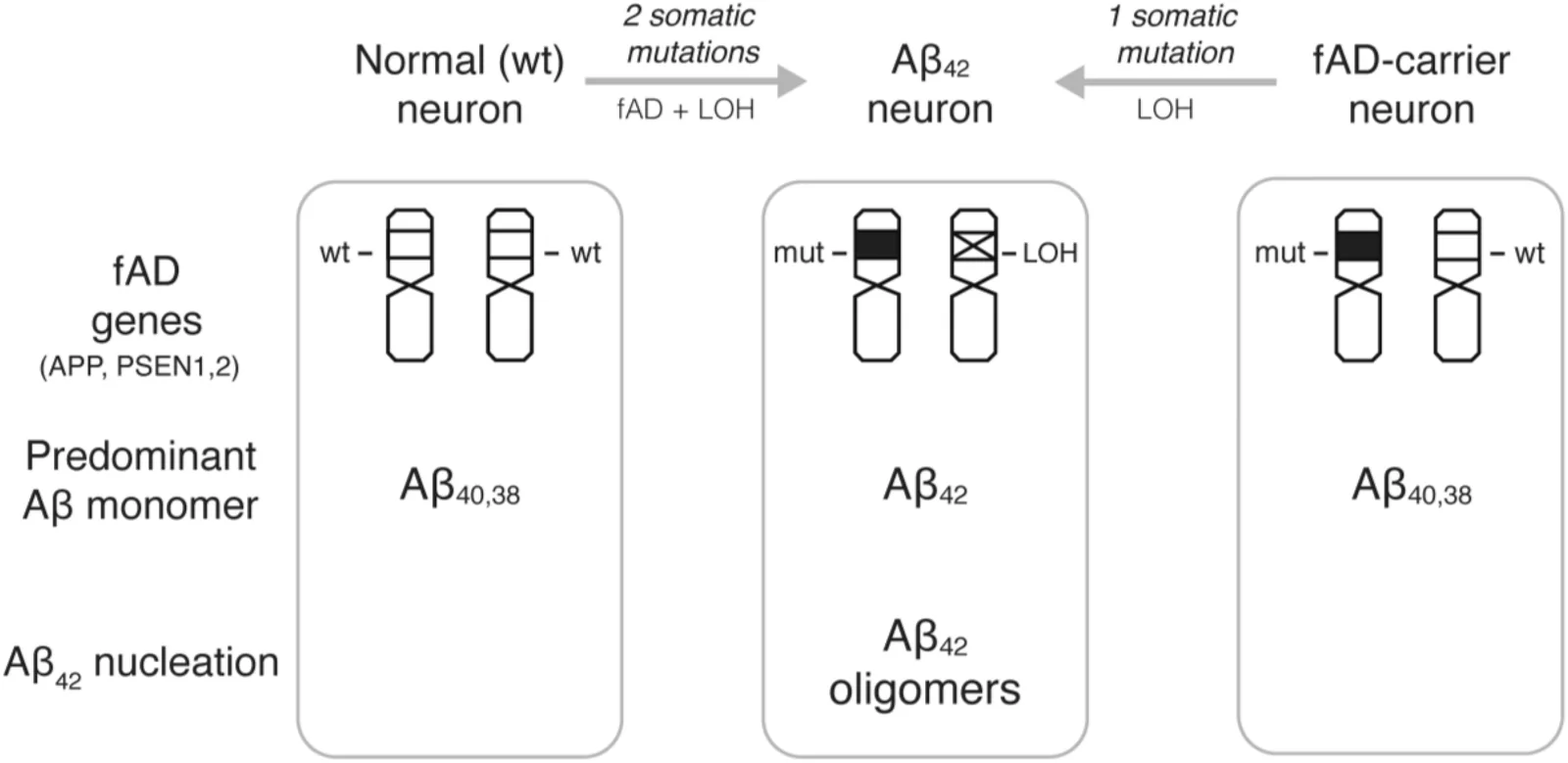
Alzheimer's disease (AD) is a neurodegenerative disorder beginning decades prior to diagnosis and characterized by aggregates of amyloid-β (Aβ)₄₂ and of hyperphosphorylated tau (ptau) proteins. The etiology of sporadic AD (sAD) is unclear and there are problems in our understanding of dominantly inherited familial AD (fAD). In carriers the dominant mutation is expressed throughout the brain in every neuron in utero; why then is the appearance of Aβ₄₂ plaques focal? To explain this, a single cell origin model for sAD is proposed based on Knudson's biallelic mutation model for neoplasia. Familial neoplasia (fN) syndromes have an autosomal dominant pattern of inheritance. However, if the fN mutations are dominant at the cellular level then every cell expressing the mutation would become a tumor and that is not the case. Tumors originate from single cells and somatic loss of heterozygosity (LOH) in a fN carrier cell is necessary for tumorigenesis and defines fN mutations as recessive. Analogously somatic LOH is necessary in a fAD carrier neuron for it to produce Aβ₄₂ monomers in sufficient concentration (Aβ₄₂ neuron) to potentiate Aβ₄₂ nucleation and to generate prion-like Aβ₄₂ oligomers. In sAD the biallelic mutations in the founder Aβ₄₂ neuron are somatic. Endogenous neuronal somatic mutations peak in incidence during development. The number of founder Aβ₄₂ neurons, the variant of the fAD mutation, and the location and neural connectivity of the Aβ₄₂ neuron to the locus coeruleus will impact the age of onset and clinical heterogeneity. Knudson's biallelic somatic mutation model in development is applicable to all prion-like neurodegenerative disorders.
- Modelling and theory
- Proteostasis
- Sporadic Alzheimer's disease
- Alzheimer's disease
- Familial Alzheimer's disease
The paper
Red Deer Regional Hospital
Journal of Alzheimer's Disease Reports, 27 Jul 2026, Open access