3D Microfluidic Networks Formed by Mechanically Guided Compressive Buckling for Large-Scale Perfused Tissue Culture
Abstract
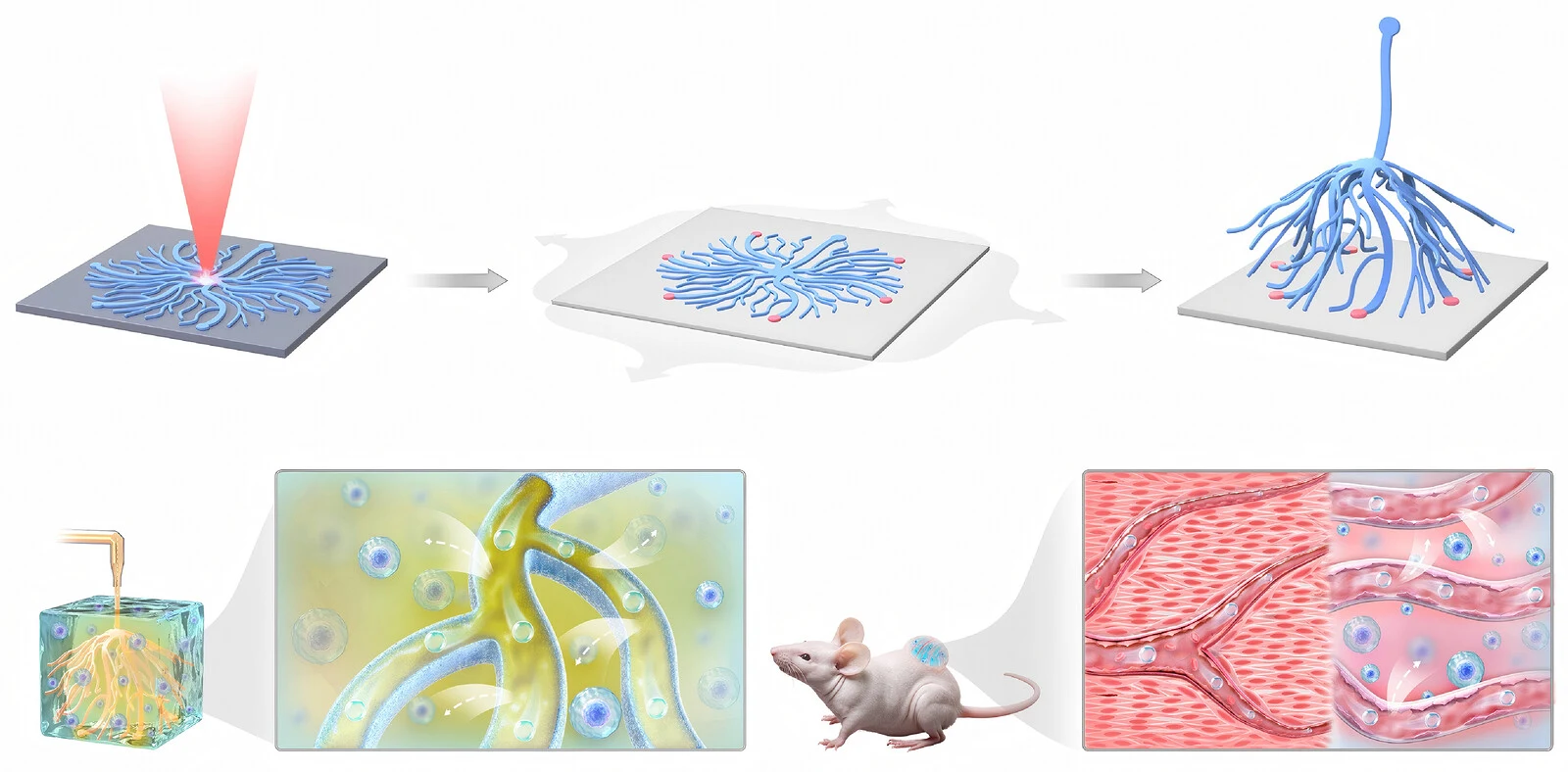
Engineered tissues and organoids offer transformative potential for drug screening and regenerative medicine, yet their application is constrained by limited size and slow maturation. Despite the development of various channel networks for large-scale engineered tissue perfusion culture, achieving sufficiently dense, architecturally complex networks with microscale channels in large-scale matrix has remained challenging. In this work, we introduce a design and fabrication strategy for creating intricate three-dimensional microfluidic networks (3D MFNs) within centimeter-scale cell-laden hydrogels using sacrificial 3D-assembled templates. A theoretical model was established to inversely design 3D MFNs with target architectures by optimizing the two-dimensional (2D) geometries of precursor structures and applying compressive strains for mechanically-guided 3D assembly. Multiple types of 3D MFNs were presented, including interconnected ribbons, ribbon-film hybrids, and multilayer networks. In particular, a dendritic MFN template was embedded within a 1-centimeter cell-laden 12 wt.% GelMA hydrogel, where template dissolution yielded robust microchannels that enabled efficient nutrient transport and supported cell survival and differentiation in vitro. Moreover, when implanted in vivo, the dendritic MFN functioned as a passageway for nutrient delivery and endogenous cell migration into the hydrogel, significantly enhancing cell survival. This strategy provides a versatile platform for large-scale 3D tissue culture and targeted tissue differentiation.
- 3d microfluidic networks
- Modelling and theory
- Cell differentiation
- Cell survival
- Endogenous cell migration
The paper
University of Science and Technology Beijing
Small, 14 Oct 2026