Association of body roundness index with incidence of chronic kidney disease: A prospective cohort study in China
Abstract
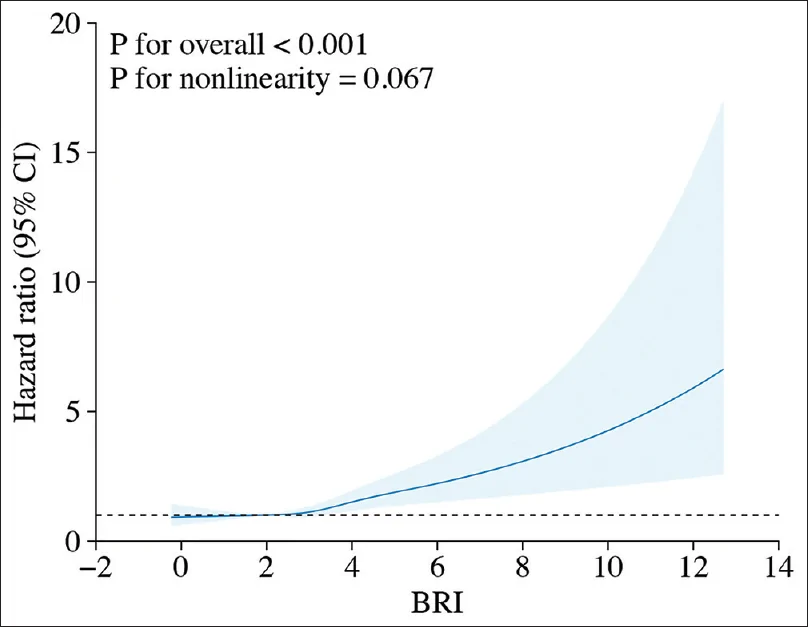
BACKGROUND: Visceral adiposity drives chronic kidney disease (CKD) progression, but conventional anthropometric indices inadequately capture its risk. We aimed to evaluate the Body Roundness Index (BRI), a geometric measure of central adiposity, as a predictor of incident CKD in Asian populations, where evidence remains scarce. MATERIALS AND METHODS: In this prospective analysis of 480,422 China Kadoorie Biobank participants without baseline CKD, BRI was calculated from waist circumference (WC) and body height using a validated formula. Incident CKD was ascertained through International Classification of Diseases, 10th Revision-coded hospitalization/death records over 10.2 years median follow-up. Cox models estimated hazard ratios (HRs) adjusting for sociodemographic, behavioral, and clinical confounders. Restricted cubic splines evaluated nonlinearity, and prespecified subgroup analyses assessed effect modification. RESULTS: During follow-up, 2,737 incident CKD cases occurred. Each 1-unit increase in BRI conferred 19% higher CKD risk in fully adjusted models (HR: 1.19, 95% confidence interval: 1.13-1.25). A nonlinear (J-shaped) association emerged with significantly elevated risk above BRI ≈ 3.5 (P for nonlinearity = 0.067). Subgroup analyses revealed stronger associations in participants aged <60 years, higher socioeconomic status (≥¥20,000/year), current drinkers, hypertensives, and non-overweight individuals (body mass index [BMI] <24 kg/m²) (P for interaction < 0.05). CONCLUSION: BRI independently predicts CKD in Chinese adults, outperforming conventional indices and identifying high-risk phenotypes missed by BMI. The nonlinear association with threshold at BRI ≈ 3.5 offers a practical tool for population screening, particularly valuable for early intervention in resource-limited settings.
From the paper
- Participants
The CKB is an ongoing population-based prospective cohort study that recruited 512,724 Chinese adults aged 30–79 years between 2004 and 2008.
- Result
Each 1-unit increase in BRI conferred 19% higher CKD risk in fully adjusted models (HR: 1.19, 95% confidence interval: 1.13–1.25).
Quoted word for word from the full text on ovid.com.
The paper
Baiyun District People’s Hospital of Guangzhou; The First Affiliated Hospital, Sun Yat-sen University
Journal of Research in Medical Sciences, 23 Sep 2026, Open access