Pulmonary nodules: classification, biomarkers, signaling pathways, diseases, early diagnosis and management
Abstract
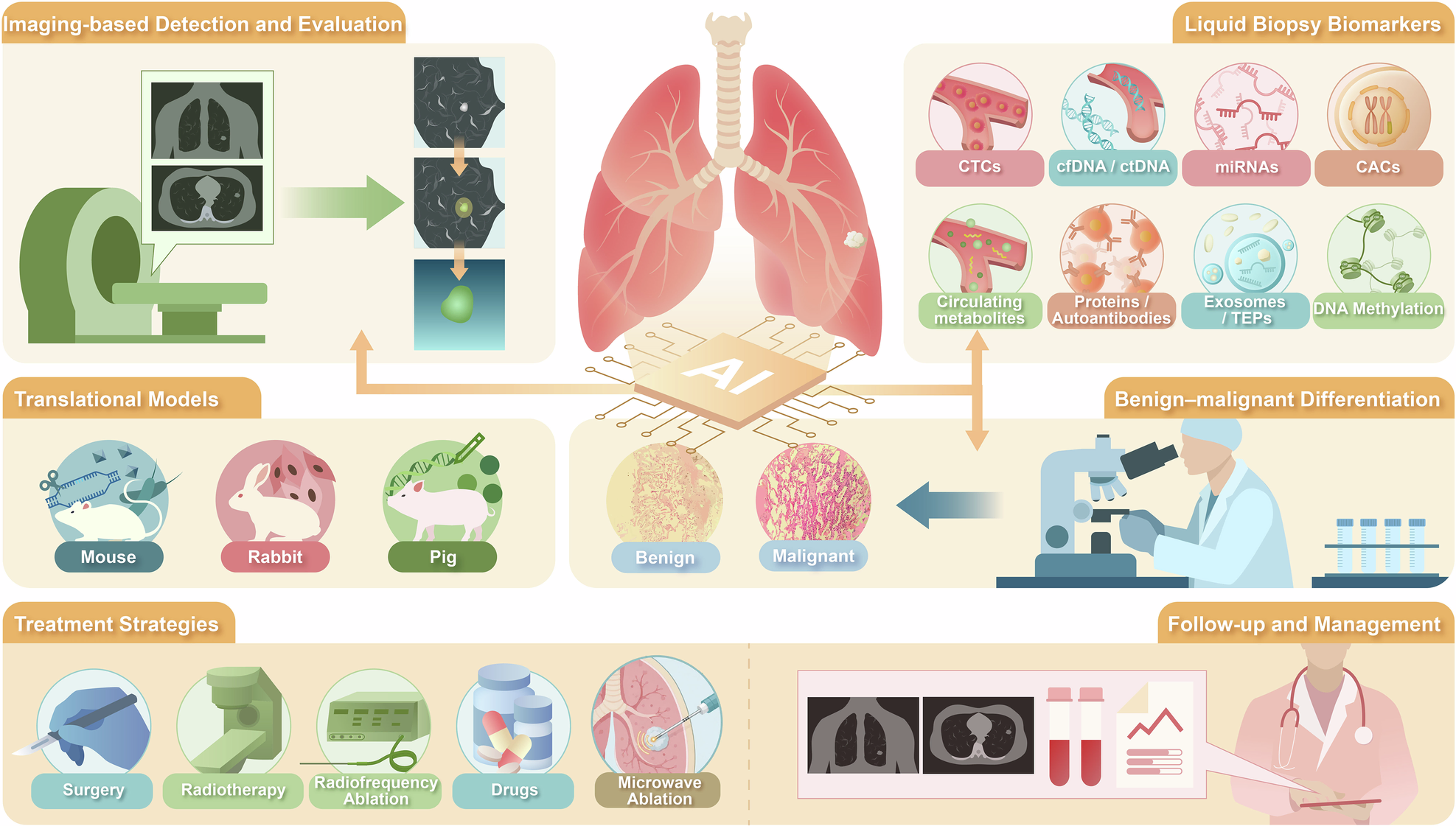
Pulmonary nodules are increasingly detected by thoracic imaging and low-dose computed tomography-based lung cancer screening, but most are benign, transient, or indolent. Clinically, the key task is to distinguish nodules that require timely cancer-directed evaluation from those that can be safely observed. This review summarizes the classification, disease spectrum, risk assessment, early diagnosis, biomarkers, signaling mechanisms, translational models, and management of pulmonary nodules. We first distinguish imaging phenotypes and disease entities, then differentiate the individual-level models used to select candidates for lung cancer screening from the nodule-level models and structured reporting systems used after nodule detection. Low-dose computed tomography remains the foundation of screening and surveillance approaches, whereas magnetic resonance imaging (MRI), positron emission tomography combined with computed tomography, contrast-enhanced computed tomography, nonsurgical biopsy, surgical diagnosis, and local therapies play more selective roles depending on the probability of malignancy and patient fitness. Noninvasive biomarkers, including circulating cellular, nucleic acid, methylation, protein, autoantibody, extracellular vesicle, and metabolic analytes, are most likely to serve as adjuncts to imaging and clinical risk assessment rather than as stand-alone diagnostic tests. Artificial intelligence may support detection, workflow efficiency, malignancy risk reclassification, invasiveness assessment, and multimodal integration, but its value depends on external validation, calibration, implementation, and prospective evidence of management benefit. Mechanistic studies of adenocarcinoma spectrum subsolid nodules have implicated the involvement of early oncogenic signaling, genomic instability, immune escape, stromal and vascular remodeling, and adaptive survival pathways. Translational models can support mechanistic and procedural research, but do not replicate real-world nodule management in patients. Overall, care for pulmonary nodules should be risk-adapted, longitudinal, multidisciplinary, and patient-centered.
- Contrast-enhanced computed tomography
- Local therapies
- Low-dose computed tomography
- Magnetic resonance imaging
- Pulmonary nodule
- Lung cancer
The paper
Chongqing University Three Gorges Hospital
Signal Transduction and Targeted Therapy, 13 Oct 2026