Donor light-sensing cells may connect in a non-human primate
A substantial share of donor cells survived 20 weeks after scaffold delivery to a non-human primate retina, with signs of possible connections to host cells.
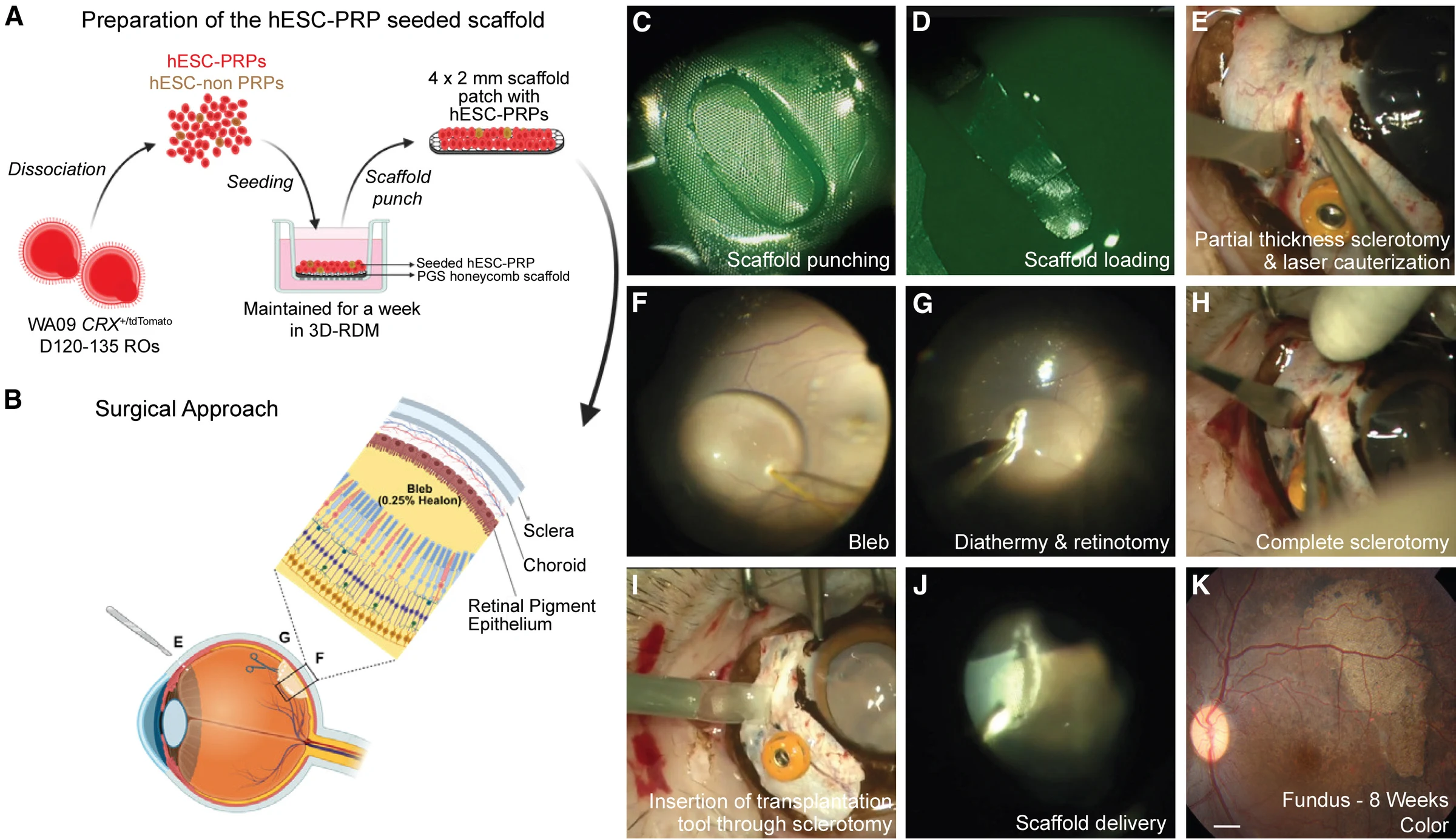
In an experiment in a non-human primate, researchers placed a tissue scaffold beneath the retina, the light-sensitive layer at the back of the eye. The scaffold carried precursors of light-sensing cells made from human embryonic stem cells.
A substantial share of donor cells survived for 20 weeks. The researchers saw thin cell extensions by week 7 and some cells lengthening by week 17. Staining at 20 weeks detected proteins involved in turning light into signals and in connections between nerve cells. Some donor cells appeared to form synapses, junctions through which nerve cells communicate, with the primate’s bipolar cells, which relay visual signals.
Why it matters
Retinal degeneration involves progressive loss of light-sensing cells and can lead to blindness. The researchers suggested that scaffold-based replacement holds promise for restoring sharp central vision.
Caveats
The possible connections were not confirmed synapses, and the abstract did not report a test of vision. The experiment involved one non-human primate, not people.
- Tissue scaffold
- Photoreceptor replacement therapy
- Synaptic transmission
- Retinal degeneration
- Donor photoreceptor survival
- non-human primate
The paper
University of California; University of Rochester
Stem Cell Reports, 13 Oct 2026