Reduced total arterial compliance in frail older adults is associated with orthostatic blood pressure variability but not baroreflex sensitivity
Abstract
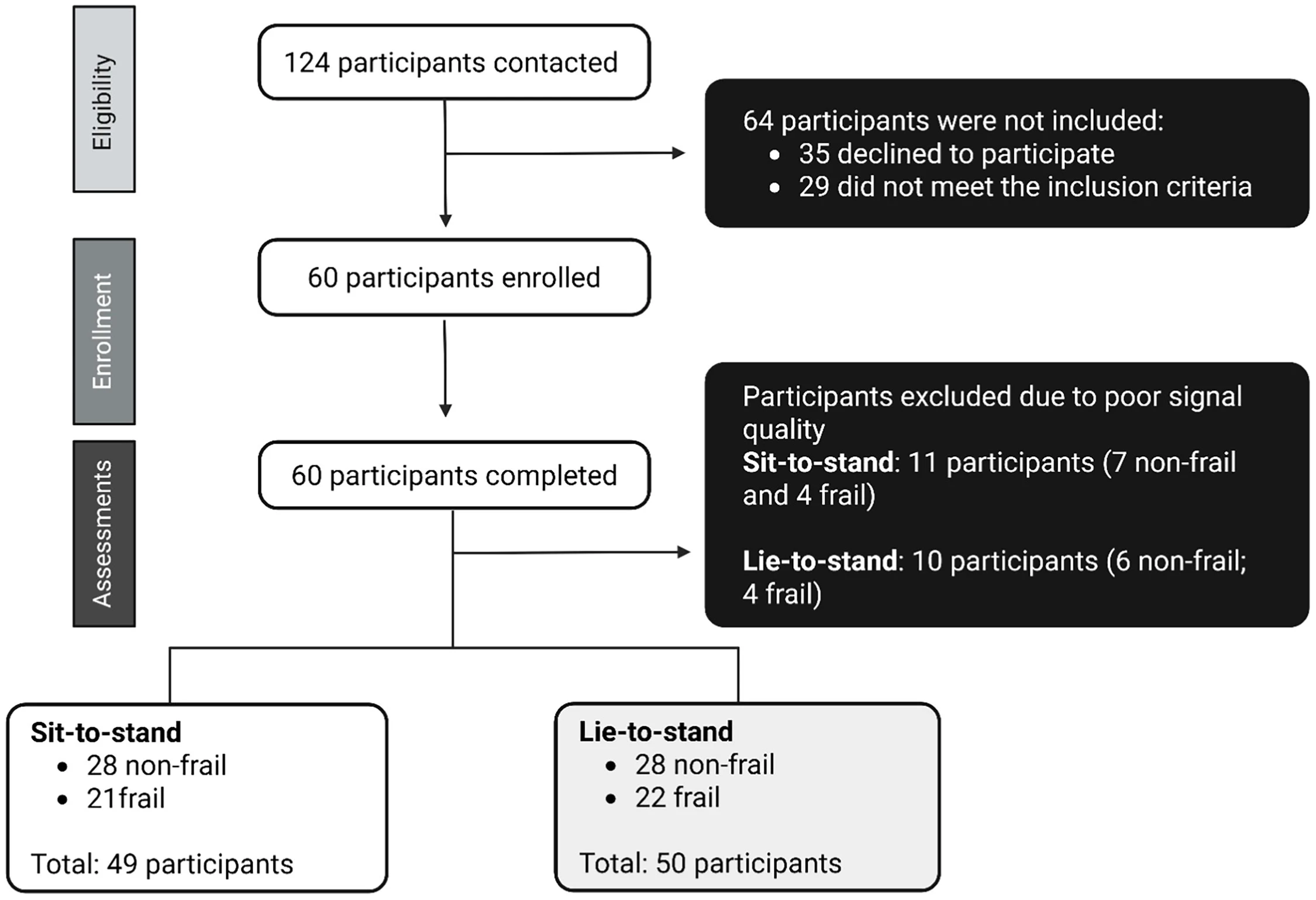
BACKGROUND: Total arterial compliance (TAC) reflects arterial elasticity and may be associated with baroreflex sensitivity (BRS) and beat-by-beat blood pressure variability (BPV) during postural transitions. Frailty is also associated with impaired autonomic cardiovascular regulation, which may further compromise blood pressure control during orthostatic stress. However, these relationships have not been investigated in frail older adults. We hypothesized that frail participants would exhibit lower TAC than non-frail participants and that reduced TAC would be associated with impaired autonomic regulation. METHODS: Community-dwelling older adults aged 60-79 years were classified as non-frail (n=28) or frail (n=22) using the Frailty Index. Participants completed sitting-to-standing and lying-to-standing transitions with continuous cardiovascular monitoring. TAC was estimated as the stroke volume-to-pulse pressure ratio, BRS using the sequence method, and BPV using frequency-domain analysis. General linear models compared TAC between groups. Correlation and regression analyses examined associations between TAC, BRS, and BPV, adjusting for frailty status and medication use. RESULTS: Frail participants exhibited lower TAC than non-frail participants during both conditions (all p < 0.05). TAC was not associated with BRS during either orthostatic transition (both p > 0.05). In contrast, lower TAC was associated with greater systolic BPV during sitting-to-standing (SBPV-VLF: β = -0.46, p = 0.006) and lying-to-standing (SBPV-VLF: β = -0.60, p < 0.001; SBPV-LF: β = -0.56, p < 0.001; SBPV-HF: β = -0.32, p = 0.04). CONCLUSIONS: These findings suggest that impaired arterial compliance contributes to orthostatic autonomic dysfunction in frail older adults primarily through reduced vascular buffering rather than impaired cardiovagal baroreflex function.
- Lying-to-standing transition
- Sitting-to-standing transition
- Total arterial compliance
- Blood pressure variability
- Baroreflex sensitivity
- Humans
The paper
The Journal of Frailty & Aging, 13 Oct 2026, Open access