Sex-specific predictive equations for estimating trochanteric soft tissue thickness across body positions and imaging modalities
Abstract
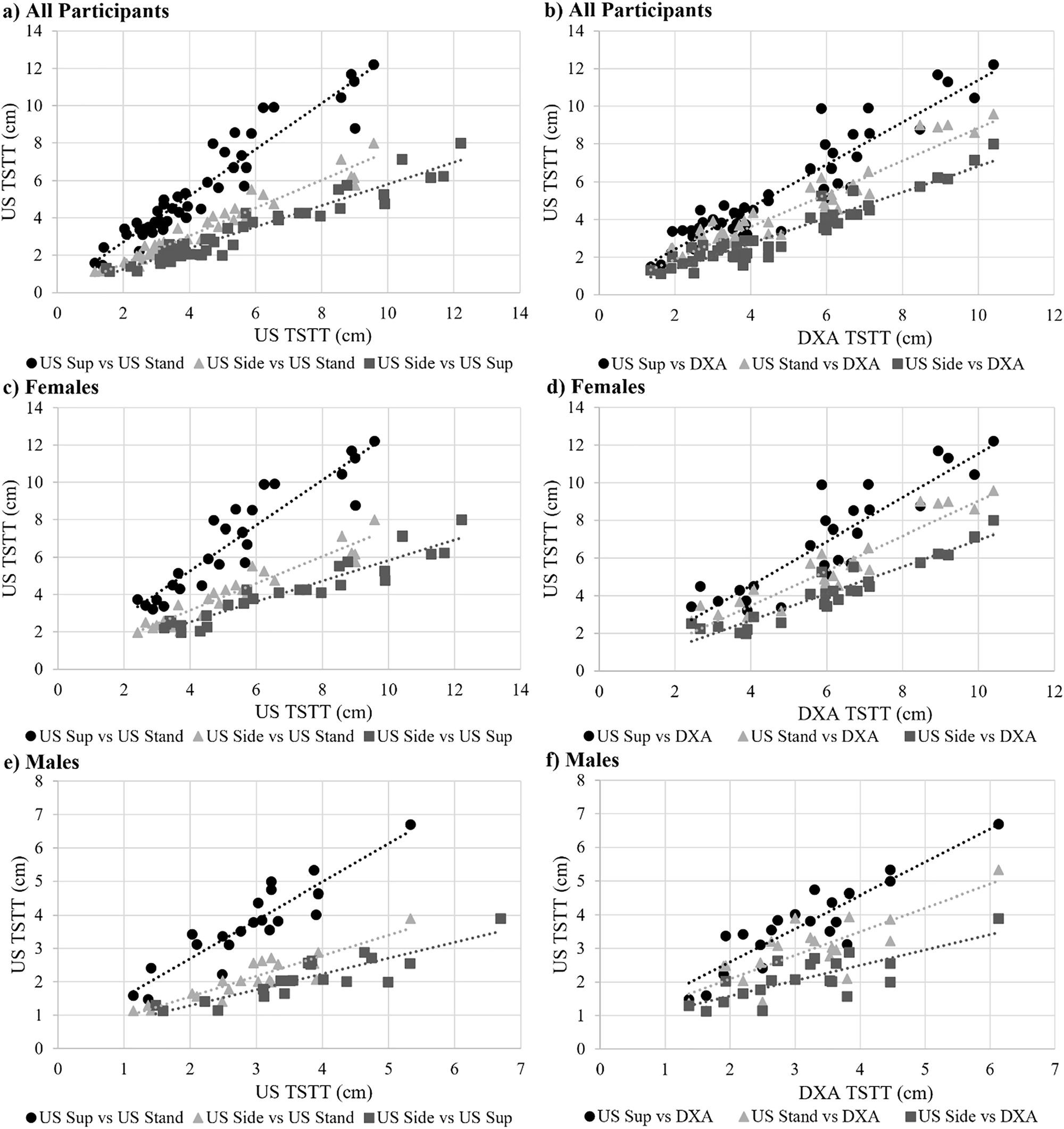
UNLABELLED: Soft tissue thickness is an important factor in fall-related hip fractures. However, methods used to measure soft tissue thickness are inconsistent. We developed sex-specific equations for estimating soft tissue thickness between body positions and imaging modalities. The equations support across-study comparisons and refinement of sex-specific hip fracture risk prediction tools. INTRODUCTION: Trochanteric soft tissue thickness (TSTT), which is the amount of soft tissues overlying the greater trochanter, may improve hip fracture risk assessments by improving estimates of the impact force applied to the hip during a fall. Accordingly, TSTT is an important variable to consider in hip fracture risk assessment. However, measurement of TSTT is inconsistent, with different body positions (supine, side-lying, standing) and imaging modalities (ultrasound, dual-energy X-ray absorptiometry (DXA)) being used. PURPOSE: The objectives of this study were to develop sex-specific regression equations to allow for estimation of 1) ultrasound-measured TSTT across three common body positions, and 2) ultrasound-based TSTT from DXA-derived TSTT. METHODS: Measurements of TSTT were obtained in standing, supine, and side-lying positions using ultrasound, and from a whole-body DXA scan in 45 community-dwelling older adults. Sex-specific linear regression equations were developed for estimating ultrasound-measured TSTT across body positions, and for estimating ultrasound-measured TSTT from DXA-derived TSTT. RESULTS: Linear regression models revealed significant positive relationships between ultrasound-measured TSTT across all body positions and by DXA and ultrasound-measured TSTT in all body positions (r² = 0.589-0.927, all p < 0.01). Association strengths were reduced in males compared to females (male: r² = 0.589-0.83; female: r² = 0.8-0.902). CONCLUSIONS: The regression equations from this study can be used to estimate TSTT between body positions and imaging modalities. The data provide valuable tools to support across-study comparisons and further refinement of sex-specific hip fracture risk prediction tools.
- Modelling and theory
- Trochanteric soft tissue thickness
- Trochanteric soft tissue thickness measured across body positions and imaging modalities
- Humans
The paper
University of Waterloo
Osteoporosis International, 13 Oct 2026