Effects of transcranial direct current stimulation on gait and balance under dual-task conditions in older adults: a systematic review and meta-analysis
Preregistered CRD420251206965
Abstract
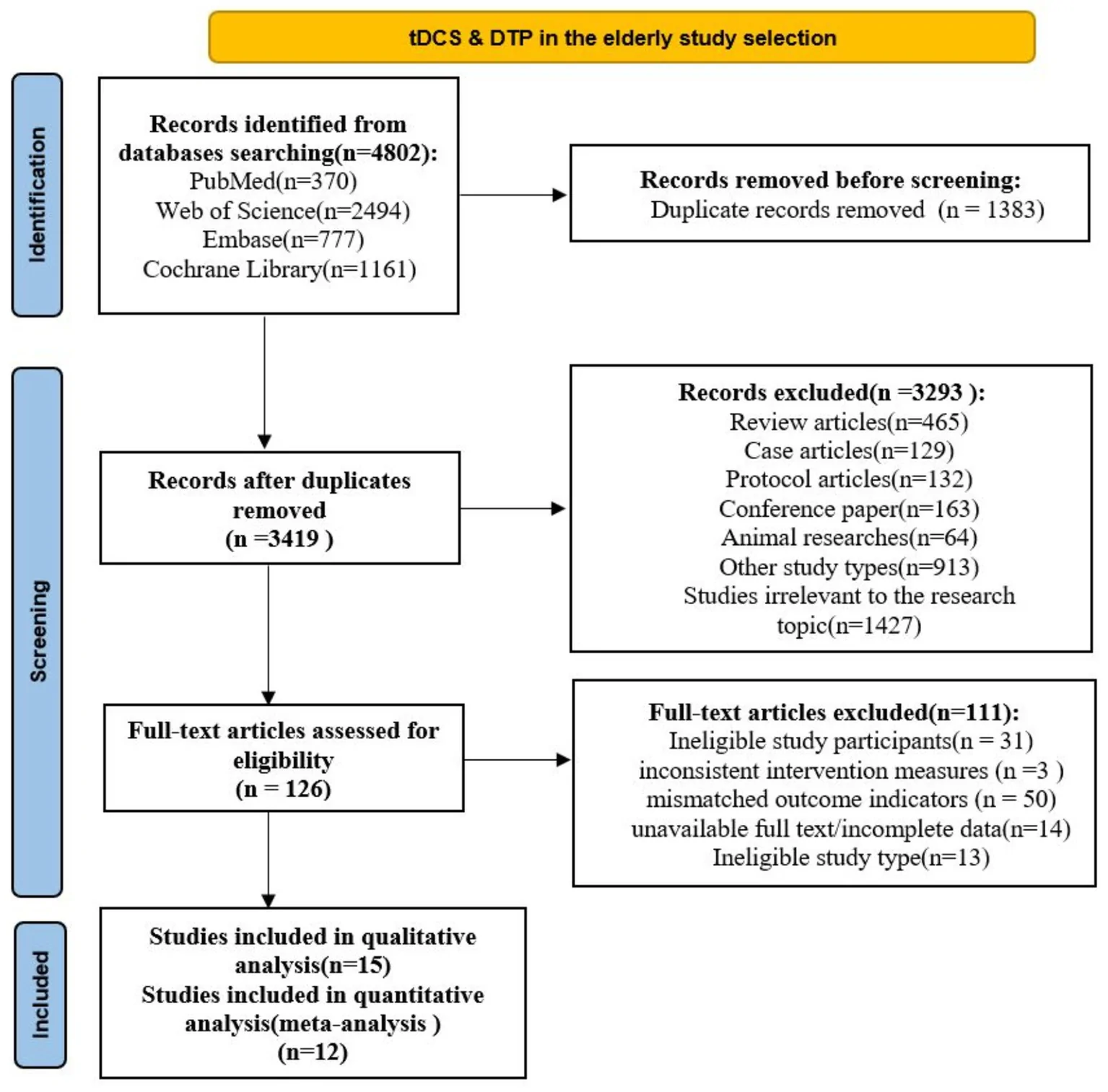
OBJECTIVE: This systematic review and meta-analysis evaluated the effects of transcranial direct current stimulation (tDCS) on gait and balance outcomes measured under dual-task (DT) conditions in older adults. METHODS: Following PRISMA guidance, four databases were searched through October 13, 2025. Random-effects meta-analyses used Hedges' g. Healthy older adults were prespecified as the primary population; clinical populations were analysed separately and mixed-population estimates were treated as exploratory. Multi-arm estimates were consolidated at the study level. Crossover trials used an assumed within-participant correlation (corr) of 0.50, with sensitivity analyses at 0.25 and 0.75. Risk of bias was assessed with RoB 2 and certainty with GRADE. RESULTS: Fifteen studies involving 385 participants were included, and 12 contributed to quantitative synthesis. The forest plots present exploratory mixed-population estimates: dual-task gait speed was not significantly improved (Hedges' g = 0.071, 95% CI -0.199 to 0.340; p = 0.607), whereas the dual-task cost (DTC) of gait speed was reduced (Hedges' g = -0.362, 95% CI -0.538 to -0.185; p < 0.001). Exploratory reductions were also observed for DTC of sway speed, sway area, and DTC of sway area. In the prespecified healthy-older-adult primary analysis, gait speed (Hedges' g = 0.200, 95% CI 0.017 to 0.383; p = 0.032) and its DTC (Hedges' g = -0.368, 95% CI -0.557 to -0.179; p < 0.001) favoured tDCS. The gait-speed result was sensitive to the assumed crossover correlation, whereas gait-speed DTC remained significant across correlation assumptions. CONCLUSION: In healthy older adults, tDCS may improve gait speed and reduce its dual-task cost, but the gait-speed inference depends on the assumed crossover correlation and both estimates are based on only two studies. Evidence for other gait, variability, mobility, and standing-balance outcomes was inconclusive or could not be pooled within the healthy population. Evidence regarding falls, long-term benefit, and safety remains insufficient. SYSTEMATIC REVIEW REGISTRATION: https://www.crd.york.ac.uk/PROSPERO/view/CRD420251206965, PROSPERO Unique Identifier: CRD420251206965.
From the paper
- Participants
A total of 15 studies involving 385 older adults (260 females and 125 males) were included in this review.
- Result
For the DTC of gait speed, Figure 3B shows a significant reduction favouring tDCS in the exploratory all-study analysis (Hedges’ g = −0.362, 95% CI -0.538 to −0.185; p < 0.001; I = 0.0%).
- Harms
Five of the 15 studies did not report whether adverse events occurred.
- Limitation
Crossover trials required an assumed within-participant correlation, and multiple effects within a study required an assumed correlation during study-level consolidation; alternative assumptions could change precision.
Quoted word for word from the full text on frontiersin.org.
- Transcranial direct current stimulation
- Dual-task cost of gait speed
- Dual-task cost of sway area
- Dual-task cost of sway speed
- Dual-task gait speed
- Humans
The paper
Beijing Sport University
Frontiers in Aging Neuroscience, 28 Sep 2026