Effect of Dermal Fibroblast-Conditioned Media on Human Dermal Fibroblasts Treated With Electromagnetic Transduction Therapy
Abstract
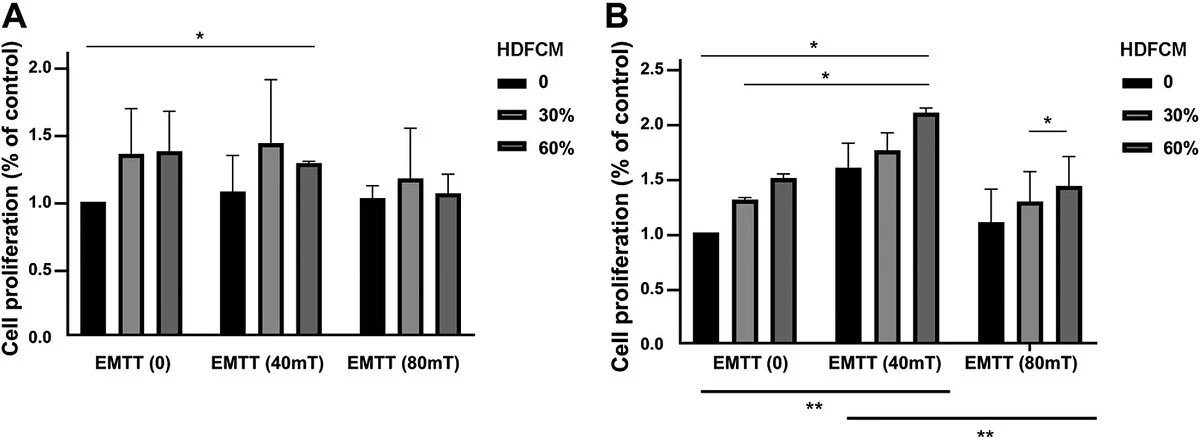
BACKGROUND: Electromagnetic transduction therapy (EMTT) is a high-intensity pulsed electromagnetic field therapy used in musculoskeletal medicine. However, its therapeutic effects on human dermal fibroblasts (HDFs) remain unclear. Secretomes from human dermal fibroblast-conditioned medium (HDFCM) can enhance wound repair and tissue regeneration. METHODS: Young and aged HDFs were treated with EMTT (40 or 80 mT) following HDFCM pretreatment (0, 30, or 60%). Proliferation and migration were assessed using cell proliferation and wound healing assays. Senescence-associated β-galactosidase (SA-β-Gal) staining and enzyme-linked immunosorbent assay (ELISA) were performed to evaluate the effects of EMTT and HDFCM on senescence and pro- and anti-inflammatory cytokine secretion. RESULTS: HDFCM significantly enhanced the proliferation of young and aged HDFs, particularly aged cells, in a dose-dependent manner. EMTT at 40 mT further enhanced these effects, with 40 mT EMTT plus 30% HDFCM yielding the greatest increase in the number of aged HDF. SA-β-Gal activity, minimal in young cells, was elevated in aged HDFs, but was reduced by 40 mT EMTT with or without HDFCM. Contrastingly, 80 mT EMTT increased SA-β-Gal activity unless counteracted by 60% HDFCM. Moreover, interleukin-6 was upregulated and transforming growth factor-β was downregulated by HDFCM and EMTT treatments. CONCLUSION: EMTT at low magnetic field strength, particularly if combined with HDFCM, promotes proliferation and migration while reducing senescence in aged HDFs. This approach may offer a promising therapeutic strategy for skin regeneration and antiaging applications, especially for aging or damaged dermal tissues.
- Electromagnetic transduction therapy
- Human dermal fibroblast-conditioned medium
- Cellular senescence
- Inflammation
- IL-6
- Humans
The paper
Ko Jung A Clinic; Yonsei Seran Dermatology and Laser Clinic
Skin Research and Technology, 1 Oct 2026