Long-term human skin platform models chronic inflammation and senolytic treatments
The culture platform maintained native tissue architecture for four weeks, revealing treatment effects on aged donor tissue that emerged only after prolonged exposure.
Advanced Science
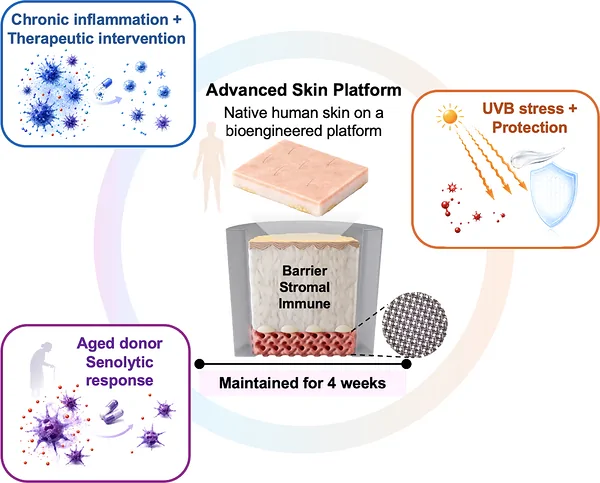
In human skin tissue samples from 20 donors, researchers established an ex vivo platform that preserved native architecture and transcriptional programs for up to four weeks. Time-course RNA sequencing across 199 samples revealed an initial culture adaptation phase followed by stable tissue-associated gene expression. Sustained stimulation with IL-17 and IL-22 for three weeks drove chronic inflammatory programs, structural deterioration, and secretion of IL-8, MCP-1, S100A8/A9, and MMP-1. Tofacitinib, a Janus kinase inhibitor, broadly suppressed these changes. In aged donor tissue, prolonged senolytic-associated treatment reduced inflammatory signaling, remodeling pathways, and secreted factors such as IL-6 and MMP-1, with significant effects appearing at week three but not week one. Ultraviolet B exposure also triggered inflammatory responses that topical sunscreen prevented.
Why it matters
Chronic inflammation and cellular senescence drive progressive tissue dysfunction during aging. This platform provides an intact human tissue system to evaluate how sustained interventions alter age-related remodeling over several weeks.
Caveats
The findings rely on an ex vivo culture system using 20 human donors, which lacks a functional systemic circulation and immune cell recruitment. Whether these prolonged responses directly mirror clinical outcomes in living individuals remains to be determined.
The paper
Show 11 more authors
Jocelyn Chiari, Paige Thompson, Erin Galt, Sunghoon Lee, Jason Scott Holsapple, Sai Hein, Bailey L Coates, Jade Michaud, Sabrina Zuccaro, Lia Kent, Chris Hinojosa,Inc. Malden Massachusetts USA
Advanced Science · 29 Sep 2026