Age-related tumor mutational burden and inflammaging: a pan-cancer multi-omics study of treatment-naïve patients
Abstract
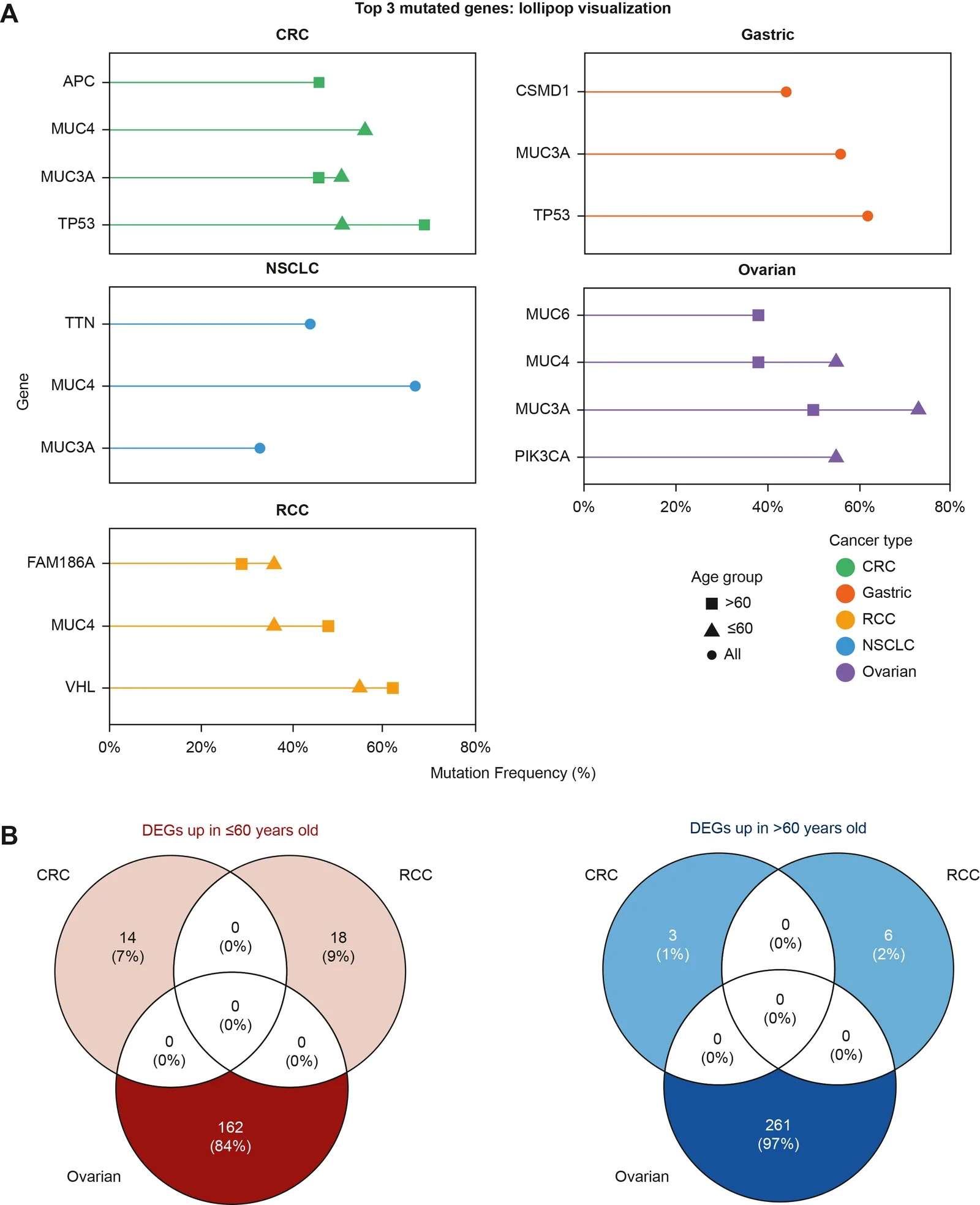
BACKGROUND: Aging is a major nonmodifiable risk factor for cancer, yet age-associated genomic instability, inflammatory activation, and tumor microenvironment interactions remain poorly characterized. PATIENTS AND METHODS: The primary genomic cohort comprised 153 treatment-naïve patients with six cancer types, stratified at age 60 years; four additional patients without genomic profiling contributed to nongenomic analyses. Tumor mutational burden (TMB) and fraction genome altered were derived from whole-genome sequencing, and inflammatory pathway activity was determined from single-sample gene set enrichment analysis of RNA sequencing and proteomics in paired tumor and normal tissue. Because cancer type distribution differed between age groups, all principal associations were re-examined in multivariable models. RESULTS: TMB was higher in older patients (median 4.55 compared with 2.84 mutations per megabase; P < 0.001) and correlated with age (r s = 0.334, P < 0.001) but was attenuated by adjustment for cancer type and lost significance once microsatellite instability (MSI) status, sex, and stage were added (P = 0.27). Normal-tissue inflammation correlated with paired tumor TMB (protein r s =0.387, P < 0.001) but not after adjustment for age and cancer type (partial r s = 0.07, P = 0.54). MSI-high tumors showed greater tumor-normal inflammation amplification than non-MSI-high tumors (+0.065, P = 0.015), strengthening after adjustment (+0.087, P < 0.001). An immune-hot cluster arose only in older patients but was not independently associated with age (odds ratio 1.03, P = 0.61). CONCLUSIONS: Most age-associated molecular differences were substantially explained by cancer type. Only the age-related increase in normal-tissue inflammation at the protein level and the greater inflammation amplification of MSI-H tumors persisted. The correlation between normal-tissue inflammation and tumor TMB is not evidence that systemic inflammaging drives genomic instability.
The paper
National Cancer Center Hospital East
Immuno-oncology Technology, 30 Sep 2026