The effectiveness of exercise on physical and cognitive function in older adults with pre-frailty or frailty: A systematic review and meta-analysis
Abstract
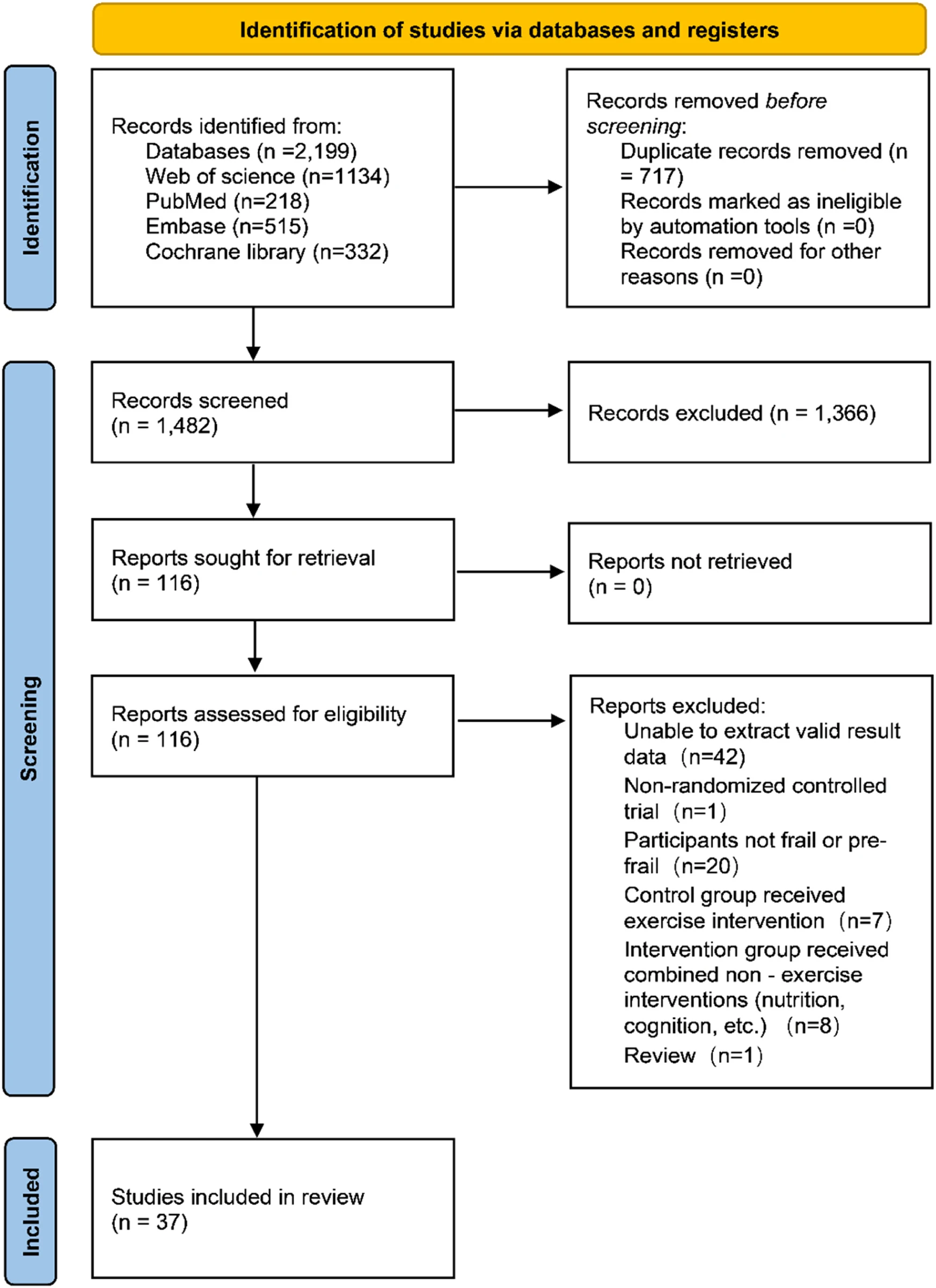
BACKGROUND: Frailty is a geriatric syndrome characterized by concurrent physical and cognitive decline. We evaluated exercise effectiveness on these domains in pre-frail and frail older adults. METHODS: We searched four databases to 8 June 2026 for randomized controlled trials (RCTs). Meta-analyses utilized the DerSimonian-Laird random-effects model. Evidence certainty was assessed using GRADE. RESULTS: Included were 37 RCTs (3409 participants). Exercise significantly reduced frailty scores (SMD = -0.95, 95% CI: -1.38 to -0.51, P < 0.001). Physical function improved, including Grip Strength (MD = 1.78 kg, 95% CI: 0.34-3.21, P = 0.020), gait speed (SMD = 1.10, 95% CI: 0.71-1.48, P < 0.001), and SPPB (MD = 1.14 points, 95% CI: 0.53-1.74, P < 0.001). Global cognition (SMD = 0.67, 95% CI: 0.50-0.85, P < 0.001), cognitive flexibility, and working memory improved significantly; executive function and processing speed showed marginal significance. Frail individuals showed larger effect sizes for frailty scores and SPPB than pre-frail individuals. Improvements in Grip Strength, SPPB, and sit-to-stand performance approached or exceeded MCID thresholds, but wide confidence intervals make clinical gains likely rather than confirmed. GRADE certainty ranged from high to very low. CONCLUSION: Exercise may improve frailty status, physical, and cognitive function, particularly for individuals with established frailty. However, substantial heterogeneity limits findings' precision. Multicomponent training appears promising and clinically practical, but current evidence does not establish its superiority over single-modality exercise.
The paper
Archives of Gerontology and Geriatrics, 1 Oct 2026