Multidisciplinary care reduces frailty in older cardiac patients
In a randomized trial, the year-long RENAP regimen yielded an adjusted mean difference of -0.79 in frailty and 2.02 in physical performance against usual care.
Nature Communications
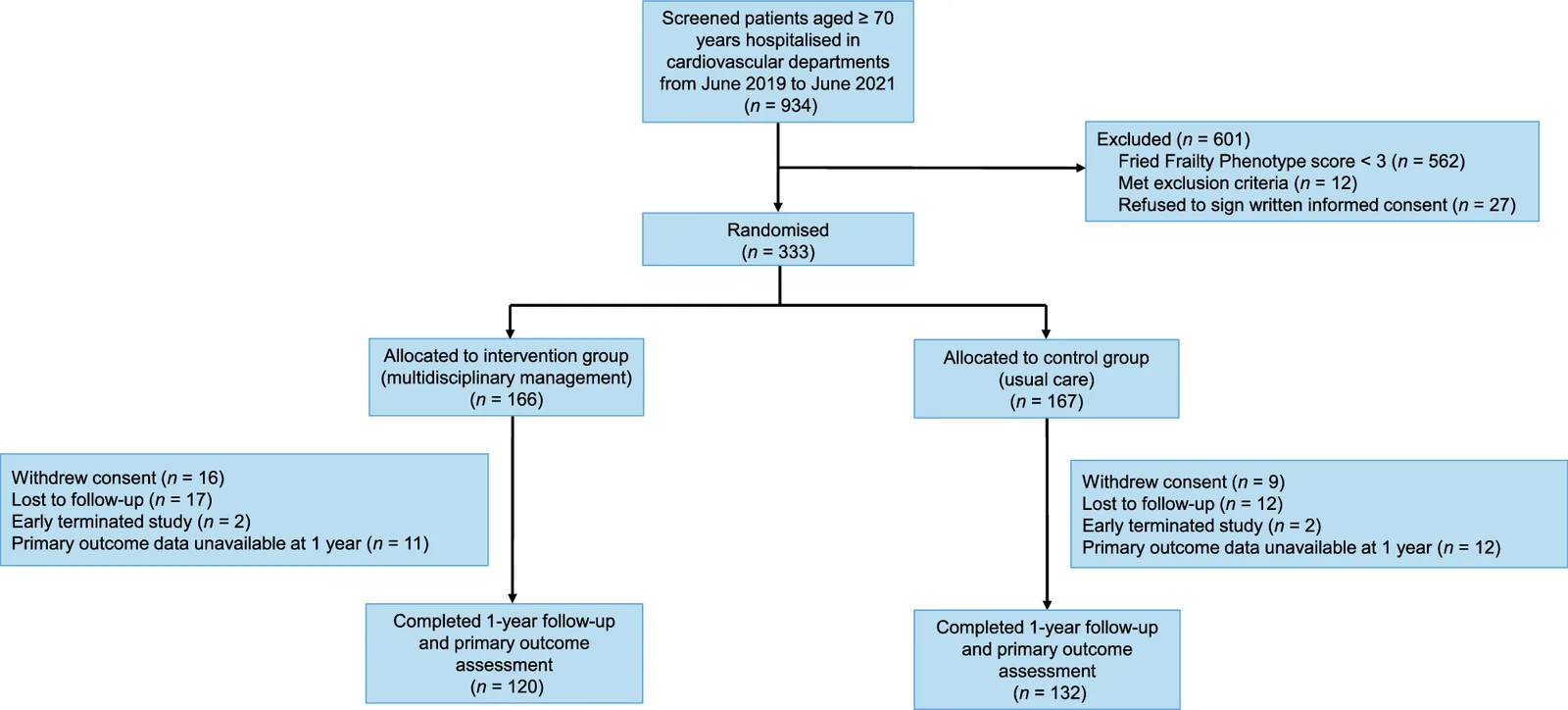
In a multicentre trial of 333 frail inpatients aged 70 and older with cardiovascular diseases in Beijing, researchers tested the RENAP programme against usual care. The year-long intervention combined personalized rehabilitation exercises, patient education, nutritional guidance, acupoint massage, and polypharmacy management.
At 12 months, intention-to-treat analysis showed the intervention improved the Fried Frailty Phenotype score by an adjusted mean difference of -0.79 points and the Short Physical Performance Battery score by 2.02 points compared to usual care. Patients receiving the intervention also had a lower risk of all-cause hospital readmission over one year (hazard ratio 0.53). No treatment-related serious adverse events were reported.
Why it matters
Frailty represents a major manifestation of biological aging that exacerbates vulnerability and functional decline in older adults. Demonstrating that a coordinated, multi-target lifestyle and clinical protocol can improve physical performance indicates that frailty phenotypes remain modifiable even alongside serious cardiovascular disease.
Caveats
The study was conducted across three hospitals in a single city, and neither participants nor clinical teams could be blinded to the intervention. In addition, 81 of the 333 enrolled patients did not complete the 12-month primary outcome assessment.
- Multidisciplinary lifestyle programme
- Cardiovascular disease
- Fried frailty phenotype
- Short Physical Performance Battery
- Humans
The paper
Show 17 more authors
Yujia Liu, Zhao Ma, Linlin Qiao, Lijuan Wang, Di Guo, Ning Sun, Lingling Cui, Simin Yao, Peipei Zheng, Xuelu Zhu, Wei Dong, Ping Zeng, Yao Lu, Ping Zhang, Guobin Miao, Yi Li, Jiefu Yang,Chinese Academy of Medical Sciences & Peking Union Medical College
Nature Communications · 31 Aug 2026