Esophageal squamous cell carcinoma prevention in high-risk, resource-limited rural China: Dysplasia screening and modifiable risk factors in a 14-year follow-up study
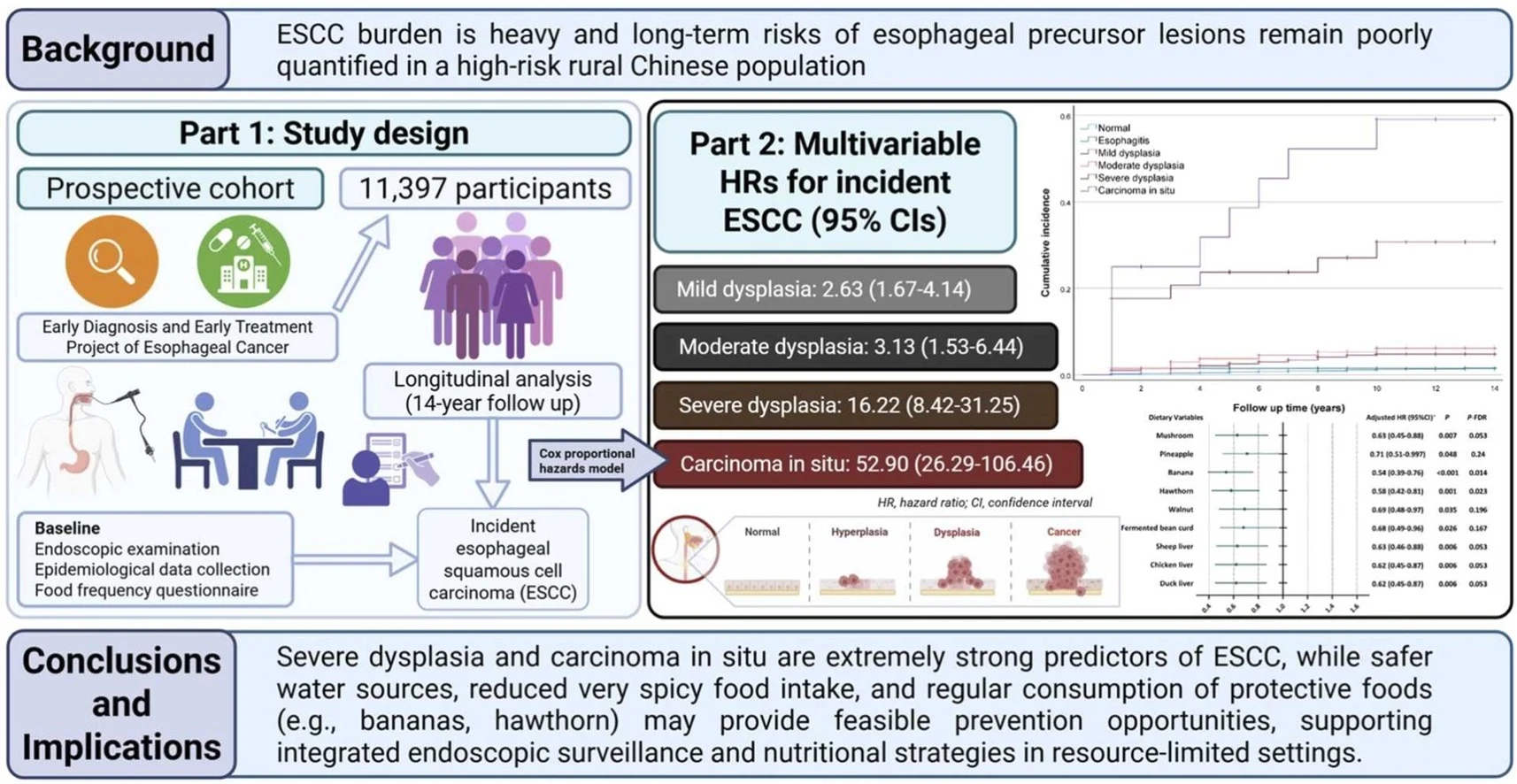
14 years
Abstract
BACKGROUND: Esophageal squamous cell carcinoma (ESCC) remains a major cause of cancer mortality in resource-limited regions, where barriers to screening, unsafe environmental exposures, and constrained health infrastructure hinder timely diagnosis and survivorship. METHODS: We conducted a 14-year follow-up study involving 11,397 adults from a rural high-risk area of Huai'an, China, integrating baseline endoscopic biopsy, epidemiological assessment, and dietary evaluations. The Cox regression model was used to assess the hazard ratio (HR) and 95% confidence intervals (CI). FDR was used to account for multiple testing. RESULTS: During follow-up, 189 incident ESCC cases were identified. Histological severity of dysplasia strongly predicted progression, particularly severe dysplasia (HR=16.22; 95% CI: 8.42-31.25) and carcinoma in situ (HR=52.90; 95% CI: 26.29-106.46). Male sex, increasing age, lower BMI (especially female smokers), a family history of ESCC, consumption of shallow well or surface water, and very spicy diets were significantly associated with increased ESCC risk. Frequent intake of banana (HR=0.54; 95% CI: 0.39-0.76; P-FDR=0.014) and hawthorn (HR=0.58; 95% CI: 0.42-0.81; P-FDR=0.023) was significantly associated with reduced ESCC risk. CONCLUSIONS: Histological severity of dysplasia is a strong predictor of ESCC development. In addition, compared with historical cohorts lacking organized early diagnosis and treatment, progression rates observed in this population suggest that the region's screening program may have contributed to improved outcomes. While early detection and treatment remain essential, modifying environmental and dietary exposures may provide additional avenues for prevention. The results support integrated prevention strategies that combine endoscopic screening with feasible lifestyle interventions to reduce ESCC burden in high-risk communities.
The paper
Southeast University
Cancer Epidemiology, 10 Oct 2026