Low education linked to tripled premature mortality in India
Among non-smoking non-drinkers, adults with no schooling had a mortality rate ratio of 2.76 in men and 2.93 in women compared to higher education.
Nature Health
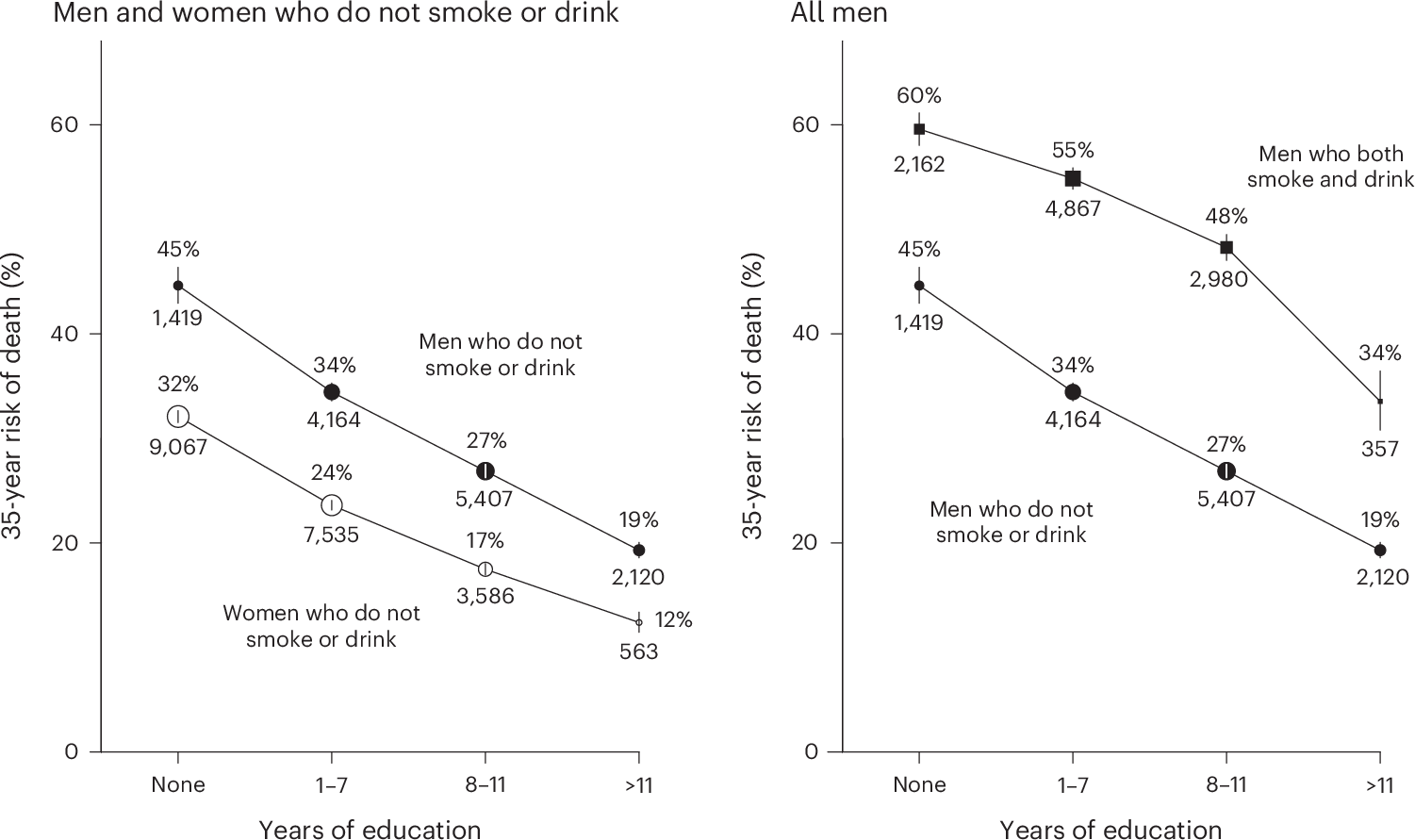
In a prospective study of 500,810 adults aged 35 and older in Chennai, India, researchers evaluated how social inequality, smoking, and alcohol use relate to premature mortality before age 70. Participants were enrolled between 1998 and 2001 and monitored through 2020, with cause-specific mortality assessed by verbal autopsy. Among individuals initially free of chronic disease, having no schooling was associated with almost three times the mortality rate ratio of having over 11 years of education, even among non-smoking non-drinkers (rate ratio of 2.76 in men; 2.93 in women). Substantial mortality excesses appeared across all major disease categories. For men, lower education coincided with higher smoking and drinking rates. Adjusted for education, male smoking was linked to a rate ratio of 1.26 and drinking to 1.52; combined, they almost doubled mortality (rate ratio 1.89). Fewer than 0.1% of women smoked or drank.
Why it matters
These findings suggest that fundamental social inequalities can strongly alter premature mortality risk independently of common behavioral factors. Understanding these socioeconomic gaps may help contextualize population-level disparities in aging and chronic disease burdens.
Caveats
The observational design cannot establish causality, and cause of death was determined via verbal autopsy rather than hospital records. Furthermore, risk factors were measured at baseline, leaving potential later changes in habits unmeasured.
The paper
Combined impact of smoking, alcohol and social inequalities on premature mortality in urban India
Show 5 more authors
Vendhan C. Kanimozhi, Manigandan Chandrasekaran, Ramu Ashok Kumar, Paul Sherliker, Richard Peto,National Institute of Epidemiology · University of Oxford
Nature Health · 19 Jun 2026