Longitudinal associations of occupational cumulative noise exposure duration and hearing loss with lipid profiles: a 9-year cohort study
9 years
Abstract
BACKGROUND: Occupational noise exposure causes auditory damage and is also closely associated with systemic metabolic abnormalities. The impact of long-term noise exposure on longitudinal lipid changes remains unclear. OBJECTIVE: This longitudinal study examined the association of baseline cumulative noise exposure duration with serum triglycerides (TG) and total cholesterol (TC) in male workers, and further examined whether binaural high-frequency average hearing threshold (BHFTA), an objective marker of noise-induced cochlear damage, modified longitudinal lipid trends. METHODS: In this retrospective longitudinal cohort study, 431 male workers were followed for 9 years. Occupational noise exposure was defined according to the Chinese national standard GBZ/T 224-2010 as exposure to an 8-hour equivalent continuous A-weighted sound level of at least 80 dB(A) (Lex, 8h), and was operationalized as the cumulative duration of employment in noise-exposed positions ascertained from plant administrative records. Linear mixed-effects models were used to analyze the effects of follow-up time, baseline cumulative noise exposure duration (mean-centered, time-invariant), and their interaction on natural log-transformed TG and TC, adjusted for age, body mass index, lipid-lowering medication use, smoking, and alcohol consumption. Simple slopes were estimated at representative exposure durations (3, 10, and 20 years). Because individual biological noise dose could not be directly measured, BHFTA was used as an objective marker of accumulated biological dose and individual susceptibility in sensitivity analyses, with simple slopes estimated at BHFTA values of mean ± 1 standard deviation (SD). RESULTS: Baseline cumulative noise exposure duration was significantly and positively associated with serum TG levels, with each additional year of exposure corresponding to an approximately 2.0% higher TG level (β = 0.0203 per year on ln(TG), 95% CI: 0.0029-0.0377, P = 0.022), whereas its association with TC did not reach statistical significance (P = 0.077). The follow-up time and baseline exposure duration interaction was negative in direction, that is, the annual rate of lipid increase tended to be smaller among workers with longer baseline exposure; this reached borderline significance for TG (β = -0.0013, 95% CI: -0.0027-0.0001, P = 0.066) and statistical non-significance for TC (P = 0.479). The estimated annual TG increase displayed a monotonic descriptive gradient across baseline exposure duration of 3, 10, and 20 years (5.35%, 4.39%, and 3.03% per year, respectively). In sensitivity analyses, BHFTA interacted positively with follow-up time for both outcomes (TG: 0.0023, 95% CI: 0.0013-0.0034; TC: 0.0005, 95% CI: 0.0001-0.0009); the estimated annual increase rose from 2.07 to 4.61% for TG and from 0.73 to 1.28% for TC as BHFTA increased from mean - 1 SD to mean + 1 SD (14.3-24.9 dB). CONCLUSIONS: Baseline cumulative noise exposure duration was associated with elevated TG levels, and the attenuated rate of lipid increase over time may partly reflect a healthy worker survivor effect. In contrast, BHFTA may be more sensitive than administrative exposure records in revealing the metabolic consequences of chronic noise exposure. Hearing conservation and metabolic monitoring should be integrated into occupational health surveillance.
From the paper
- Participants
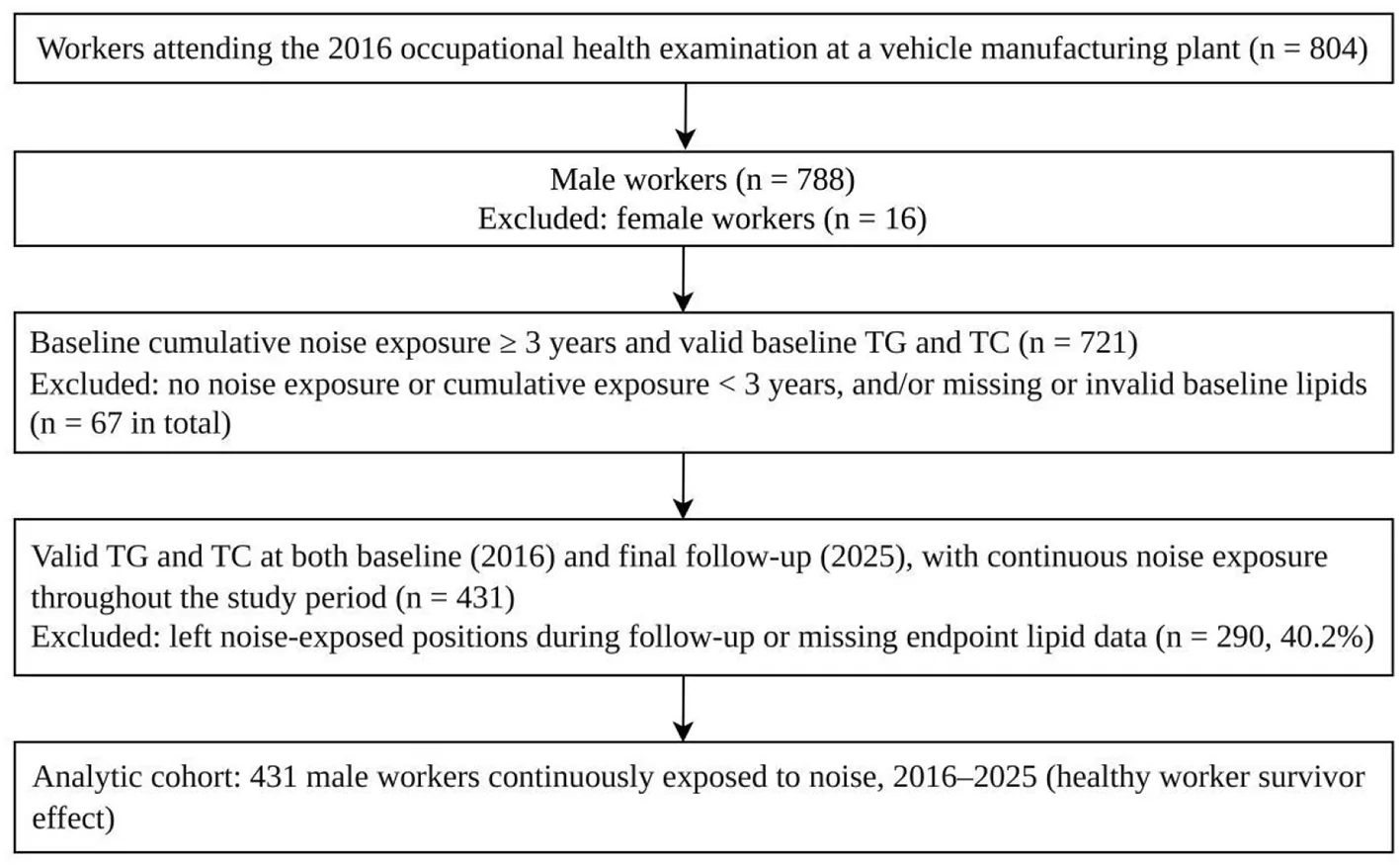
This longitudinal analysis included 431 male workers.
Results, Baseline characteristics of the study population and longitudinal trends of lipid profiles
- Primary outcome
For ln(TG), the interaction coefficient was −0.0013 (95% CI: −0.0027–0.0001; P = 0.066), indicating a borderline tendency for the annual TG increase to attenuate with longer baseline exposure.
- Limitation
Individual noise intensity and dose were not monitored during follow-up, so a precise individual cumulative noise dose could not be obtained.
Quoted word for word from the full text on frontiersin.org.
- Occupational noise
- Lipid and ceramide metabolism
- Hearing loss
- Binaural high-frequency average hearing threshold
- Total cholesterol
- Humans
The paper
Nanjing Prevention and Treatment Center for Occupational Diseases
Frontiers in Public Health, 25 Sep 2026


