Traditional Chinese and Western medicine-integrated risk prediction models for coronary heart disease: a systematic review and meta-analysis
Independent replication, preregistered CRD420250652605
Abstract
BACKGROUND: Coronary heart disease (CHD) remains a leading global cause of mortality, necessitating improved early risk prediction. Traditional Chinese Medicine (TCM) may provide complementary diagnostic information for models based on Western medicine (WM), but the performance and certainty of TCM-WM integrated models remain unclear. METHODS: This systematic review and meta-analysis evaluated TCM-WM integrated risk prediction models for CHD. Sixteen studies were included; diagnostic-accuracy outcomes were synthesized from 12 studies and odds ratios (ORs) from 7 studies. Heterogeneity, risk of bias, subgroup effects, and meta-regression findings were assessed. RESULTS: The pooled sensitivity was 0.79 (95% CI: 0.62-0.89; I² = 98.17%), specificity was 0.87 (95% CI: 0.76-0.94; I² = 99.39%), and summary AUC was 0.90 (95% CI: 0.88-0.93). The pooled OR was 1.80 (95% CI: 1.40-2.30; I² = 95.6%). Twelve of 16 studies had high or unclear overall risk of bias, and only 5 studies reported external validation. Although subgroup analyses suggested possible differences according to the number of TCM predictors, these analyses were exploratory and did not resolve the extreme between-study heterogeneity. CONCLUSIONS: TCM-WM integrated models yielded favorable average discrimination estimates, but extreme heterogeneity, methodological limitations, and limited external validation substantially reduce certainty in the pooled estimates. The findings should therefore be considered hypothesis-generating and do not establish reliable performance or clinical benefit across settings. Multicenter prospective validation, standardized TCM definitions, and transparent reporting according to TRIPOD and PROBAST are required before clinical implementation. SYSTEMATIC REVIEW REGISTRATION: https://www.crd.york.ac.uk/PROSPERO/view/CRD420250652605, CRD420250652605.
From the paper
- Studies
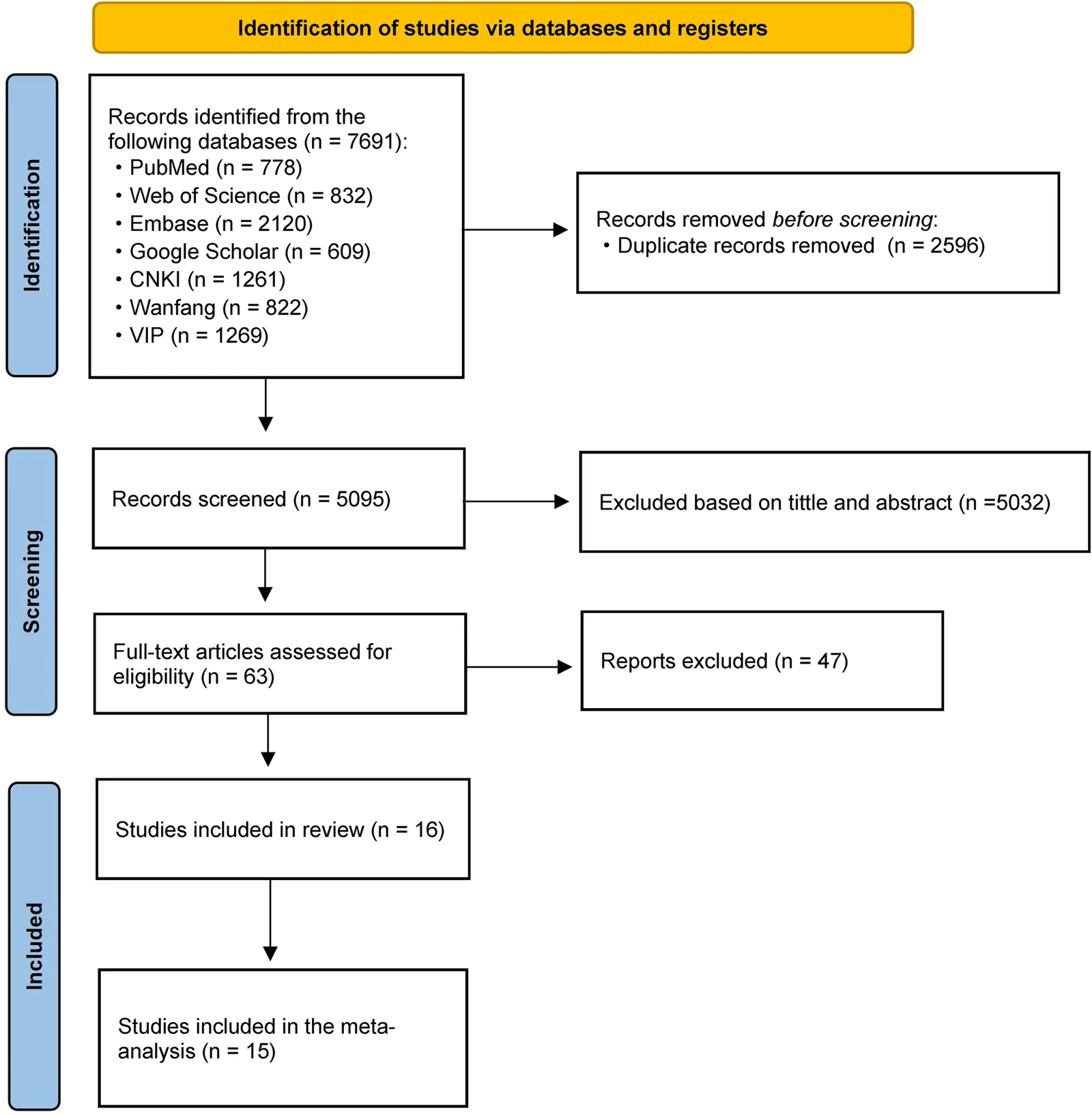
A total of 16 studies were included in the final systematic review, of which 15 were eligible for quantitative synthesis.
- Result
The random-effects pooled OR was 1.80 (95% CI: 1.40–2.30) ( Figure 4 ); however, because the study effects were highly inconsistent, this value should be viewed as an average association rather than a precise or broadly generalizable effect estimate.
Results, 3.5 Meta-analysis for odds ratio of the included models
- Limitation
First, heterogeneity was extreme for the main outcomes (sensitivity I² = 98.17%, specificity I² = 99.39%, and OR I² = 95.6%).
Quoted word for word from the full text on frontiersin.org.
The paper
China Academy of Chinese Medical Sciences
Frontiers in Cardiovascular Medicine, 25 Sep 2026