Brain receptor gene activity linked to lower Alzheimer’s risk
An analysis of inherited genetic differences linked a hormone receptor’s gene activity to lower disease risk, with results pointing mainly to the brain’s outer layer.
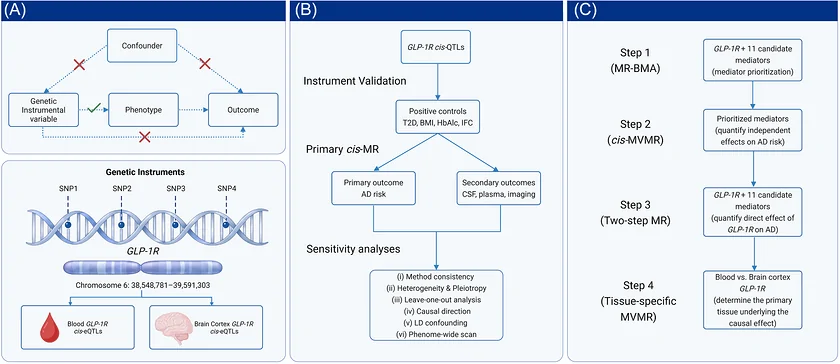
An analysis of human genetic data examined links between Alzheimer’s disease and activity of the gene for the glucagon-like peptide-1 receptor, a protein that responds to a hormone. Researchers used Mendelian randomization, a method that uses inherited genetic differences to assess associations. They analysed genetic variants linked to gene activity in blood and the brain’s cortex, its outer layer.
Receptor gene activity was associated with lower Alzheimer’s risk and lower levels of phosphorylated tau, a chemically modified protein, in fluid around the brain and spinal cord. Among 11 metabolic and inflammatory factors, systolic blood pressure—the pressure when the heart contracts—was the only independent intermediary identified. The link with lower disease risk remained after accounting for these factors. Further analyses attributed the association predominantly to gene activity in the cortex rather than blood.
Why it matters
For Alzheimer’s disease, an age-related illness, the study bears on whether a potential drug target acts through the brain or through metabolic changes elsewhere in the body.
Caveats
This was a genetic analysis, not a trial of receptor-activating drugs. It did not test whether those drugs prevented Alzheimer’s disease.
From the paper
- Result
Notably, GLP-1R expression was associated with higher LDL-C levels (β = 0.032 [95% CI: 0.016 to 0.049], FDR-adjusted p = 2.02 × 10⁻⁴), which is opposite of the LDL-lowering effect reported in clinical trials.
Results, 3.2 Effects of GLP-1R expression on AD and mediators
- Limitation
First, co-localization analysis was likely underpowered (PP.H3 + PP.H4 = 0.109), reflecting the weak AD GWAS signal at the GLP-1R locus.
Quoted word for word from the full text on alz-journals.onlinelibrary.wiley.com.
The paper
First Affiliated Hospital of University of South China
Alzheimer's & Dementia, 1 Oct 2026, Open access