Inhibiting miR-128-3p restores muscle mass and function in aged mice
The microRNA inhibitor also improved cardiac outcomes after infarction and reduced pathology in mouse and pig models of muscular dystrophy.
bioRxiv
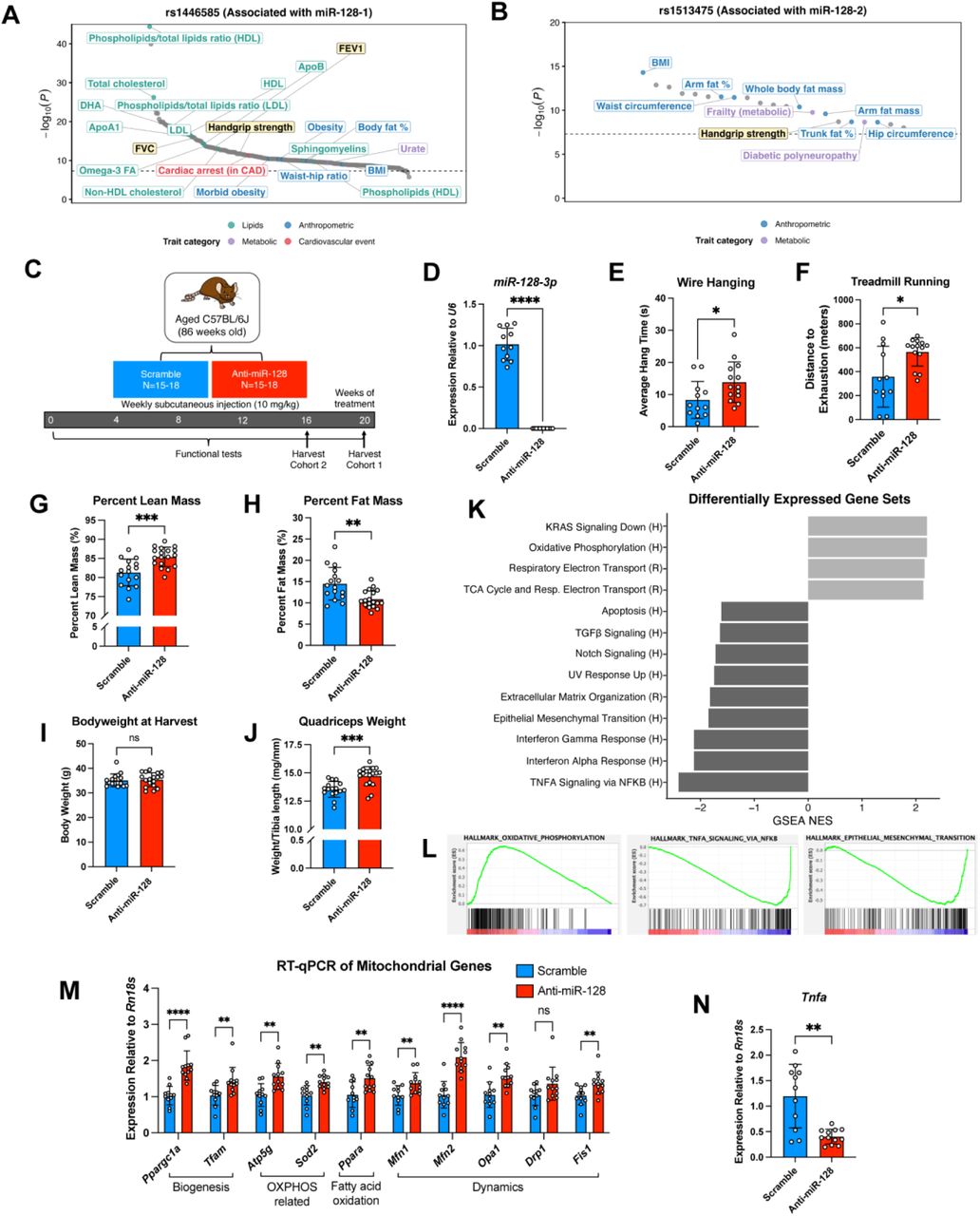
In aged mice, inhibiting the microRNA miR-128-3p with antisense oligonucleotides restored muscle mass and function, according to a recent preprint. The researchers targeted miR-128-3p because its genomic locus associates with variation in human grip strength, pulmonary function, and cardiometabolic traits. Beyond restoring aged muscle, miR-128-3p inhibition improved cardiac function and limited adverse remodeling after myocardial infarction in mice. It also ameliorated skeletal and cardiac muscle pathology in mouse and pig models of Duchenne muscular dystrophy. Across these settings, blocking miR-128-3p activated mitochondrial gene programs and suppressed inflammatory and fibrotic signaling, resembling patterns produced by established longevity interventions.
Why it matters
These findings identify miR-128-3p as a regulator of a conserved striated muscle aging program involving mitochondrial dysfunction and inflammation. The results demonstrate that aging-related functional declines in muscle can be pharmacologically reversed in animal models.
Caveats
The work is reported in a preprint and has not yet completed peer review. While the locus is linked to human traits, therapeutic interventions were evaluated only in mouse and pig models.
The paper
A positively selected microRNA controls a reversible aging program in striated muscle
Show 33 more authors
Michael Stirm, Gracia M. Bonilla, Chi Zhu, Justin Y. Lee, Rachelle L. Stark, Sneha Damal Villivalam, Marianne Begtson Loevendorf, Andreas Petri, Alexandre Wagschal, Caslin Gilroy, Federico Gonzãlez, Lei Cai, Peter I. Hecker, Mogens Vyberg, Rahul Almeida, chaitanya punnati, Christopher Jin, Theresia Maria Schnurr, Dominique O. Riddell, John C. W. Hildyard, Bachuki Shashikadze, Andreas Lange, Nikolai Klymiuk, Thomas Fröhlich, Sakari Kauppinen, Richard J. Piercy, Joshua W. Knowles, Alexander Fay, Sona Kang, Ryan E. Temel, Ruslan I. Sadreyev, Eckhard Wolf, Matthew L. Springer,Innovative Genomics Institute
bioRxiv · 7 Sep 2026 · Preprint, not peer-reviewed