Neuropeptide signaling drives lipid breakdown during dietary restriction in roundworms
A relay involving sensory neurons, interneurons, and gut receptors coordinates fat mobilization when food intake drops.
bioRxiv
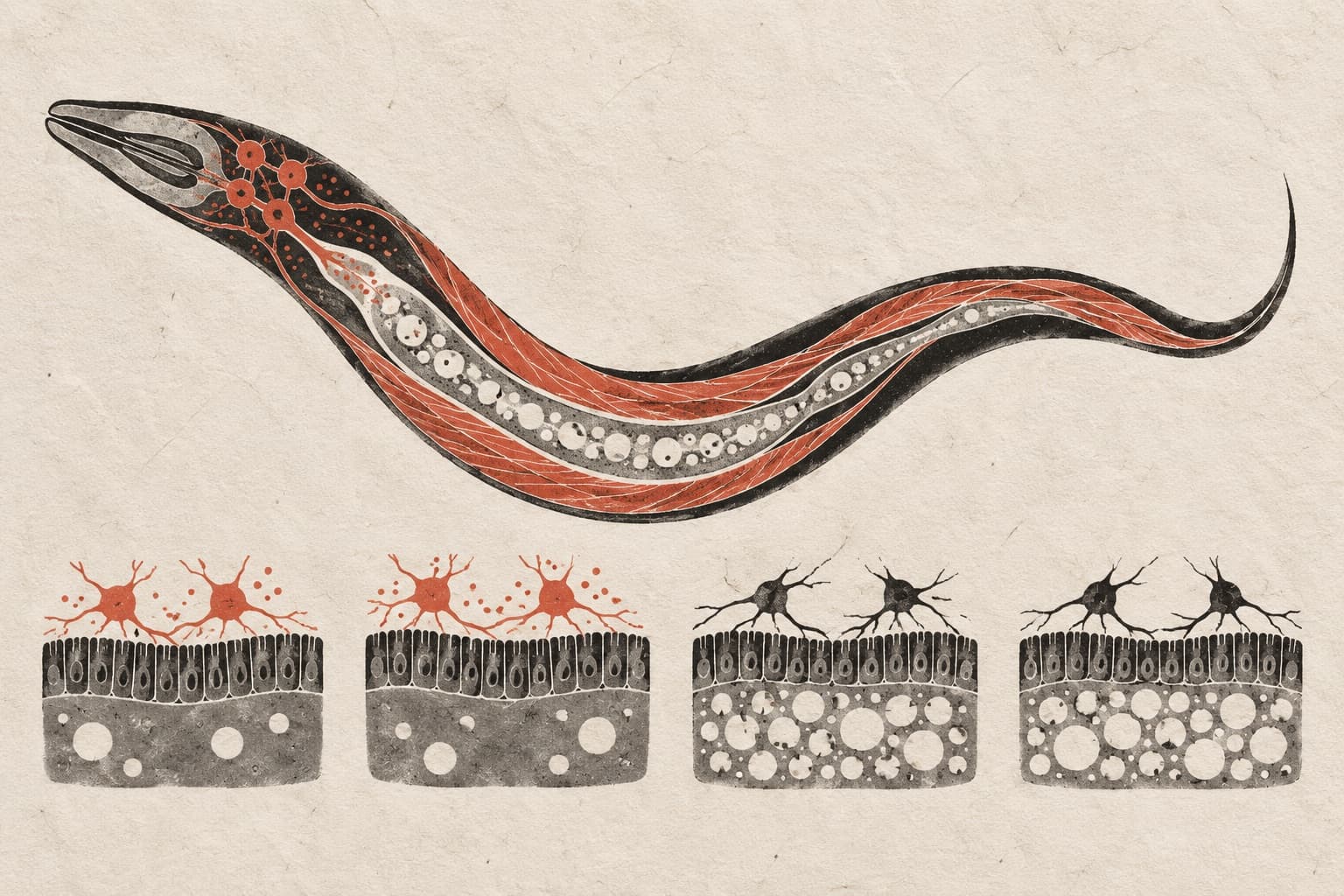
In a preprint study using Caenorhabditis elegans, researchers identified a neuropeptide signaling cascade that triggers lipid breakdown under chronic dietary restriction. Impaired pharyngeal function caused nutrient shortages that activated two peptide-receptor pairs: NLP-10 with NPR-35 and FLP-18 with NPR-4. This neuroendocrine pathway originates in ADL sensory neurons, passes through several interneurons, and stimulates triglyceride hydrolysis in the intestine. Genetically disrupting any part of this circuit restored fat storage in diet-restricted worms. However, overexpressing individual components in well-fed worms failed to induce fat mobilization. The authors also found that starving wild-type worms engaged the identical signaling cascade, showing that it functions as a general physiological response to energy deficits.
Why it matters
Dietary restriction is a well-established intervention that influences metabolic health and lifespan across species. Defining the specific neuroendocrine circuits that regulate fat utilization helps explain how organisms adapt systemically to low nutrient availability.
Caveats
The findings are limited to nematodes and have not yet undergone peer review. Whether equivalent neuropeptide networks control lipid breakdown in mammals remains to be tested.
The paper
Xiamen University
bioRxiv · 23 Sep 2026 · Preprint, not peer-reviewed