PFOS exposure is linked to higher glaucoma risk in humans
An analysis of NHANES participants from 2005 to 2008 and Mendelian randomization linked PFOS exposure to higher glaucoma risk.
Food and Chemical Toxicology
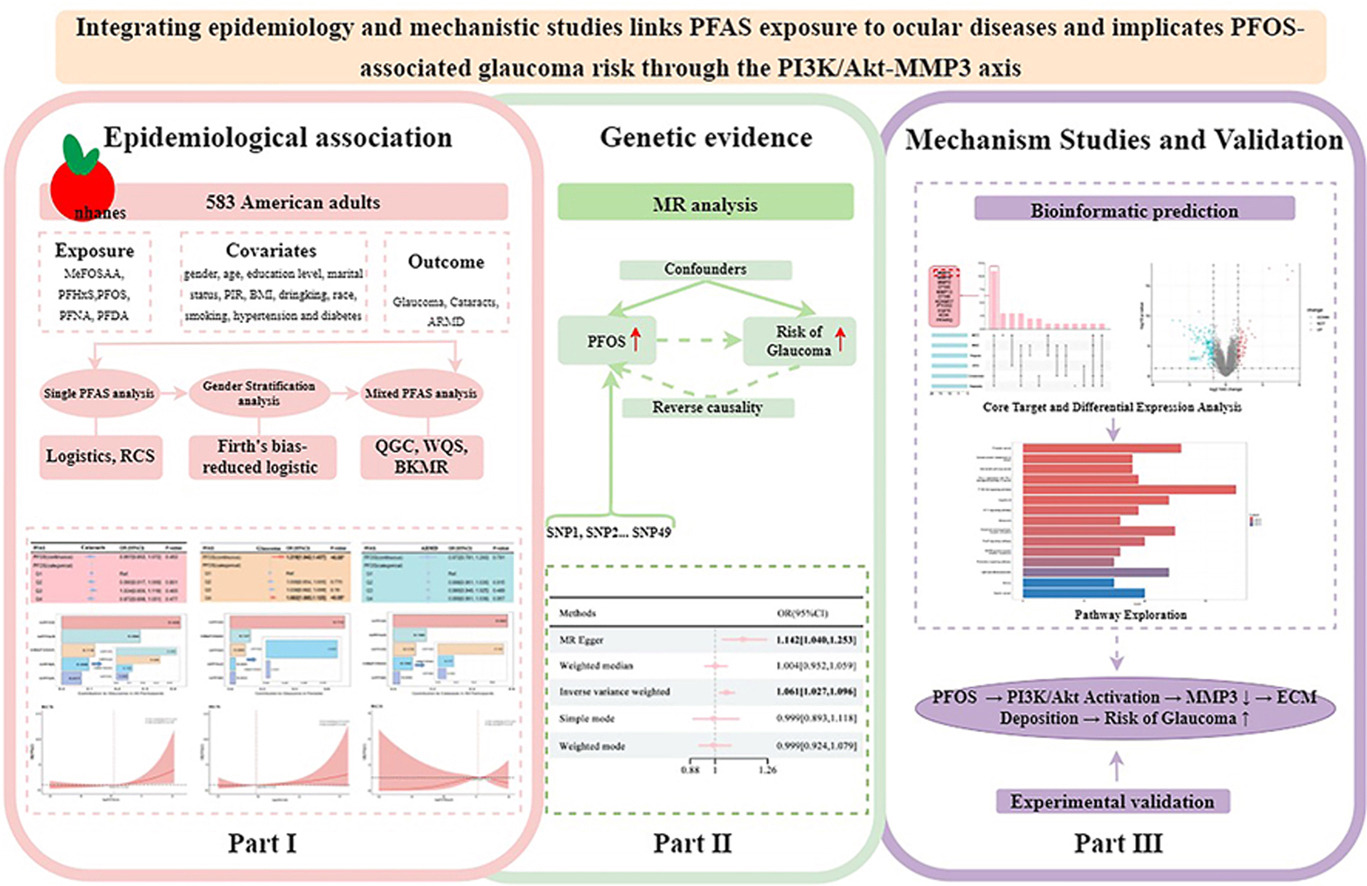
In an analysis of human survey data from NHANES (2005–2008), researchers examined single and mixed perfluoroalkyl substance (PFAS) exposures in relation to ocular diseases. Cross-sectional results suggested positive associations between PFOS and glaucoma, and between PFNA and cataracts. Sex-stratified analyses showed positive associations between PFOS and glaucoma in females, as well as between PFDA and glaucoma and PFNA and cataracts in males. Mixture models suggested that PFOS may be a driving factor for glaucoma risk, an association further supported by Mendelian randomization. In vitro experiments in trabecular meshwork cells indicated that PFOS activates PI3K/Akt signaling and reduces MMP3 expression. Treatment with LY294002 partly restored MMP3 expression, suggesting the PI3K/Akt-MMP3 axis may be involved in PFOS-induced extracellular matrix changes.
Why it matters
Glaucoma is a major cause of age-related vision loss worldwide. These findings suggest that widely distributed environmental contaminants may act as risk factors influencing age-related ocular degeneration.
Caveats
The primary human findings rely on cross-sectional survey data, which cannot determine temporal sequence. Furthermore, the mechanistic signaling pathways were tested in vitro in cultured cells rather than intact living eyes.
- Perfluorooctane sulfonic acid
- Perfluorononanoic acid
- Extracellular matrix
- Extracellular matrix remodelling
- Glaucoma
- Humans
The paper
Show 7 more authors
Zengxu Shen, Yue Fei, Luyao Jiang, Mingjing Sun, Zihan Wang, Jing Xiao, Demin Cheng,Nantong University
Food and Chemical Toxicology · 30 Sep 2026