An altered collagen form changes tail tendon properties in mice
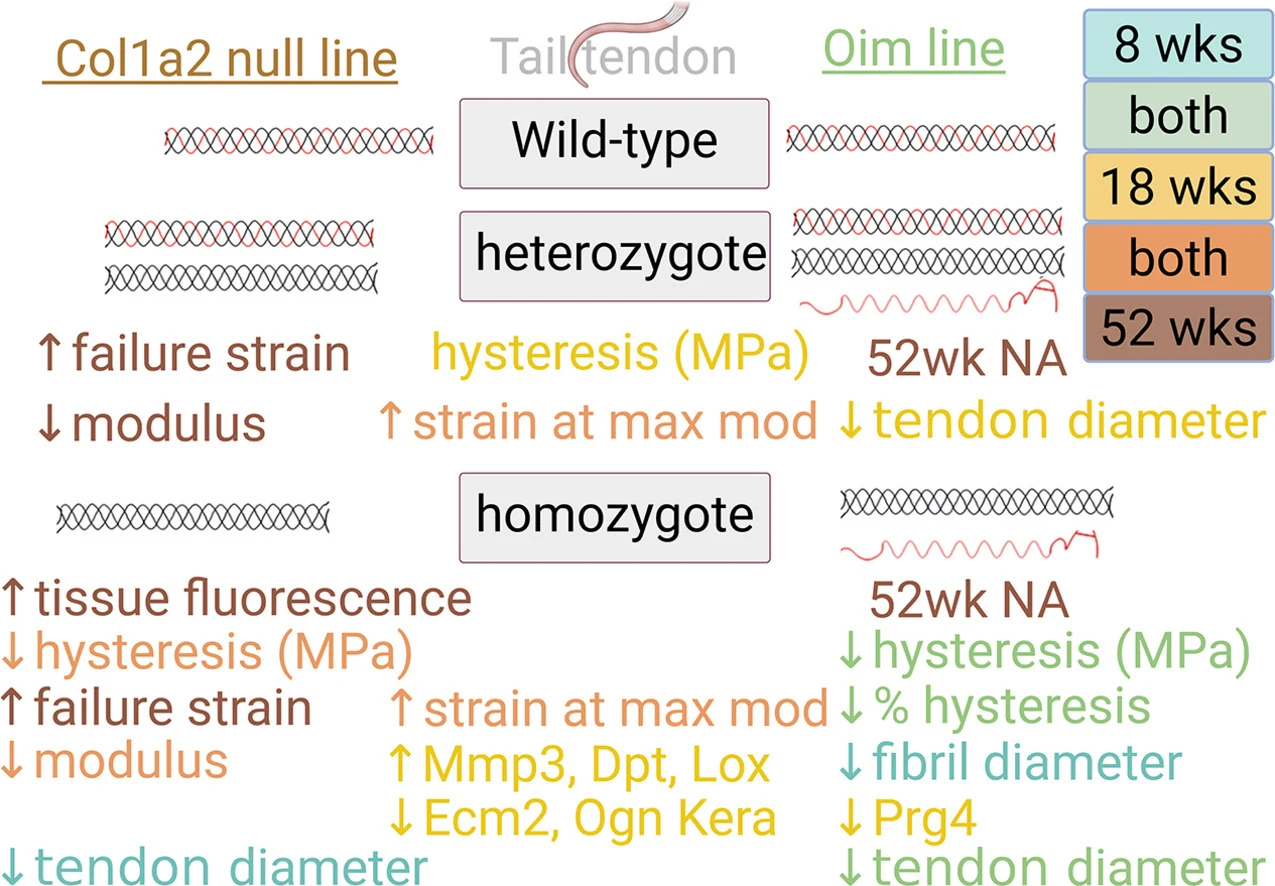
Experiments in genetically altered mice found changes in tail tendon properties at 8, 18 and 52 weeks, with more pronounced changes at older ages.
Edited by Boris Djordjevic · AgingResearch.News
In an experiment in mice, researchers inactivated a collagen gene to study an altered form of type I collagen, a structural protein, in tail tendons.
Mice with both gene copies inactivated had narrower tendons at 8 weeks. At 18 and 52 weeks, tendons had a lower maximum modulus, a measure of material stiffness, and lost less energy per unit volume during stretching and release. The mix of proteins surrounding tendon cells also changed. Mice with one gene copy inactivated showed evidence of the altered collagen and milder changes in some tendon properties at 18 weeks. A separate mutation used to model brittle-bone disease produced earlier and additional changes in how tendons lost energy.
Why it matters
This collagen form is associated with age-related diseases of muscles, bones, the heart and blood vessels. The authors suggest the more pronounced tendon changes at older ages could reflect accumulated damage or adaptive responses.
Caveats
These experiments in genetically altered mouse tail tendons do not establish what happens in human tendons or other tissues.
The paper
Type I collagen homotrimer alters tail tendon material properties
University of Liverpool
Acta Biomaterialia, Sep 9, 2026, Open access


Comments
Be the first to comment.