Older mouse tendons responded poorly to repeated compression
A seven-day laboratory experiment compared responses to repeated squeezing in tendons from 32 young and 36 aged male mice.
Edited by Boris Djordjevic · AgingResearch.News
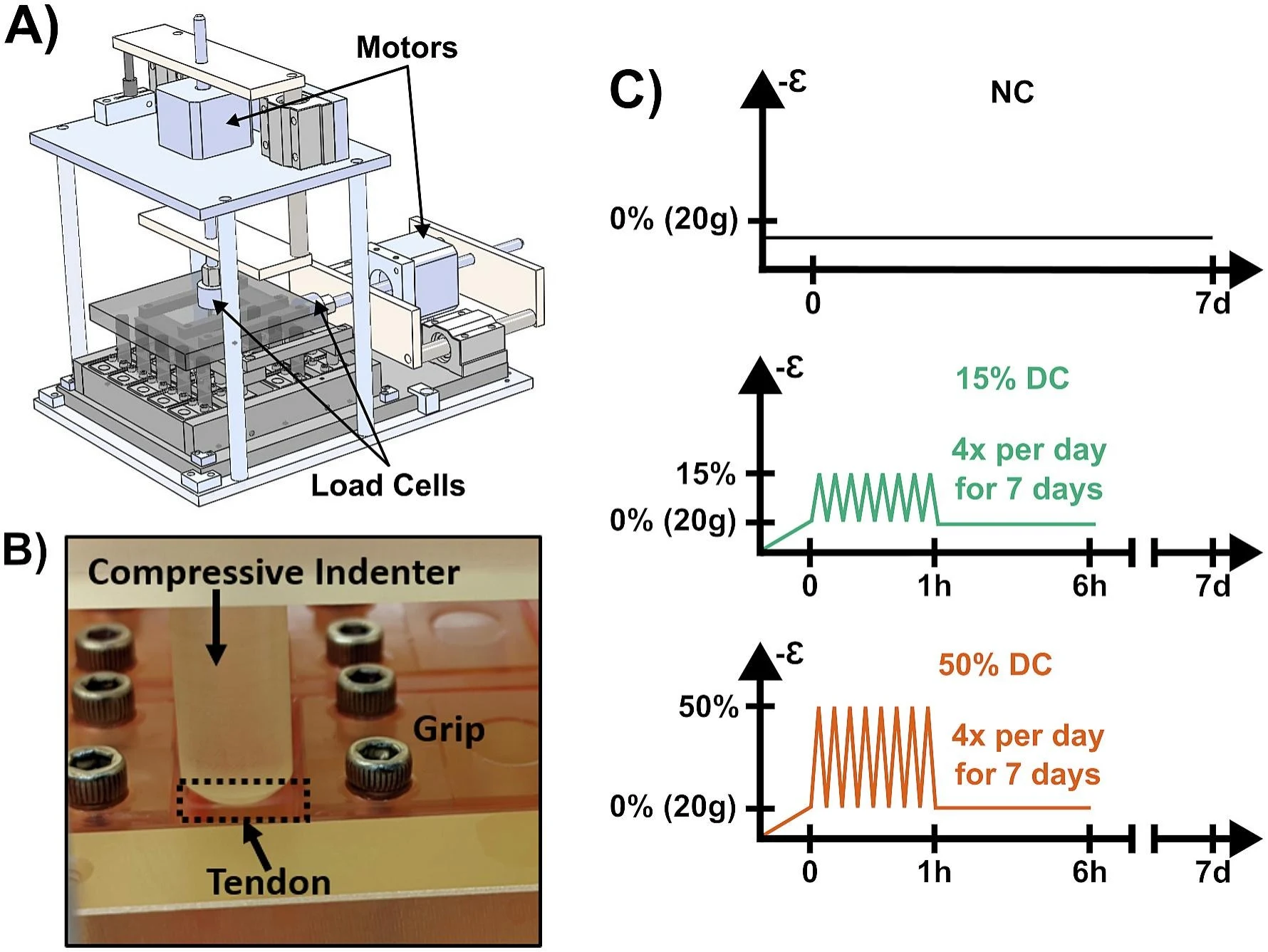
In a laboratory experiment, researchers cultured hind-limb tendons from 32 young male mice aged four months and 36 aged male mice aged 22–24 months. They kept the tendons under constant tension for seven days, with either repeated compression or no compression.
Young tendons maintained a stable state under moderate compression. High compression increased their content of collagen, a structural protein, and the activity of genes involved in tissue rebuilding, inflammation and cell death. Aged tendons responded differently even at low compression. At 15% compression, they made less new collagen and released more of a tissue-degrading enzyme than aged tendons kept without compression. The authors suggested that impaired responses to mechanical forces and a lower injury threshold may leave repeatedly loaded tissues vulnerable to degeneration.
Why it matters
Rotator cuff tendon disease is common in aging populations. The work explored how responses to compression may contribute to age-related tendon degeneration.
Caveats
The experiment used tendons cultured outside the body, not injuries measured in living animals or people. All mice were male, and the higher compression level was an experimental overload.
The paper
Boston University
Journal of Biomechanics, Aug 18, 2026, Open access

Comments
Be the first to comment.