Antibody buildup may contribute to skin aging in mice
An experiment in young mice found that giving an antibody encouraged immune cells to enter the skin.
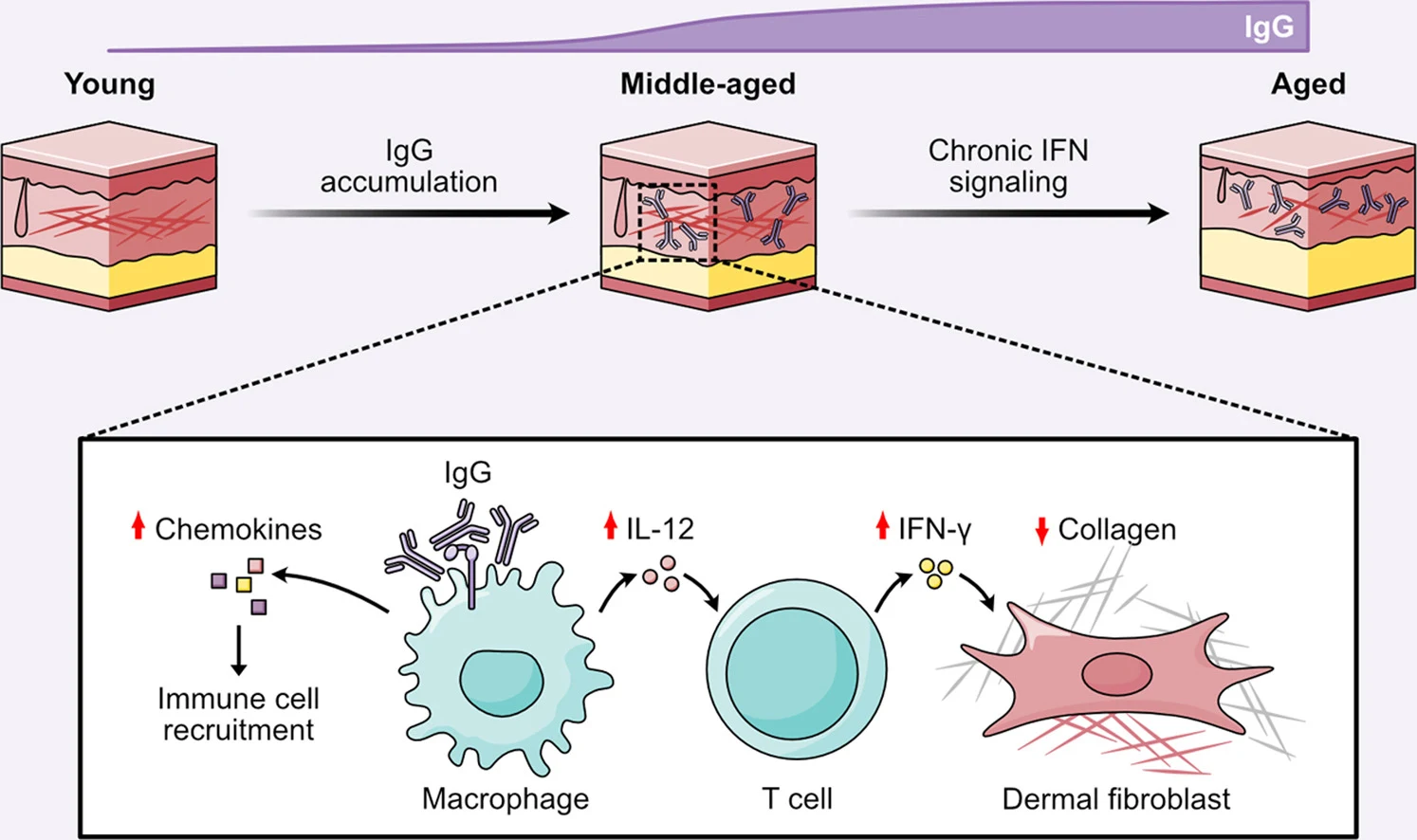
Limit: Immune-cell entry into skin is a stand-in for skin aging
Edited by Boris Djordjevic · AgingResearch.News
Mouse and human skin tissues showed an age-related buildup of immunoglobulin G (IgG), a type of antibody. The study combined tissue analysis with an experiment that gave IgG to young mice.
In those mice, IgG increased gene activity for chemokines, chemical signals that attract immune cells. This helped macrophages and T cells, two kinds of immune cells, enter the skin. The findings supported a role for IgG in inflammation and thinning of the dermis, the layer beneath the skin’s surface. The authors proposed that IgG activates macrophages to produce chemokines and interleukin-12, an immune signal. Their model links this signaling to increased T-cell production of interferon-gamma, another immune signal, and suppressed collagen production by fibroblasts, cells that make skin’s supporting material.
Why it matters
Chronic inflammation is a feature of aging skin. The authors suggested that targeting IgG buildup or its downstream signals may delay skin aging and extend the time tissues remain healthy.
Caveats
The antibody administration experiment was in young mice, not people. The abstract does not report an experiment showing that blocking IgG delays skin aging.
The paper
Aging-related IgG accumulation promotes skin inflammation
Kumamoto University
The Journal of Investigative Dermatology, Sep 9, 2026, Open access


