An AI-driven clinical decision support system for coronary artery disease prediction in T2DM patients using clinical laboratory parameters and deep fusion learning
Abstract
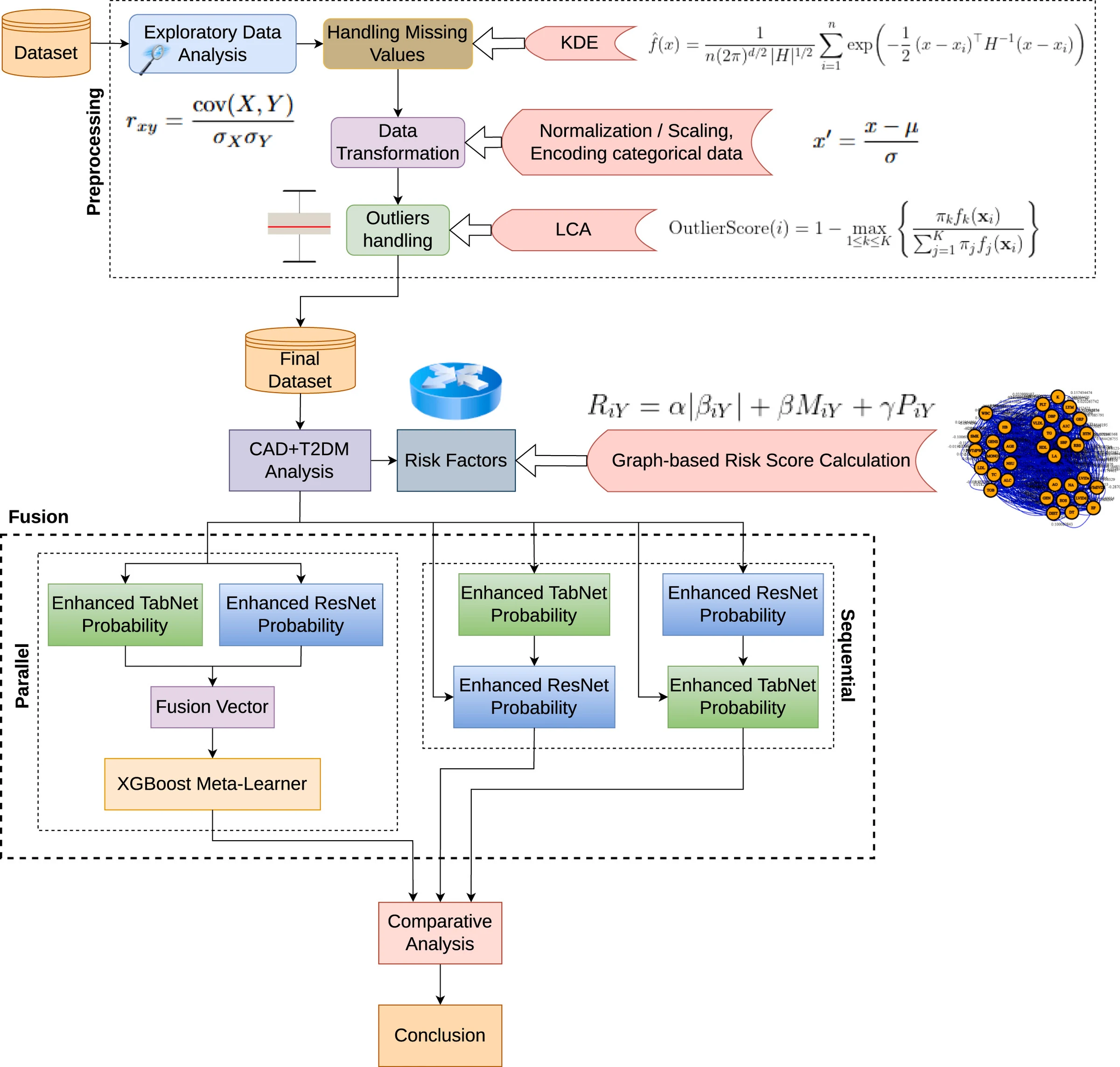
This article presents an intelligent clinical decision support system that integrates graph-based modelling and deep fusion learning for coronary artery disease (CAD) risk prediction using a clinical Laboratory and validated dataset. A Graph-Based Multivariate Kernel Density Estimation (KDE) imputation approach is proposed to handle the missing values, while latent class analysis (LCA) is applied for outlier detection. The framework further incorporates with the graph-based directional risk scoring and the comorbidity network analysis to identify significant clinical attributes and capture complex relationships among risk factors. For prediction, the Enhanced TabNet and Enhanced Residual MLP (ResNet) architectures are then combined through the probabilistic fusion with XGBoost as a meta-learner. The proposed system achieves 96.77% accuracy, demonstrating improved robustness and predictive performance.
- Deep fusion learning clinical decision support system
- Deep learning
- Machine learning
- Coronary artery disease
- Type 2 diabetes
- Humans
The paper
Indian Institute of Engineering Science and Technology, Shibpur
Clinica Chimica Acta; International Journal of Clinical Chemistry, Aug 28, 2026


