Facial foundation model estimates clinical biomarkers
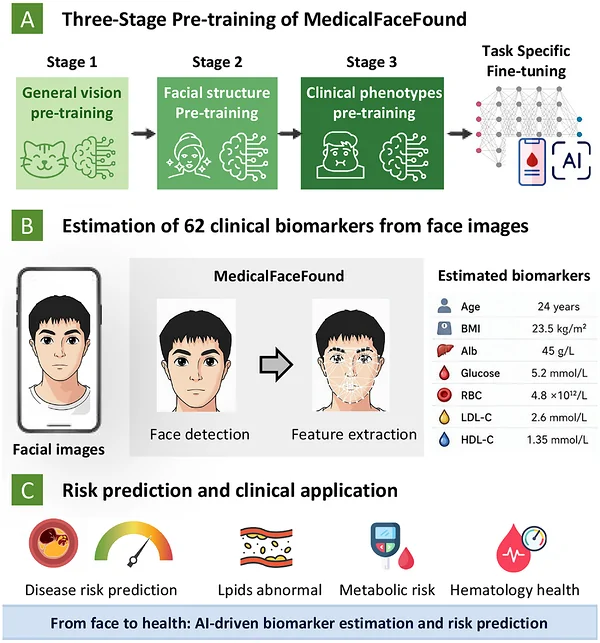
Pretrained on 10 million images, the model assessed 62 biomarkers across eight physiological systems, reaching a median Pearson's r of 0.172 across four cohorts.
Our read
AI & data- Studied:
- Computational study
Editor of record: Boris Djordjevic · AgingResearch.News
In human datasets, researchers developed MedicalFaceFound, a facial foundation model trained on over 10 million images to predict clinical biomarkers non-invasively. The team evaluated the model across 62 biomarkers representing eight physiological systems.
MedicalFaceFound outperformed Swin-Large and ResNet18 models on 45 of 62 (73%) biomarkers. In tests across four independent external cohorts, it achieved an overall median Pearson's r of 0.172, showing its highest correlations for red blood cell count (median r = 0.478), eGFR (median r = 0.442), and HDL-C (median r = 0.430). The model also surpassed polygenic risk score models for 14 of 26 biomarkers, and face-estimated cardiovascular metrics were associated with coronary stenosis with an AUC of 0.66. The architecture retained predictive accuracy with 400 labeled samples and was successfully deployed as a smartphone application.
Why it matters
Non-invasive estimation of physiological indicators through facial features offers a scalable way to track multi-organ health and functional decline without repeated blood sampling.
Caveats
Across external cohorts, the overall median correlation across all 62 biomarkers was modest (r = 0.172), and the association with coronary stenosis yielded a moderate AUC of 0.66.
From the paper
- Participants
To fine‐tune MedicalFaceFound to predict 62 biomarkers routinely tested in a healthcare system across eight physiological systems, we collected data from 4,698 individuals with linked hospital records from the AZ‐TR‐unfiltered dataset (N = 4698; median age 60.0 years; IQR 54.0–67.0; 26.4% female).
- Result
… facial estimation (OR/SD 0.705, 95% CI: 0.579–0.858, P < 0.001) showed associations consistent with those obtained from laboratory measurements (OR/SD 0.856, 95% CI: 0.749–0.978, P = 0.022), both having higher levels in the control group.
Quoted word for word from the full text on PubMed Central.
- Smartphone application
- Deep learning
- Foundation models
- Red blood cell count
- Estimated glomerular filtration rate
- Humans
The paper
A Facial Foundation Model for Clinical Biomarker Prediction and Real-World Mobile Deployment
Chinese Academy of Sciences
Advanced Science, Oct 1, 2026, Open access


Comments
Be the first to comment.