Heart and blood vessel disease projected to rise in US by 2050
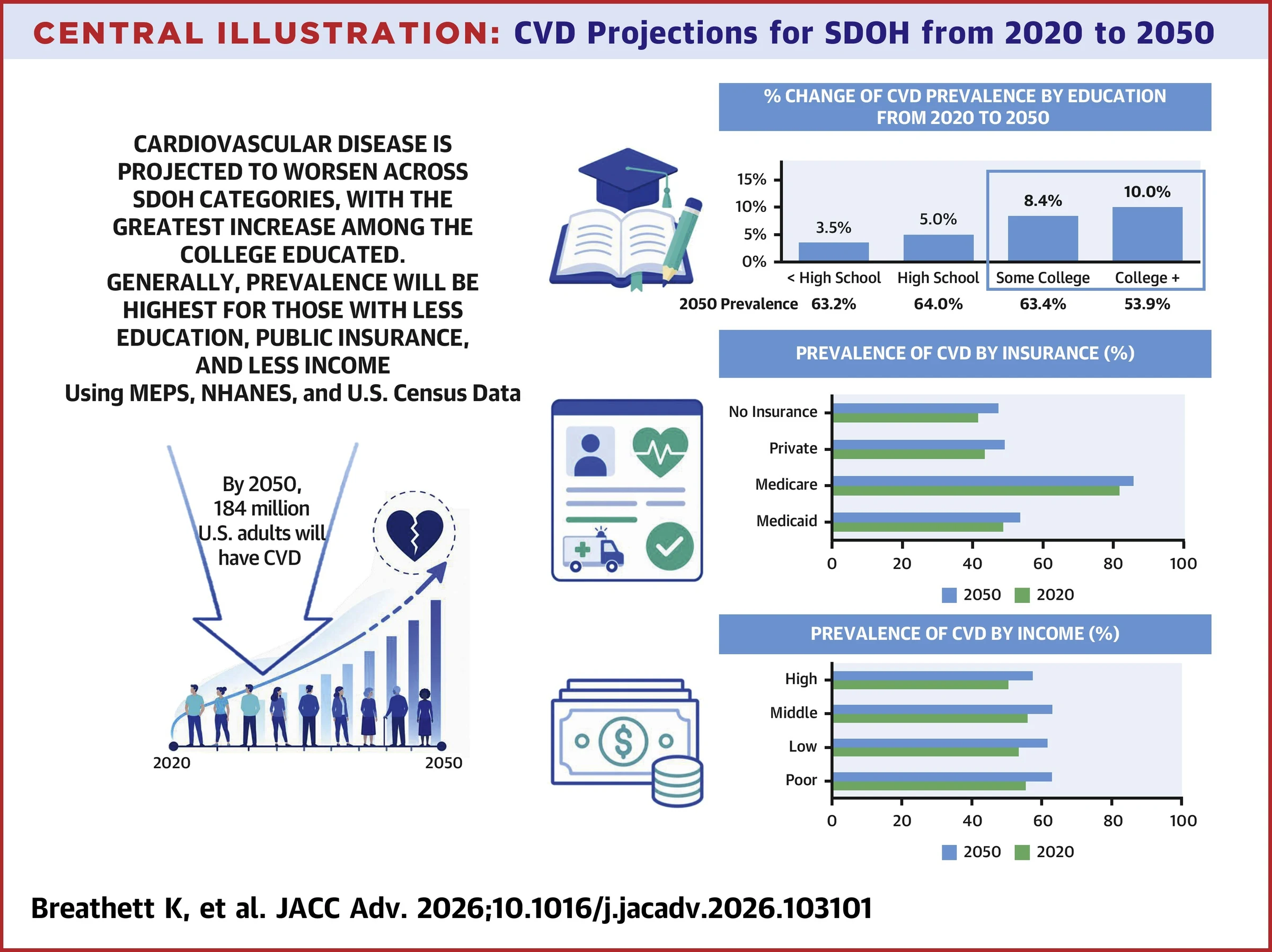
The model projected a 10.0-percentage-point rise in cardiovascular disease prevalence among college graduates from 2020 to 2050, the largest increase across education groups.
Our read
Populations- Studied:
- Computational study of people in the United States
- What changed:
- Total cardiovascular disease prevalence was projected to increase from 2020 to 2050 across education, insurance, and income categories
- The catch:
- The model's assumptions and uncertainty around its projections were not reported
- Why it’s aging research:
- It bears on staying healthy in midlife and later life.
Editor of record: Boris Djordjevic · AgingResearch.News
In the US population, a computational modeling study projected how common cardiovascular disease—disease of the heart and blood vessels—would become from 2020 to 2050. Researchers used the National Health and Nutrition Examination Survey, Medical Expenditure Panel Survey and US Census to estimate future disease patterns by education, insurance and income.
Total cardiovascular disease prevalence was projected to rise across all three categories. The greatest increases were projected among college graduates, bringing prevalence across education levels closer together by 2050. Medicare beneficiaries were projected to have the highest total prevalence throughout the period, reaching 86% in 2050. Most risk factors and individual cardiovascular conditions were projected to worsen and remain worst among people with less education, Medicare or Medicaid coverage, and lower incomes.
Why it matters
As the US population ages, anticipating cardiovascular disease burdens can inform planning across social groups. The authors called for prioritizing efforts to address social drivers of health to mitigate the forecast.
Caveats
These are model projections, not observed outcomes through 2050. The abstract does not describe the model’s assumptions or report uncertainty around its estimates.
The paper
Social Drivers of Health Advisory: Cardiovascular Disease Projections Through 2050
Indiana University Indianapolis; University of Alabama at Birmingham
JACC Advances, Aug 5, 2026, Open access

Comments
Be the first to comment.