Primary care recruited most adults at risk of heart failure
Primary care enrolled 444 (81%) participants and digital advertising 68 (12%), compared with 5 (1%) through community outreach events.
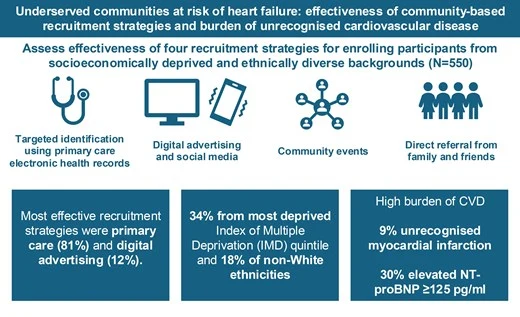
In a prospective cohort study, researchers enrolled 550 adults aged 50 or older with at least two risk factors for heart disease or conditions affecting how the body uses energy, but no previous heart failure diagnosis. Recruitment used eight primary care centres, digital advertising, ten community events and referrals from family or friends. Of those enrolled, 185 (34%) were in the most deprived fifth on a deprivation index, and 97 (18%) were of non-White ethnicity.
Primary care and digital advertising recruited most participants while maintaining diverse representation. Baseline tests included recordings of the heart’s electrical activity, blood sampling and imaging. Researchers identified heart abnormalities warranting clinical action in 125 (23%) participants, including previously unrecognised heart attacks in 46 (9%). Uncontrolled blood pressure affected 331 (60%).
Why it matters
For adults aged 50 or older at risk of heart failure, more inclusive research could help clarify who develops the condition in communities often under-represented in cardiovascular studies.
Caveats
This observational pilot study compared recruitment routes rather than testing them in a randomised trial. The disease findings came from adults selected for multiple risk factors, not the wider population.
- Digital advertising
- Community outreach
- Direct referral from family or friends
- Heart failure
- Blood pressure
- Humans
The paper
University of Manchester
European Journal of Heart Failure, 13 Oct 2026