Nicotinamide Mononucleotide Adenylyltransferase 1 and NAD⁺ Homeostasis in Neuroprotection and Aging
Abstract
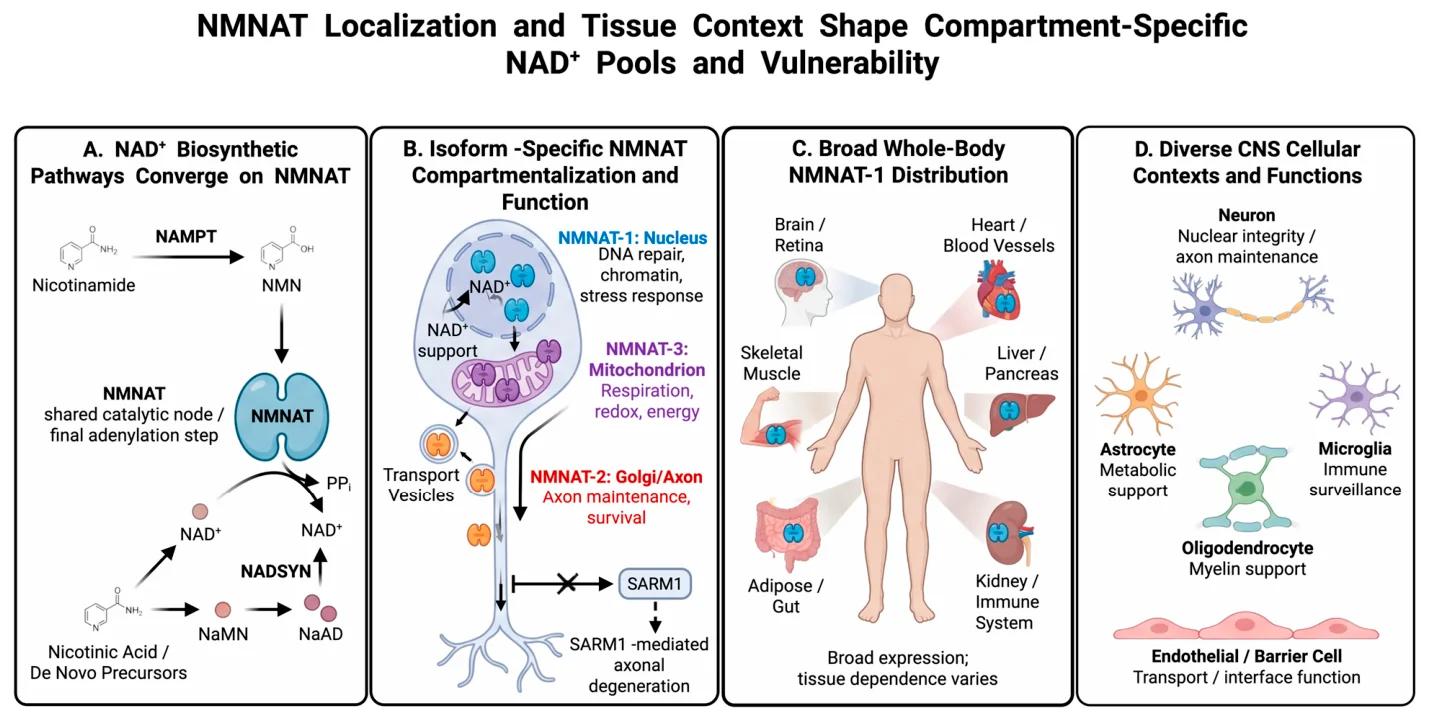
Nicotinamide adenine dinucleotide (NAD⁺) is a fundamental metabolic cofactor and signaling molecule that supports redox reactions, DNA repair, chromatin regulation, stress adaptation, inflammation, and neuronal maintenance. Age-associated NAD⁺ decline has been implicated in brain aging and neurodegenerative disorders, but the causal node and limiting compartment differ across tissues and disease states. Nicotinamide mononucleotide adenylyltransferase 1 (NMNAT-1) catalyzes the final step in NAD⁺ biosynthesis and represents the major nuclear isoform of the mammalian NMNAT family. Direct human genetic evidence establishes NMNAT-1 as a causal gene in inherited retinal degeneration, whereas evidence linking endogenous NMNAT-1 to broader brain aging or sporadic neurodegeneration is mainly convergent preclinical, preliminary, or indirect. Beyond NAD⁺ synthesis, biochemical and Drosophila studies suggest possible chaperone-like and proteostasis-supporting functions, but a separable NAD⁺-independent function of endogenous mammalian NMNAT-1 has not yet been established in vivo. Here, we review the molecular structure, localization, and regulation of NMNAT-1, emphasizing calibrated distinctions among catalytic nuclear NAD⁺ supply, engineered axonal protection, pathway-adjacent NAD⁺ interventions, and putative non-catalytic protection. We further discuss how NMNAT-1 dysfunction may contribute to aging-associated genomic instability, neuroinflammation, synaptic impairment, retinal degeneration, selected neurodegenerative models, and glioma biology. Finally, we evaluate therapeutic strategies targeting NMNAT-1 and NAD⁺ pathways, noting that no human trial has yet established efficacy for an NMNAT-1-directed neurological therapy. A compartment-aware and evidence-stratified view is therefore essential for translating NMNAT-1 biology into interventions for age-related neural disease.
The paper
Southern University of Science and Technology; Chinese Academy of Sciences
Metabolites, 21 Aug 2026, Open access

