Human iPSC-derived mesenchymal progenitor cell sheets promote tissue formation after xenotransplantation
Declared no competing interests
Abstract
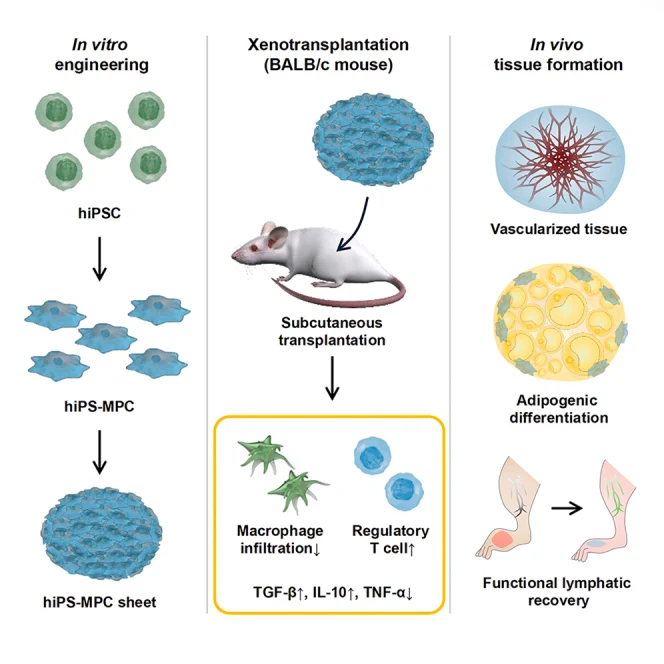
Mesenchymal stromal cell (MSC) sheets are a promising platform for regenerative therapy, but their in vivo survival and capacity to form tissue-like structures remain poorly understood. Here, we investigated whether sheets derived from human induced pluripotent stem cell (iPSC)-derived mesenchymal progenitor cells (hiPS-MPCs) can survive and form tissue-like structures after xenotransplantation. hiPS-MPCs were differentiated from human iPSCs, validated by surface marker expression and multilineage differentiation potential, and assembled into intact cell sheets. Mouse MSC, fibroblast, and hiPS-MPC sheets were transplanted subcutaneously into immunocompetent mice. By day 7, mouse MSC and hiPS-MPC sheets formed organized vascularized tissue-like structures, whereas fibroblast sheets frequently induced inflammatory responses and showed limited persistence. Notably, hiPS-MPC-derived tissues exhibited reduced immune cell infiltration and higher expression of anti-inflammatory cytokines than fibroblast tissues. These findings demonstrate that hiPS-MPC sheets generate vascularized tissues in vivo and support survival across species, highlighting their potential as a scalable regenerative therapy platform.