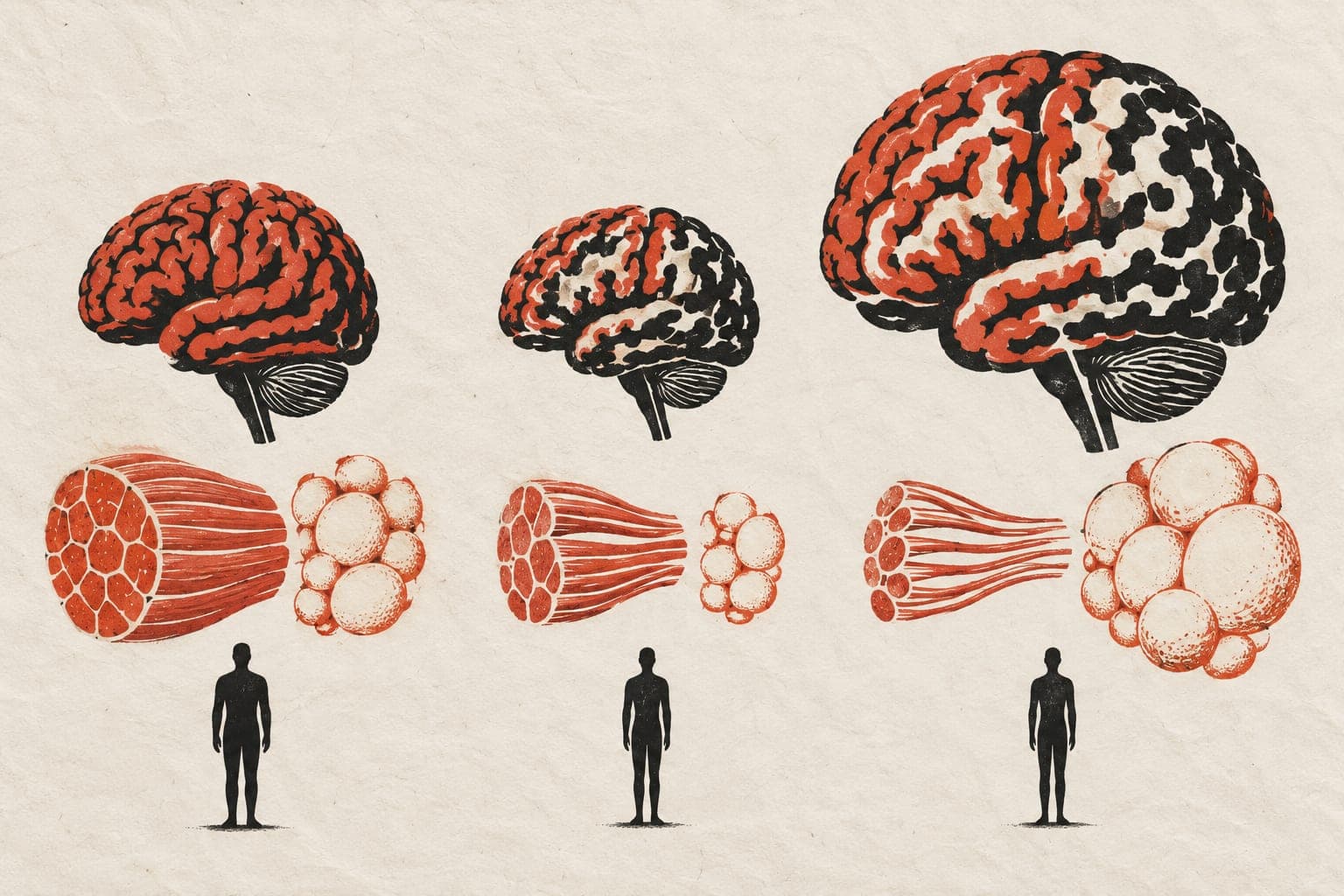
Creatine may help adults aged 45–65 maintain muscle mass and strength
Among 64 completers aged 45–65, a 12-week placebo-controlled trial reported gains in fat-free mass and strength with and without exercise.
Double-blind, placebo-controlled, registered ISRCTN83081058
Limit: Only 13 to 20 participants per group completed the 12-week intervention
Edited by Boris Djordjevic · AgingResearch.News
Seventy-three healthy, sedentary adults entered a 12-week randomized trial; 64 aged 45–65 completed it and were analyzed, including 40 women and 24 men. Participants chose exercise or nonexercise groups. Within each group, researchers randomly assigned creatine monohydrate or a maltodextrin placebo, each taken as two 5-gram doses daily. Neither participants nor researchers knew supplement assignments.
Creatine groups gained fat-free mass compared with placebo groups. Alongside exercise and a weight-loss diet, creatine produced a greater reduction in body fat percentage than the other groups. The authors also reported improved strength and endurance with and without exercise, and favorable changes in selected thinking and memory measures. Several cognitive tests showed no benefit. The authors called individual cognitive and blood-marker findings exploratory. Supplementation was well tolerated.
Why it matters
The trial addressed how to maintain muscle and strength during middle and later adulthood, including alongside exercise and a weight-loss diet.
Caveats
The analysis included only completers, and participants chose their exercise group rather than being randomly assigned to it. The findings do not establish effects in people older than 65 or with cognitive impairment.
From the paper
- Participants
Seventy-three participants selected exercise or non-exercise participation and were then matched and randomized to PLA or CrM within their selected exercise-status stratum using a counterbalancing approach to minimize baseline differences in age, sex, and body mass index.
- Who took part
Healthy, community-dwelling adults aged 45–65 were recruited through targeted advertisements in local media outlets, on social media platforms, and via campus-based communication networks.
- Ages
As shown in Table S1, the participants were 54.5 ± 6.2 years, 84.5 ± 21.3 kg, 66.3 ± 3.6 in tall, had a BMI of 29.93 ± 6.1 kg/m², 36.8% ± 8.5% fat, and had a resting heart rate of 66.4 ± 9.0 bpm, systolic blood pressure of 117.7 ± 6.4 mmHg, a diastolic blood pressure of 76.3 ± 8.0 mmHg, and VO₂peak of 36.8 ± 8.5 mL/kg/min …
- Duration
This study utilized a randomized, double-blind, placebo-controlled, parallel-group design within participant-selected exercise and non-exercise strata, with repeated measures collected over a 12-week intervention period.
- Lean tissue mass
Participants in the CrM supplemented groups gained fat-free mass compared to the NoEx+PLA and Ex+PLA groups, while percentage body fat loss was statistically significantly greater in the Ex+CrM than NoEx+PLA, NoEx+CrM and Ex+PLA groups.
- Muscle strength
Interestingly, some statistically significant benefits were observed in the NoEx+CrM group compared to NoEx+PLA group in 1RM bench press performance.
- Cognitive function
This analysis shows that participants supplementing their diet with CrM were generally able to recognize more correct words, with evidence of an increase in correct, Yes, and No reaction times in the NoEx+CrM or Ex+PLA groups, while better maintained in the NoEx+PLA and Ex+CrM groups.
Quoted word for word from the full text on PubMed Central.
Creatine is part of Bryan Johnson's Blueprint and Rhonda Patrick's supplement routineMore supplements
The paper
Texas A&M University
Journal of the International Society of Sports Nutrition, Aug 11, 2026, Open access