Exercise may help preserve thinking skills in older adults
Healthy exercisers’ thinking-test scores stayed stable over 48 months, from 29.37 to 29.19, versus 29.40 to 27.52 in controls.
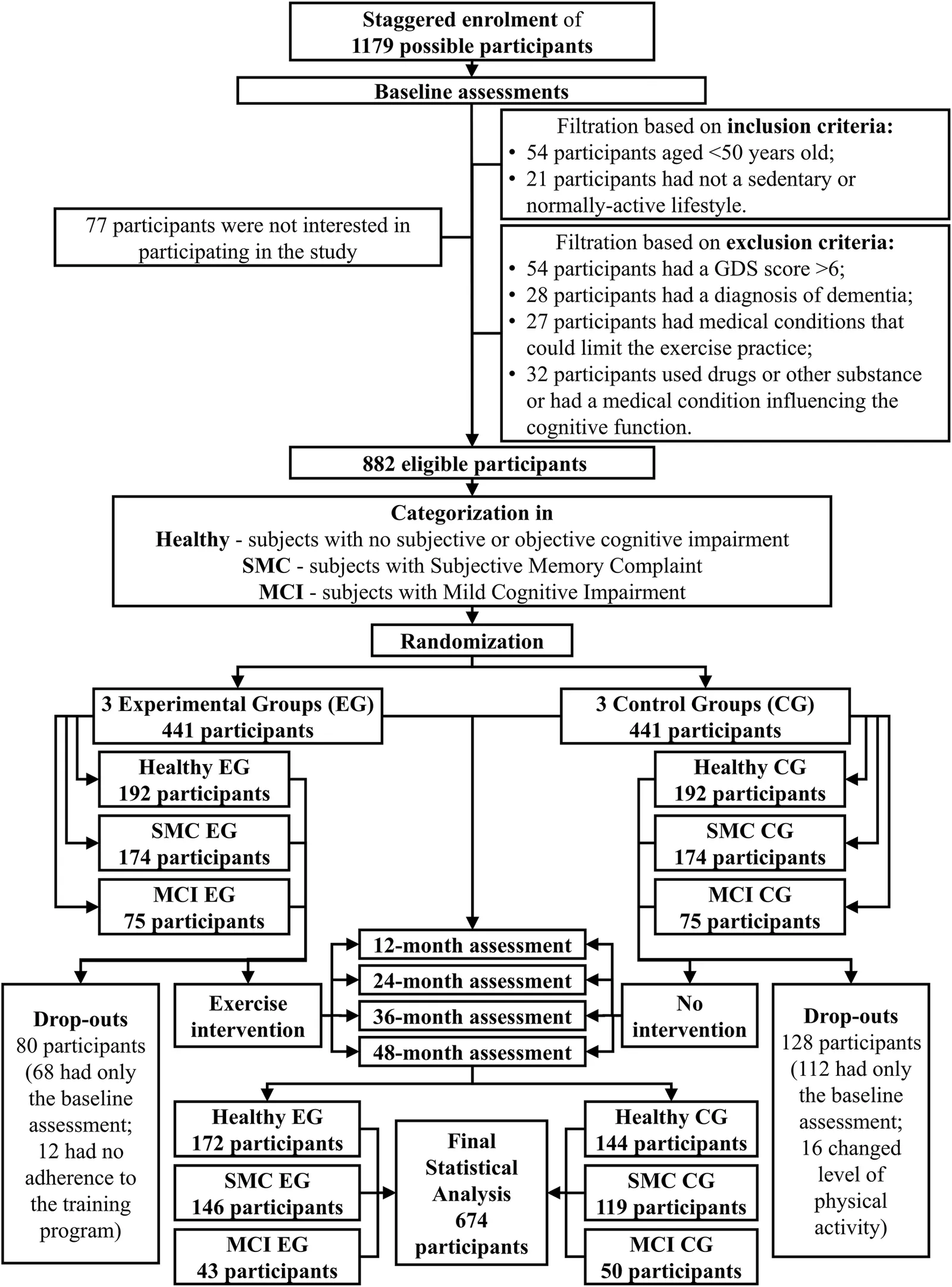
882 participants, blinded, registered NCT02236416
Limit: Excluding controls who adopted moderate or vigorous exercise could exaggerate the benefit
Edited by Boris Djordjevic · AgingResearch.News
The randomized trial enrolled 882 community-dwelling adults aged 50 or older in Italy: healthy people, people reporting memory concerns despite normal test performance, and people with mild cognitive impairment—mild difficulties with memory or thinking. Participants continued usual habits or undertook supervised aerobic exercise, resistance training and stretching at moderate-to-high intensity for one hour, three times weekly, for 48 months.
The analysis included 674 participants. Healthy exercisers had higher general thinking-test scores than controls. For those with memory concerns, scores followed a more favorable course, but the overall between-group difference narrowly missed statistical significance. Exercise also favored memory, attention and reasoning in these two categories. Musculoskeletal discomfort affected 30 women and 7 men; symptoms resolved within 2–4 weeks with rest and anti-inflammatory drugs. Three women fell with minor injuries. Two men’s lightheadedness resolved after reducing blood-pressure medication. No other adverse events were reported.
Why it matters
Age-related cognitive decline raises a practical question: whether a structured exercise routine can help maintain mental abilities over several years.
Caveats
The final analysis left out some randomized participants, including controls who increased exercise intensity, and the outcomes were thinking tests, not dementia diagnoses. The group with mild cognitive impairment was too small for firm conclusions; people with dementia or medical conditions limiting exercise were excluded from the trial.
From the paper
- Who took part
Volunteers aged ≥50 years from community centers for older adults in Campobasso (Italy), classified as sedentary or normally active according to the definition of, were screened for study eligibility.
- Duration
Participants assigned to the EG were involved in a 1-hour exercise session three times a week for 48 months.
- Limitation
A limitation of the present study is the use of the MMSE as the primary measure of global cognitive functioning.
- Cognitive function
Global cognitive status (MMSE) remained stable in the EG (29.37 ± 1.19 to 29.19 ± 1.23), while it declined significantly in the CG (29.40 ± 0.95 to 27.52 ± 1.34; time*group interaction: F4,1063 = 6.915, p < 0.001, η² p = 0.025).
- Cognitive function
In participants with MCI (category C), global cognitive status (MMSE) and executive functions (FAB) remained stable in both groups over 48 months without meaningful divergence (MMSE time*group interaction: F4,366 = 1.169, p = 0.324, η² p = 0.013; FAB time*group interaction: F4,366 = 1.035, p = 0.389, η² p = 0.011 …
Quoted word for word from the full text on PubMed Central.
Exercise is part of Bryan Johnson's Blueprint
The paper
Physical exercise for prevention of dementia study: a 48-month randomized controlled trial
University of Molise
Frontiers in Aging, Aug 10, 2026, Open access


