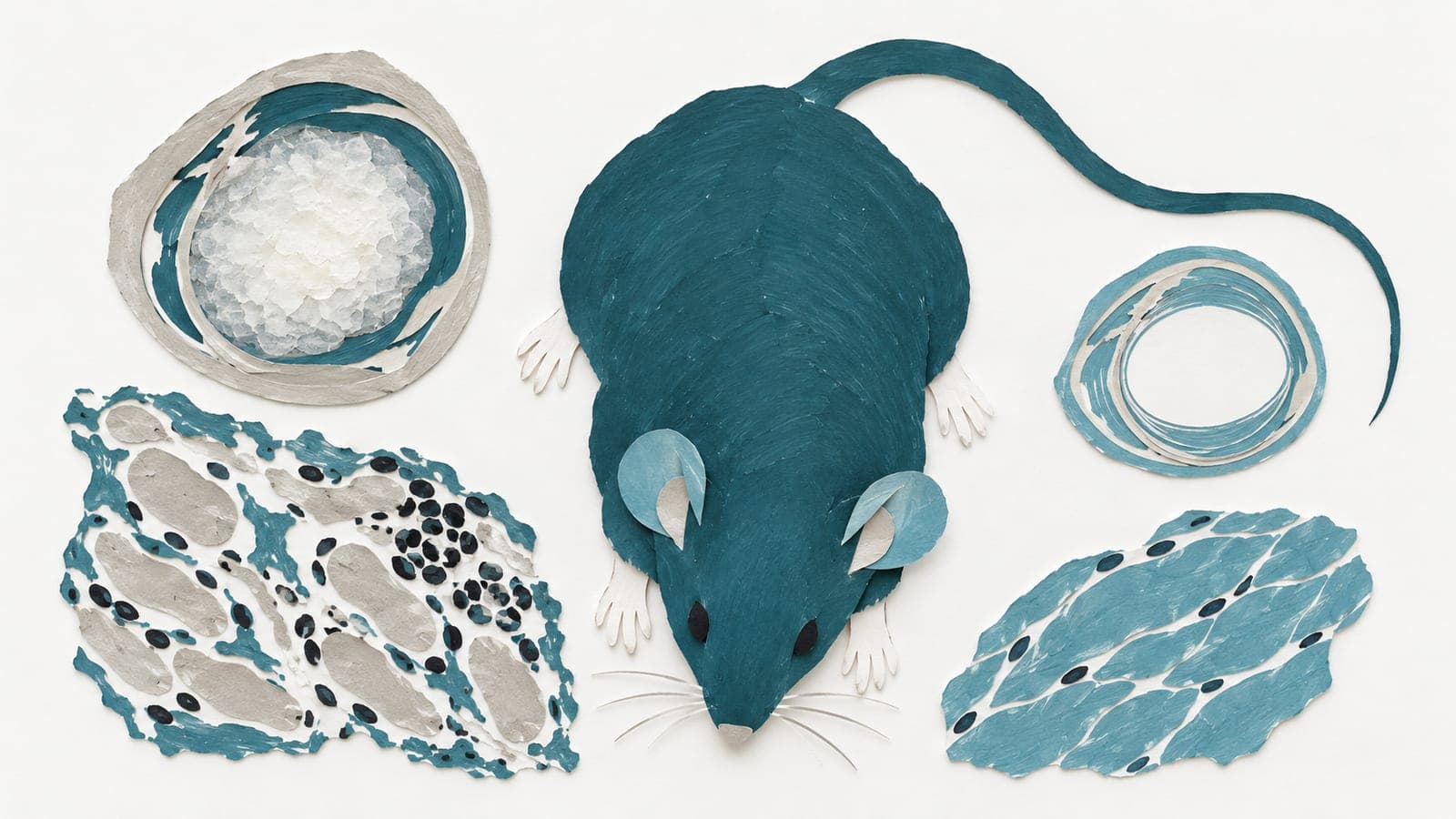
Gene delivery extended life in mice with Cockayne syndrome
Median survival reached 189 days in treated mice, compared with 22 days in controls given a salt solution.
Limit: Treated mice still had likely life-limiting changes in liver gene activity
Edited by Boris Djordjevic · AgingResearch.News
In an animal experiment, newborn male and female mice lacking two genes served as a severe model of Cockayne syndrome. Researchers delivered the human gene for CSA, a protein involved in DNA repair, using a virus. They injected 1 × 10¹¹ viral genomes into fluid-filled spaces in the brain at birth or one day later.
The approach extended survival, and the human protein appeared widely in the brain and heart. Yet treated mice still had brain abnormalities, including too little myelin, the insulating coating around nerve fibers, and signs of inflammation. They also developed severe kidney dysfunction by the study endpoint. Liver gene activity was altered at that point; the authors described these changes as likely limiting lifespan. Growth stalled at about eight weeks, and body weight later declined.
Why it matters
Cockayne syndrome combines faulty DNA repair with progressive nervous-system degeneration and a shortened lifespan. The authors see these experiments as a step toward testing gene therapy in people with the disease.
Caveats
The experiment tested gene delivery in newborn mice with a severe genetic disease, not in people or normal aging. Separate safety experiments in rats found minimal to mild damage to nerve cells and nerve fibers after delivery into spinal fluid.
The paper
AAV-mediated gene therapy demonstrates phenotypic rescue in a mouse model of Cockayne syndrome
Department of Genetic and Cellular Medicine
The Journal of Clinical Investigation, Jul 30, 2026, Open access