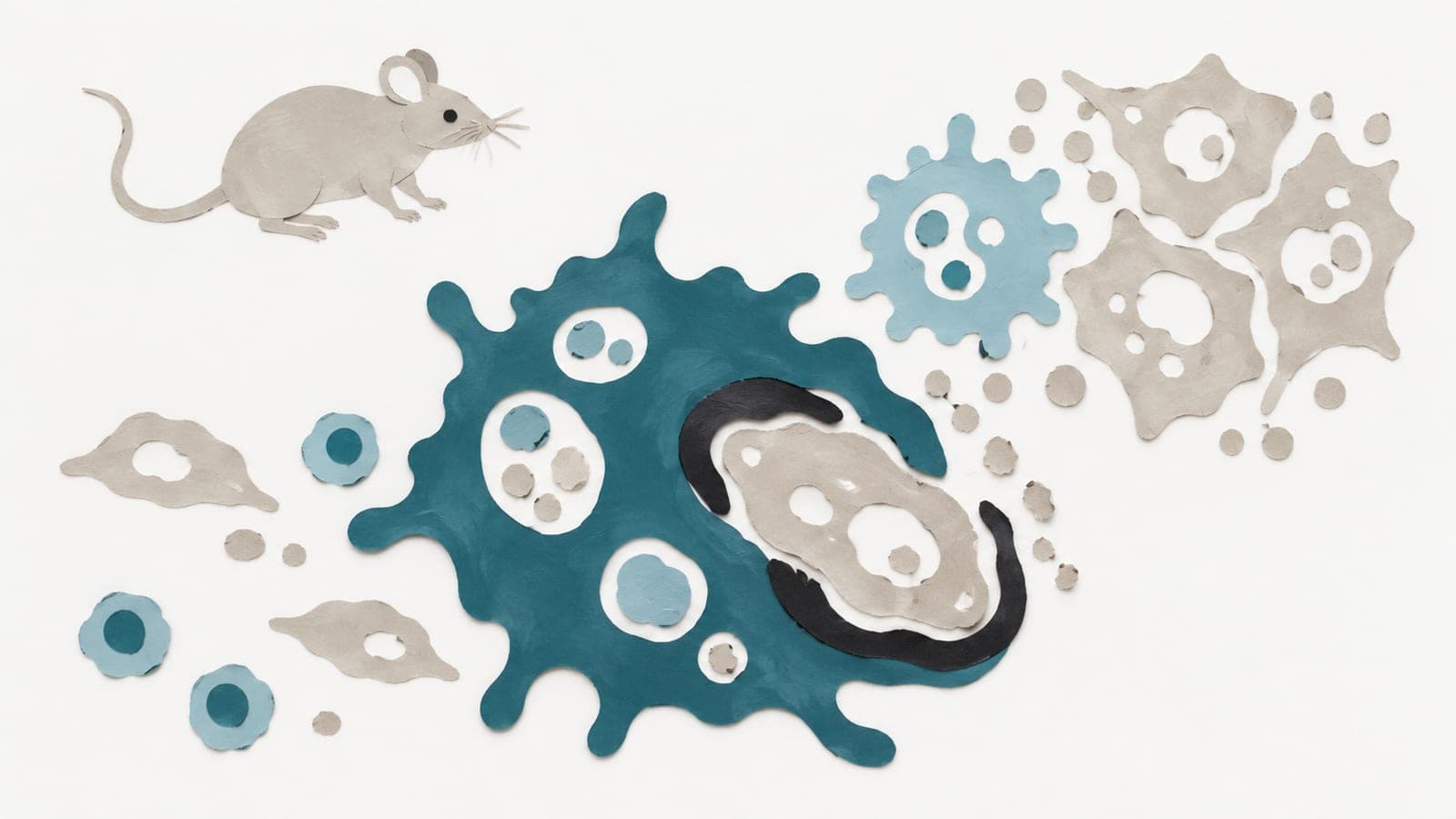
Reducing a cell-division brake reduced lung scarring in mice
A 14-day experiment in male mice tested a compound that lowered production of a protein involved in stopping cell division and reduced lung scarring.
Limit: Only at least three mice per group in the drug experiment
Edited by Boris Djordjevic · AgingResearch.News
In mouse experiments, reducing p16, a protein that stops cell division, reduced lung fibrosis, or scarring, and preserved cells’ recycling activity after a fibrosis-inducing challenge. Researchers tested genetic removal of p16 and compounds that changed its production.
For one drug experiment, they randomly assigned eight-week-old male B6 mice, with at least three per group. They induced lung injury with bleomycin and began injecting toosendanin one day later, every other day for 14 days. The compound came from extracts of Melia azedarach fruit. Doses of 50 and 100 micrograms per kilogram reduced lung collagen deposits, a measure of scarring; 10 micrograms per kilogram did not significantly change them. Toosendanin also restored cellular recycling activity. Its effects depended partly on p16.
Why it matters
Senescence, a state in which cells stop dividing, is implicated in idiopathic pulmonary fibrosis, a progressive, fatal lung disease. The authors suggest that targeting its connection with faulty cellular recycling may offer new treatment opportunities.
Caveats
These animal experiments were not blinded, and drug dosing began one day after induced lung injury. They did not test whether this approach benefits people with established lung fibrosis.
The paper
Targeting the senescence‒autophagy axis via p16INK4a inhibition alleviates pulmonary fibrosis
Graduate School of Pharmaceutical Sciences and College of Pharmacy; Ewha Womans University
Signal Transduction and Targeted Therapy, Jun 15, 2026, Open access