Blocking a signal countered senescence in a lung disease cell model
In experiments modeling a rare lung tumor, a compound counteracted senescence in disease-model cells and other lung cells exposed to fluid collected from them.
Our read
Mechanisms- Studied:
- Experiments in primary LAM/TSC cells and lung fibroblasts
- What changed:
- SB225002 counteracted senescence in disease-model cells and lung fibroblasts exposed to their fluid
- The catch:
- Reduced cellular senescence does not directly measure protection against lung tissue destruction
- In the record:
- The 8th paper on conditioned medium with results in people; 26 on record in all. Its result on cellular senescence agrees with 2 of 4 other findings on record; 2 point the other way.
Editor of record: Boris Djordjevic · AgingResearch.News
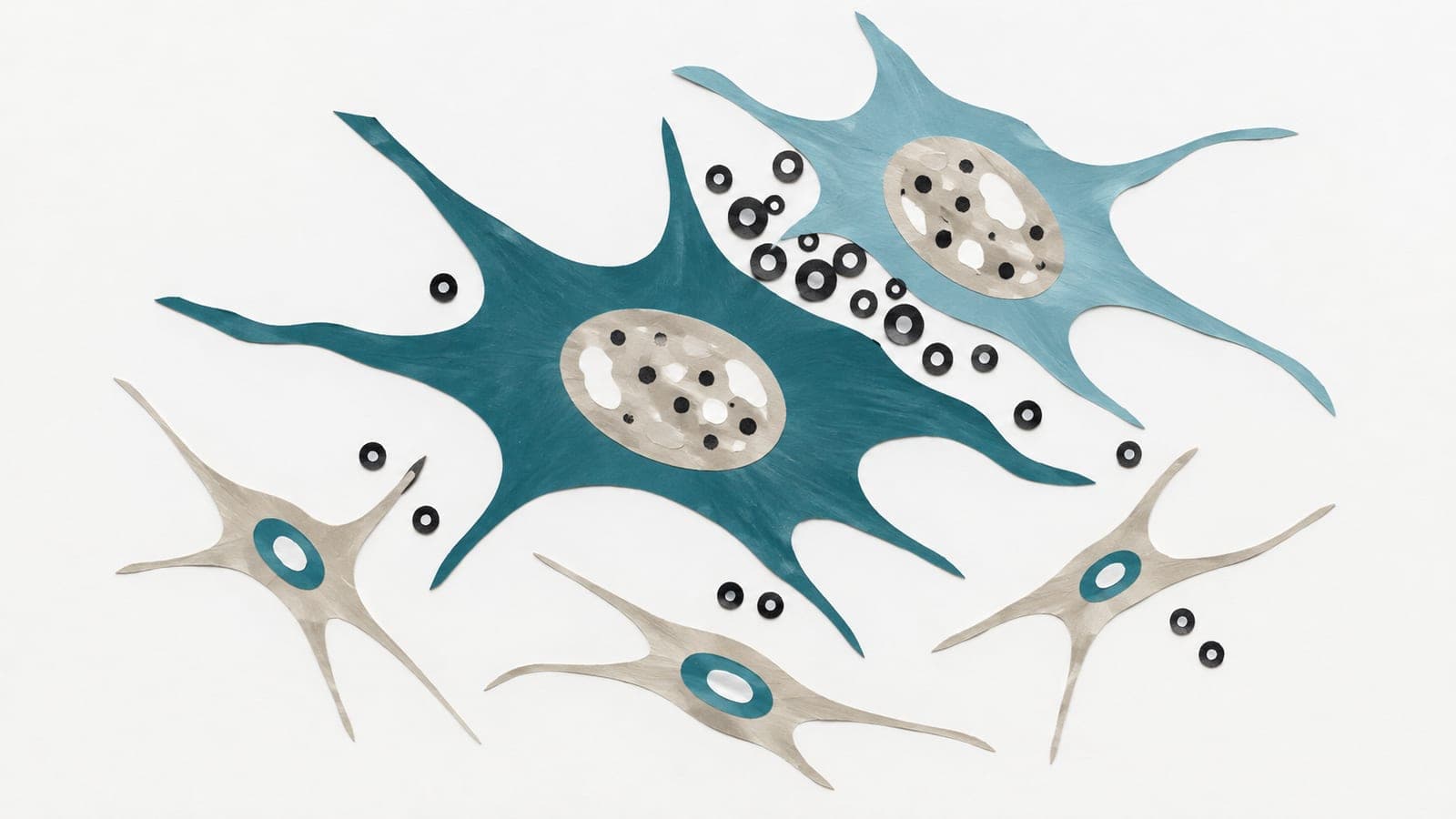
In a laboratory experiment, researchers studied primary cells used to model lymphangioleiomyomatosis, a rare, destructive lung tumor, and lung fibroblasts, cells that make supporting tissue. The disease-model cells were senescent, meaning they had stopped dividing. Fluid collected from them also induced senescence in the fibroblasts.
The compound SB225002 counteracted senescence in both the disease-model cells and fibroblasts exposed to their fluid. It blocked CXCR2, a receptor for interleukin-8, an inflammation-promoting protein. The disease-model cells also released small extracellular vesicles, tiny cell-released packages, that contributed to senescence spreading to fibroblasts. Vesicle samples from the disease-model cells contained more interleukin-8 than samples from fibroblasts.
Why it matters
Substances released by senescent cells may contribute to inflammation and tissue destruction. The authors suggest targeting senescence as a possible drug approach for this rare lung disease.
Caveats
The findings came from cells grown in the lab, not people with the disease. They do not show whether blocking this receptor would benefit patients.
The paper
University of Milan
Biomedicine & Pharmacotherapy, Jun 11, 2026, Open access

Comments
Be the first to comment.