RNA-binding protein extends lifespan in worms
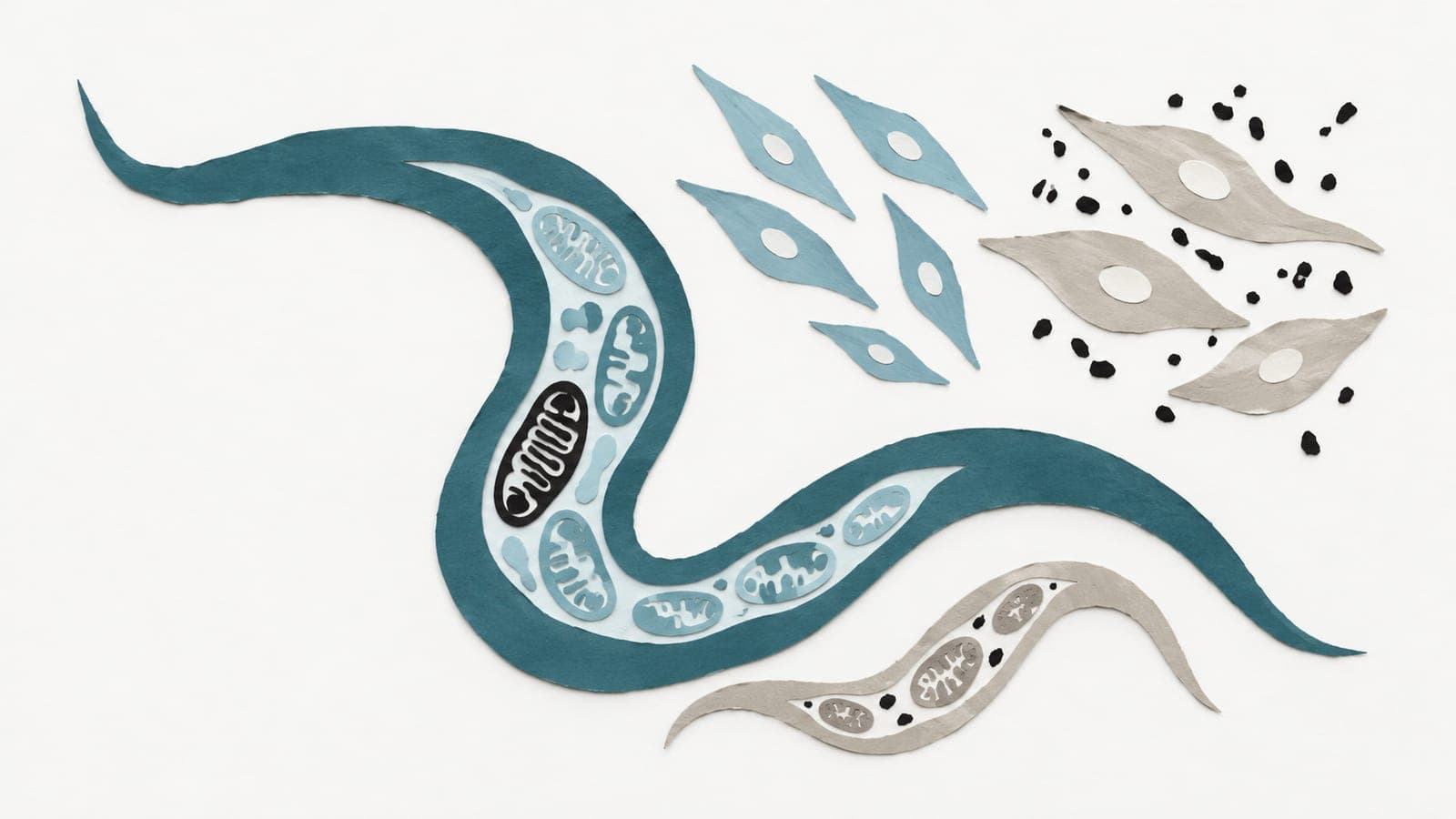
Experiments in worms identified a protein that extended lifespan by reducing double-stranded RNA, molecules that can trigger immune responses.
Our read
Mechanisms- Studied:
- Experiments in Caenorhabditis elegans worms
- What changed:
- FARS-1 extended lifespan in worms
- The catch:
- The abstract gives no size for the lifespan increase
- Why it’s aging research:
- Lifespan, survival or healthspan.
Editor of record: Boris Djordjevic · AgingResearch.News
Experiments in Caenorhabditis elegans worms and human cells grown in the lab examined double-stranded RNA, molecules that can trigger immune responses. Levels rose with aging in worms and with cellular senescence, a state in which cells stop dividing.
The researchers identified FARS-1 in worms and its human counterpart, FARSA, as proteins that bind and reduce double-stranded RNA, particularly RNA from mitochondria, the cell’s energy-producing structures. In worms, FARS-1 was necessary and sufficient to extend lifespan. The proteins worked with an RNA-unwinding protein to reduce double-stranded RNA. This activity was separate from their usual role in helping cells make proteins.
Why it matters
The study addresses how controlling immune-triggering molecules may connect aging with the balance between limiting unwanted immune activity and defending against pathogens.
Caveats
These were experiments in worms and human cells grown in the lab, not studies in people. The abstract does not report how much lifespan changed.
The paper
Korea Advanced Institute of Science and Technology
Molecular Cell, May 25, 2026
Comments
Be the first to comment.