Advanced glycation end-products accumulate preferentially in type I muscle fibers of aging adults but are unchanged by training and polyphenol supplementation
12 weeks, placebo-controlled
Abstract
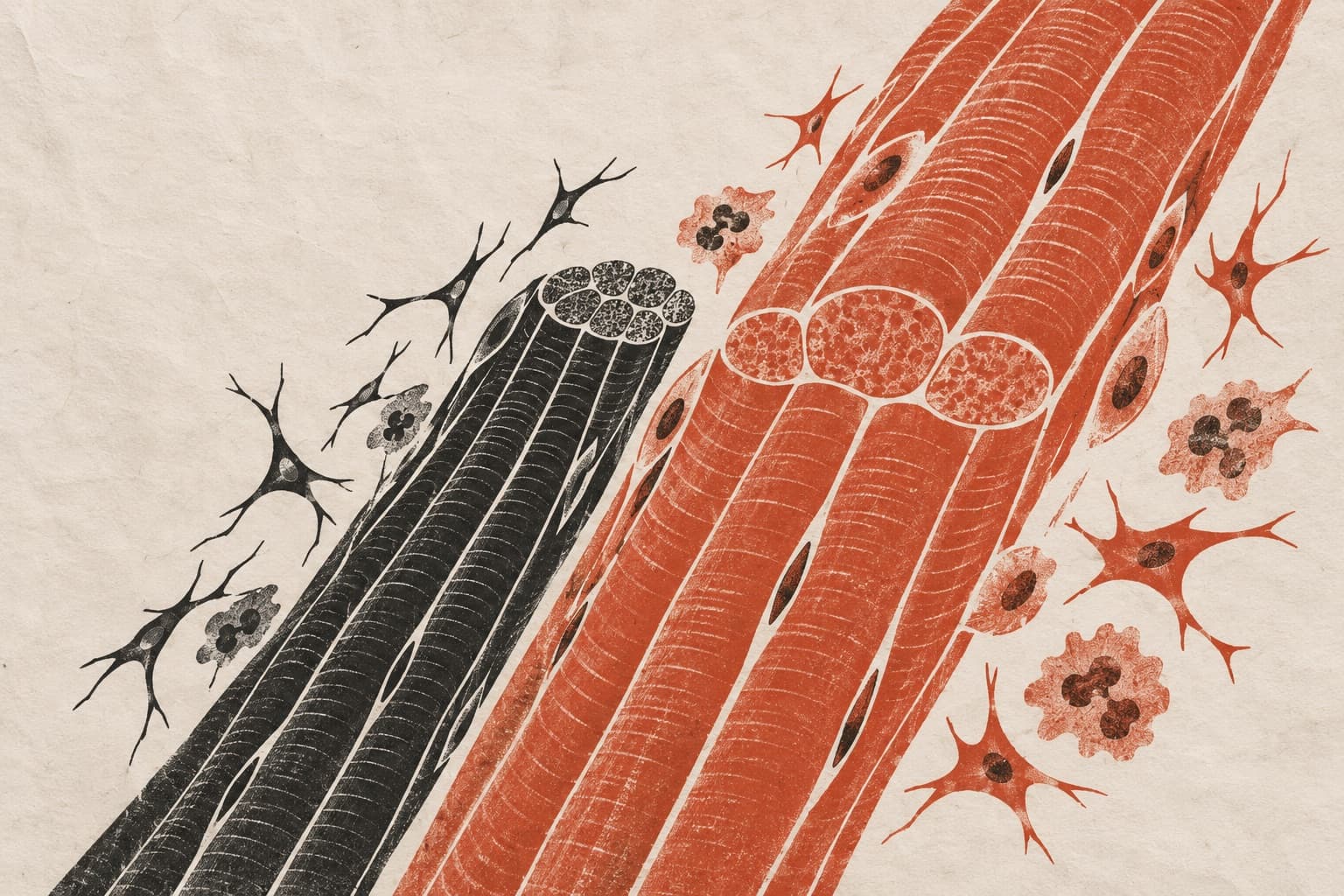
Advanced glycation end-products (AGEs) accumulate with age and may contribute to skeletal muscle decline, yet their distribution within muscle compartments is unknown. Resistance training (RT) and high-intensity interval training (HIIT) improve muscle function, but their effects on muscle AGEs remain unexplored. Polyphenols have antioxidant properties, which could limit AGE formation. This study investigated AGE accumulation in different muscle compartments and whether a 12-wk RT + HIIT intervention, with or without polyphenol supplementation, could modify AGE levels. Forty-one healthy middle-aged and older adults (55-70 yr) were randomized to receive a polyphenol-rich berry extract or placebo for 30 days, followed by 12 wk of supervised RT + HIIT. Vastus lateralis biopsies were collected before and after the intervention and analyzed for subtypes of AGEs using immunofluorescence. AGE immunoreactivity was quantified in type I and type II fibers and in the extracellular matrix (ECM). AGE immunoreactivity was higher in type I than in type II fibers (P < 0.0001) and most pronounced in the ECM (P < 0.05 vs. both fiber types). AGE signals did not differ between sexes and were unrelated to age or plasma IL-6. Neither training nor polyphenol supplementation altered AGE content in fibers or ECM. These findings provide the first evidence of fiber-type-associated localization of AGE immunoreactivity in humans. The absence of change following 12 wk of RT and HIIT, with or without polyphenol, suggests that AGE turnover in skeletal muscle is limited in short-term interventions, highlighting the need for longer strategies to reduce AGE accumulation.NEW & NOTEWORTHY This study is the first to show that advanced glycation end-products (AGEs) may preferentially accumulate in type I muscle fibers and the extracellular matrix of middle-aged and older adults. Twelve weeks of resistance training combined with high-intensity interval training, with or without polyphenol supplementation, did not alter AGE levels. These findings suggest a fiber type-specific susceptibility to glycation and indicate that short-term lifestyle interventions are insufficient to reverse established AGE cross links in human skeletal muscle.
- High-intensity interval training
- Polyphenols
- AGE–RAGE signalling
- Extracellular matrix remodelling
- Advanced glycation end products
- Humans
The paper
University of Copenhagen
Journal of Applied Physiology, 9 Mar 2026