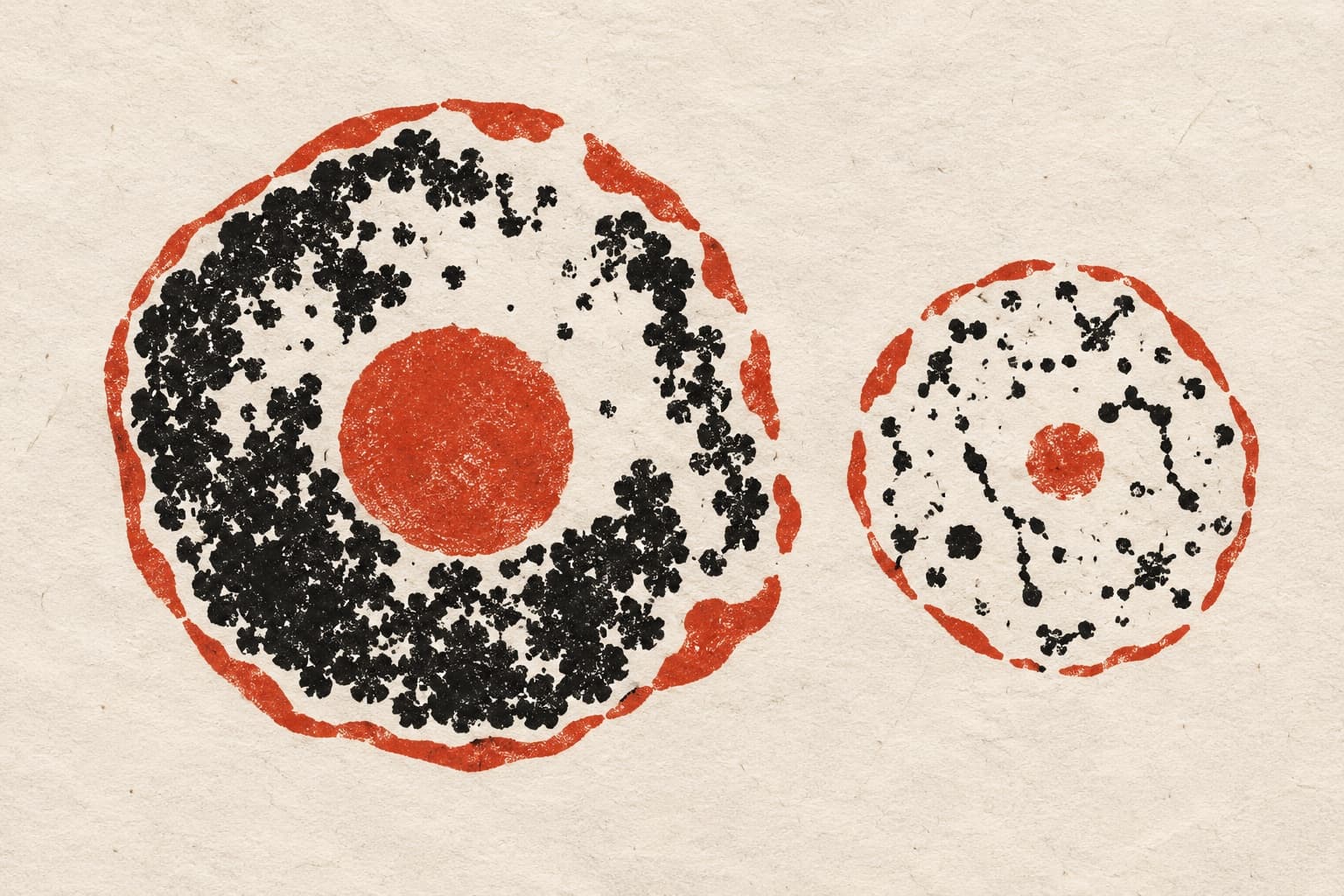
Chromatin Geometry Collapse as the Primary Driver of Aging and Disease
Abstract
Aging biology has made substantial progress in characterizing molecular damage, epigenetic change, and transcriptional dysregulation, yet remains unable to explain several persistent paradoxes: why resilience fails before overt dysfunction, why recovery trajectories degrade before baseline measures shift, and why partial reprogramming can restore youthful signatures without repairing all accumulated damage. These limitations suggest that aging cannot be fully understood at the level of molecular information or regulatory activity alone. Here, we propose that biological aging reflects the progressive loss of epigenetic observability: the capacity of a biological system to reconstruct, stabilize, and recover its regulatory state. We argue that observability arises from higher-order chromatin geometry, which constitutes a third organizational layer beyond sequence (information) and gene regulation (activity). This geometric layer renders biological information meaningful by constraining which future states are viable and recoverable. In this framework, aging is not simply the accumulation of damage or noise, but the gradual loss of biological meaning—defined as the weakening of structural constraints that keep healthy futures reachable. We synthesize evidence from chromatin architecture, reprogramming biology, nuclear organization, and fragmentomics to support a geometry-first model of aging. We further show that epigenetic clocks and other state-based metrics, while correlated with age, are insufficient to assess recoverability or true biological resilience, as they do not capture higher-order constraint geometry. Cell-free DNA (cfDNA) fragment patterns provide a systemic, though lossy, readout of chromatin organization and thus of biological meaning collapse across tissues. Finally, we argue that reading biological meaning requires models capable of learning non-random structure, long-range dependencies, and contextual constraints from fragment-level data. Drawing on advances in artificial intelligence, we propose geometry-aware transformer architectures as appropriate readers of epigenetic observability. In this view, AI is not an auxiliary analytic tool but a necessary instrument for interpreting the organizational layer that makes biological information functional. This framework unifies aging, reprogramming, and resilience under a common principle and motivates new approaches to measuring and intervening in biological aging. Keywords: Chromatin geometry; biological aging; epigenetic observability; biological meaning; partial reprogramming; cell-free DNA
- Deep learning
- Modelling and theory
- Chromatin
- Chromatin and 3D genome organisation
- Cell-free DNA fragment patterns
- Epigenetic clock
The paper
Zenodo, Mar 6, 2026, Open access, CC BY, Preprint, not peer-reviewed