Ramelteon reduced nerve-cell loss in a mouse Parkinson’s model
Experiments in mice with a chemically induced model of Parkinson’s disease found that the drug also improved movement problems.
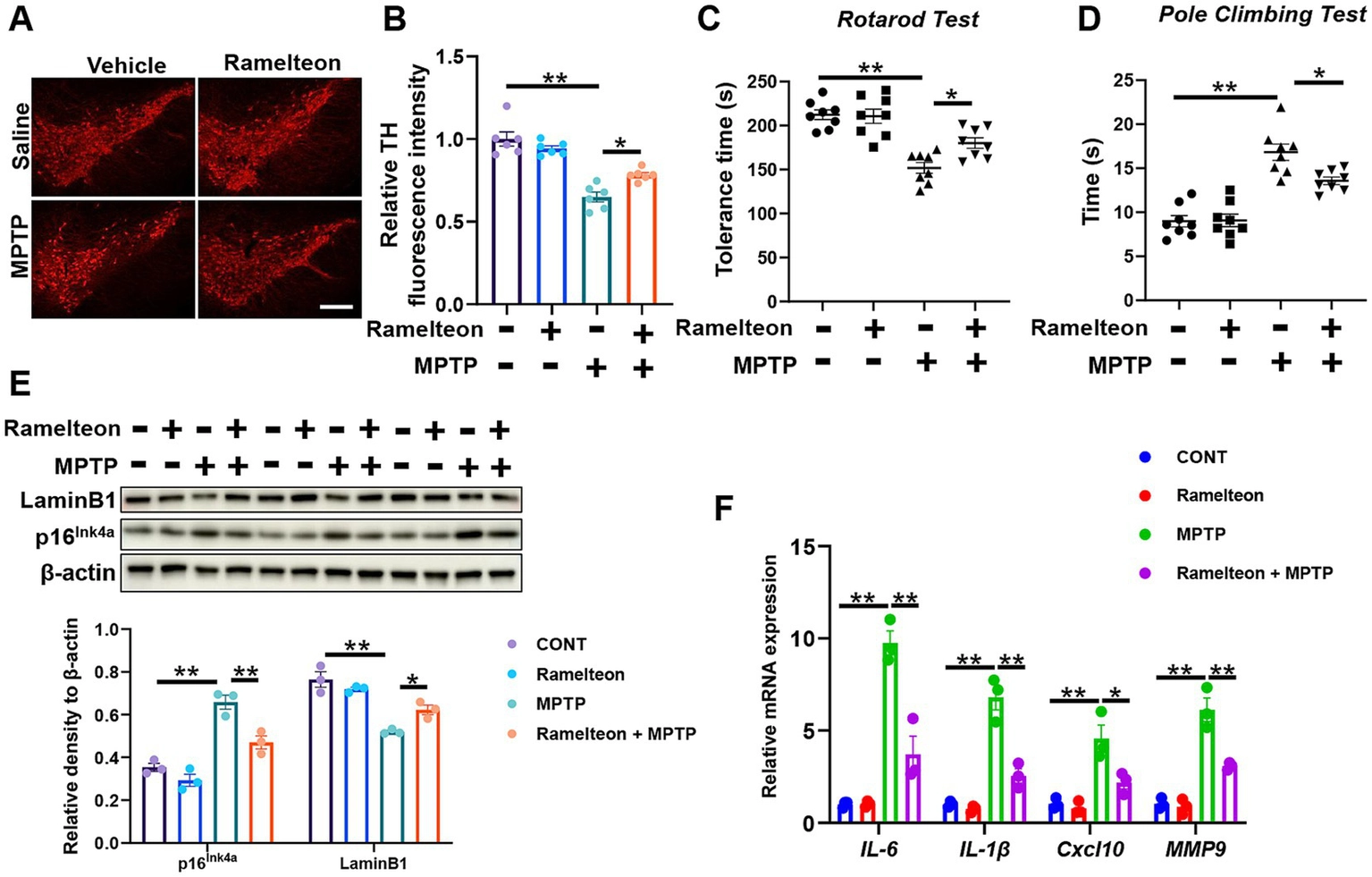
Limit: Only 6 mice per group were assessed for nerve-cell loss
Edited by Boris Djordjevic · AgingResearch.News
In an experiment in mice with a chemically induced model of Parkinson’s disease, ramelteon reduced the loss of dopamine-producing nerve cells and improved movement problems. The researchers also tested ramelteon in astrocytes, cells that support nerve cells, grown in the lab.
Growing these cells for 40 days or exposing them to a chemical induced senescence, a state in which cells stop dividing. Ramelteon reduced signs of senescence in both models. Reducing production of MT1, a melatonin receptor, largely abolished these effects. Experiments linked the effects to lower levels of cyclic adenosine monophosphate, a chemical messenger inside cells. Ramelteon also reduced production of reactive oxygen molecules in mitochondria, the cells’ energy-producing structures.
Why it matters
Cell senescence may contribute to Parkinson’s disease. The authors identified ramelteon as a potential drug candidate for targeting this process.
Caveats
These experiments in mice and cells grown in the lab do not establish whether ramelteon would benefit people with Parkinson’s disease.
From the paper
- Animals
A total of 40 neonatal mice were used.
- Limitation
The molecular analyses relied on a small sample size and only male mice, which may limit generalizability.
Quoted word for word from the full text on frontiersin.org.
The paper
Ramelteon suppresses astrocytic senescence via MT1-cAMP axis to protect dopaminergic neurons
Soochow University
Frontiers in Aging Neuroscience, Oct 26, 2026, Open access, CC BY


