Osteosarcopenic obesity across adiposity definitions: prevalence and functional vulnerability in community-dwelling Chinese older adults
Abstract
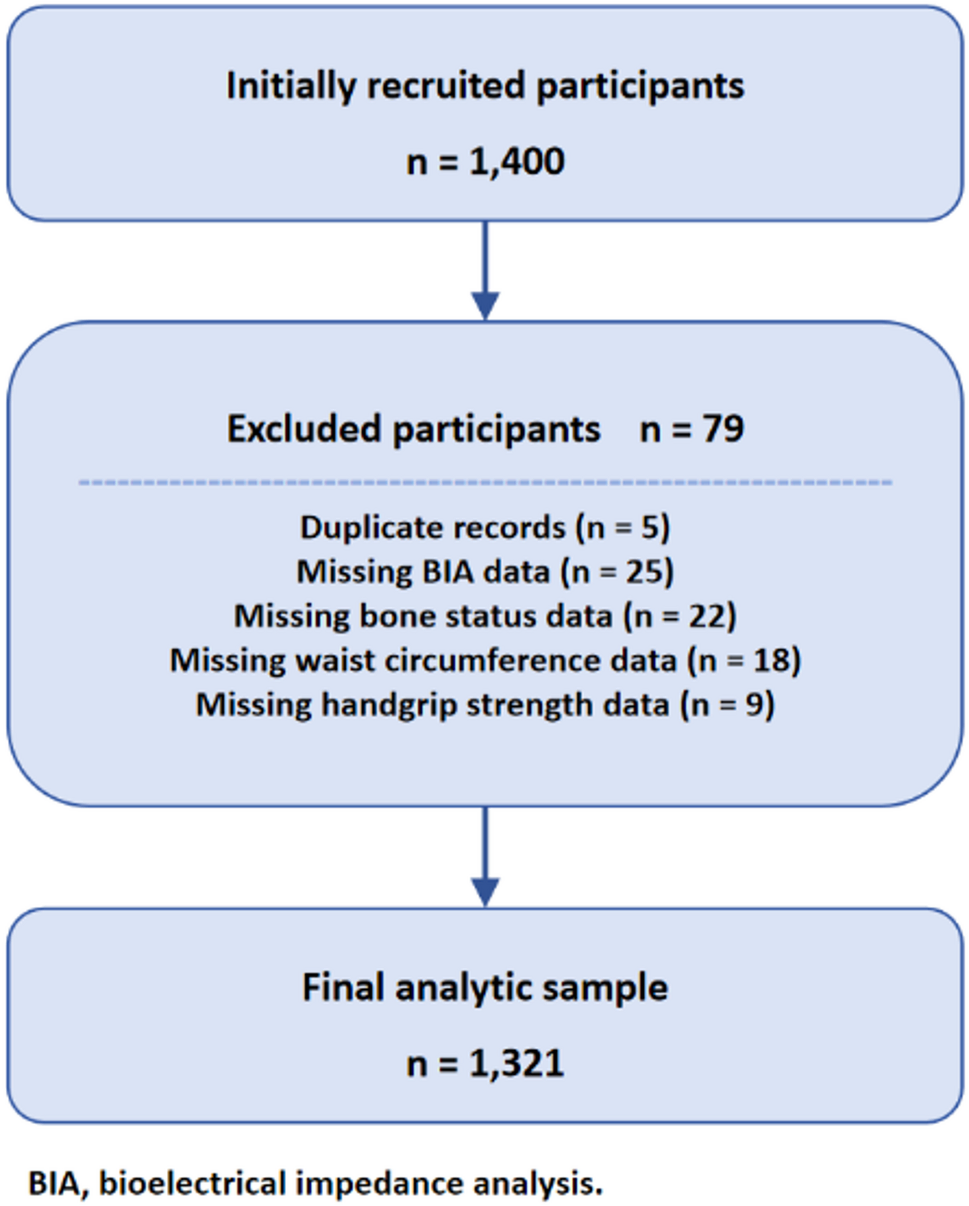
Osteosarcopenic obesity (OSO), defined by the coexistence of low bone mass, sarcopenia, and obesity, lacks standardized diagnostic criteria, particularly for obesity. This study examined how different obesity definitions affect OSO classification and associated functional and behavioral characteristics among community-dwelling older adults. This cross-sectional study included community-dwelling adults aged ≥ 65 years. Obesity was defined using percentage body fat (PBF), waist-to-hip ratio (WHR), waist-to-height ratio (WHtR), visceral fat area (VFA), and waist circumference (WC). Sarcopenia was defined according to the Asian Working Group for Sarcopenia (AWGS) 2025 consensus, and low bone mass as a calcaneal quantitative ultrasound-derived T-score < − 1.0. We assessed OSO prevalence, pairwise agreement (Cohen’s κ), and overlap across obesity definitions.We also compared functional and behavioral characteristics between each definition-specific OSO group and a common control group comprising participants who were not classified as having OSO under any of the five obesity definitions. Multivariable linear regression was used to examine associations between the number of obesity definitions under which participants were classified as having OSO (0–5) and these outcomes. Among 1,321 participants, OSO prevalence varied across obesity definitions, ranging from 1.36% for WC-defined OSO to 4.09% for PBF-defined OSO, with variable pairwise agreement (κ = 0.33–0.77). Across definitions, participants with OSO generally had slower gait speed, lower Short Physical Performance Battery (SPPB) scores, longer chair-stand times, and lower physical activity than those without OSO. In multivariable analyses, each additional fulfilled OSO definition was associated with slower gait speed (β = −0.049 m/s, 95% CI: −0.072 to − 0.026; P < 0.001), lower SPPB scores (β = −0.208, 95% CI: −0.354 to − 0.062; P = 0.005), longer chair-stand time (β = 0.912 s, 95% CI: 0.122 to 1.701; P = 0.024), and lower physical activity (β = −255.399 MET-min/week, 95% CI: −392.876 to − 117.923; P < 0.001). OSO prevalence and classification varied across obesity definitions, whereas poorer functional performance and lower physical activity were generally observed among participants identified with OSO. Fulfilling a greater number of OSO definitions was associated with greater functional vulnerability. These findings suggest that functional characteristics may provide complementary information despite variation in adiposity-based classification. Keywords: Osteosarcopenic obesity; sarcopenia; low bone mass; obesity definitions; physical function; community-dwelling older adults.
- Osteosarcopenic obesity
- Obesity
- Low bone mass
- Sarcopenia
- Calcaneal quantitative ultrasound T-score
- Humans
The paper
Capital Medical University
BMC Geriatrics, 13 Oct 2026, Open access, CC BY-NC-ND