Specific macronutrient clusters associated with biological aging
Abstract
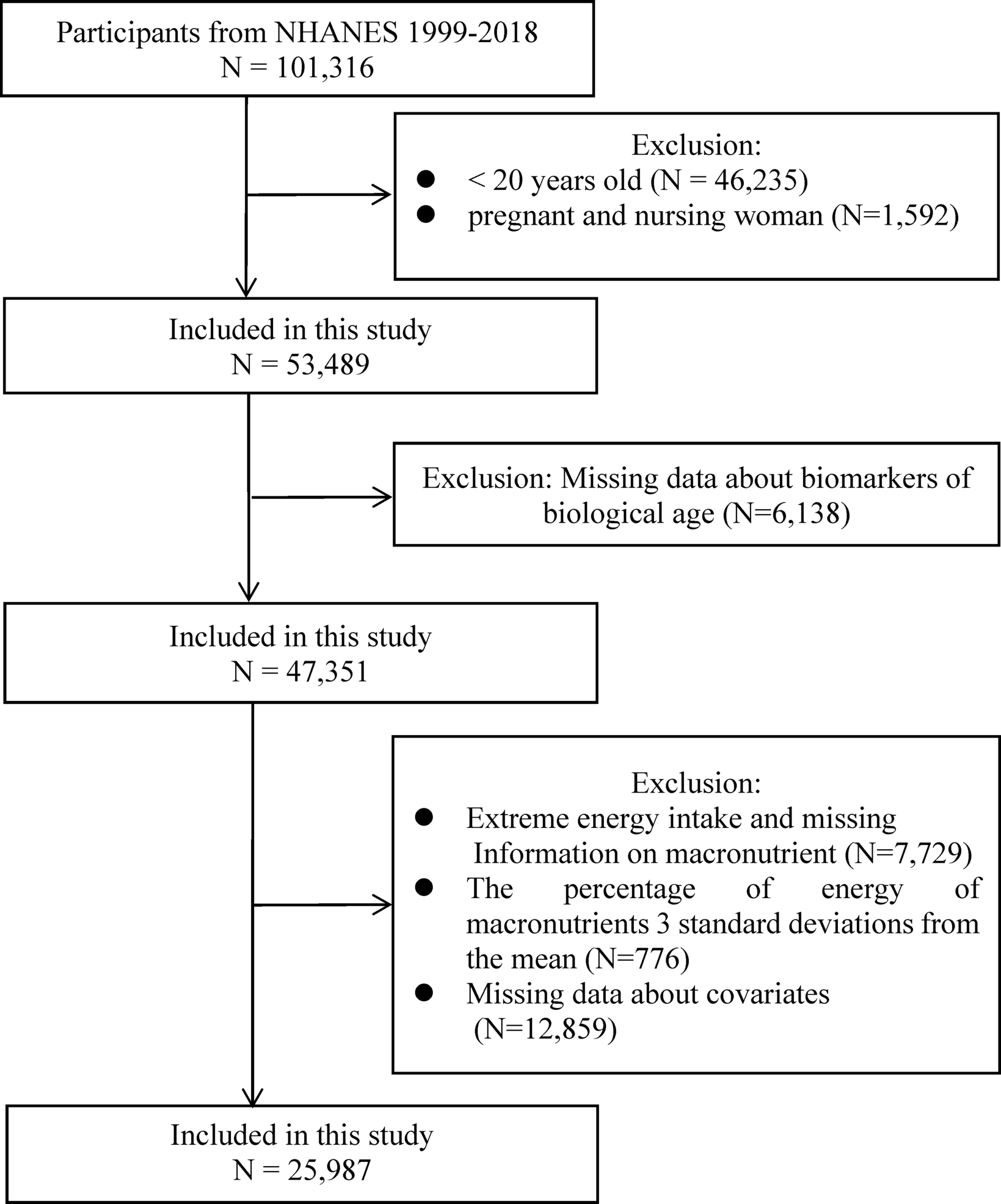
Nutrition is a key modifiable factor influencing aging, yet most studies focus on isolated nutrients or predefined dietary patterns, leaving the relationship between naturally occurring macronutrient clusters and biological aging poorly understood. This study aimed to identify naturally occurring macronutrient intake clusters using a novel three-dimensional approach and examine their associations with biological aging in U.S. adults. Data from 25,987 adults in the National Health and Nutrition Examination Survey (NHANES) were analyzed. Biological age was estimated using the Klemera-Doubal method (KDM-BA). Biological age acceleration (AA) was computed as the difference between biological age and chronological age. Dietary intake was assessed using 24-hour recalls. Participants were classified into macronutrient clusters based on energy percentages from protein, fat, and carbohydrates using percentile-based cutoffs. Multivariable weighted logistic regression models were used to evaluate associations between macronutrient clusters and AA, with stratification by energy intake, sex, and age. Compared to the reference cluster (Pm: Fm: Cmh—moderate protein, moderate fat, moderate-high carbohydrate), the Pm: Fm: Cm cluster (moderate protein, moderate fat, moderate carbohydrate) (OR: 1.21, 95% CI: 1.06–1.38) and the Pm: Fmh: Cml cluster (moderate protein, moderate-high fat, moderate-low carbohydrate) (OR: 1.25, 95% CI: 1.03–1.50) showed suggestive positive associations with AA. However, after adjusting for multiple comparisons using the Benjamini-Hochberg False Discovery Rate (FDR) method, neither cluster reached the prespecified level of statistical significance (FDR q = 0.063 and 0.086, respectively). These associations were more pronounced in females and middle-aged adults (40–60 years). In restricted cubic spline analyses, a U-shaped relationship was observed for carbohydrate intake within Cluster Pl: Fm: Cml: AA risk decreased as carbohydrate intake increased from low to moderate levels, then increased with further higher carbohydrate intake ( P overall = 0.031; P non-linear = 0.050). Exploratory subgroup analyses suggested potential effect modification by demographic factors, but these findings should be interpreted with caution due to limited statistical power. Specific, naturally occurring macronutrient clusters showed suggestive associations with AA, with potential effect heterogeneity by energy intake, sex, and age. Our findings underscore the importance of moving beyond isolated nutrients toward a holistic dietary pattern approach and suggest preliminary avenues for personalized nutritional interventions. These associations warrant validation in future prospective studies.
- Carbohydrate intake
- Moderate-protein, moderate-fat, moderate-carbohydrate dietary cluster
- Moderate-protein, moderate-high-fat, moderate-low-carbohydrate dietary cluster
- Biological-age acceleration
- Klemera-Doubal biological age
- Humans
The paper
Third Affiliated Hospital of Zhengzhou University
Scientific Reports, 13 Oct 2026, Open access, CC BY-NC-ND