Associations of planned pre-iftar walking and Ramadan step count with cardiometabolic changes among Palestinian university students
Abstract
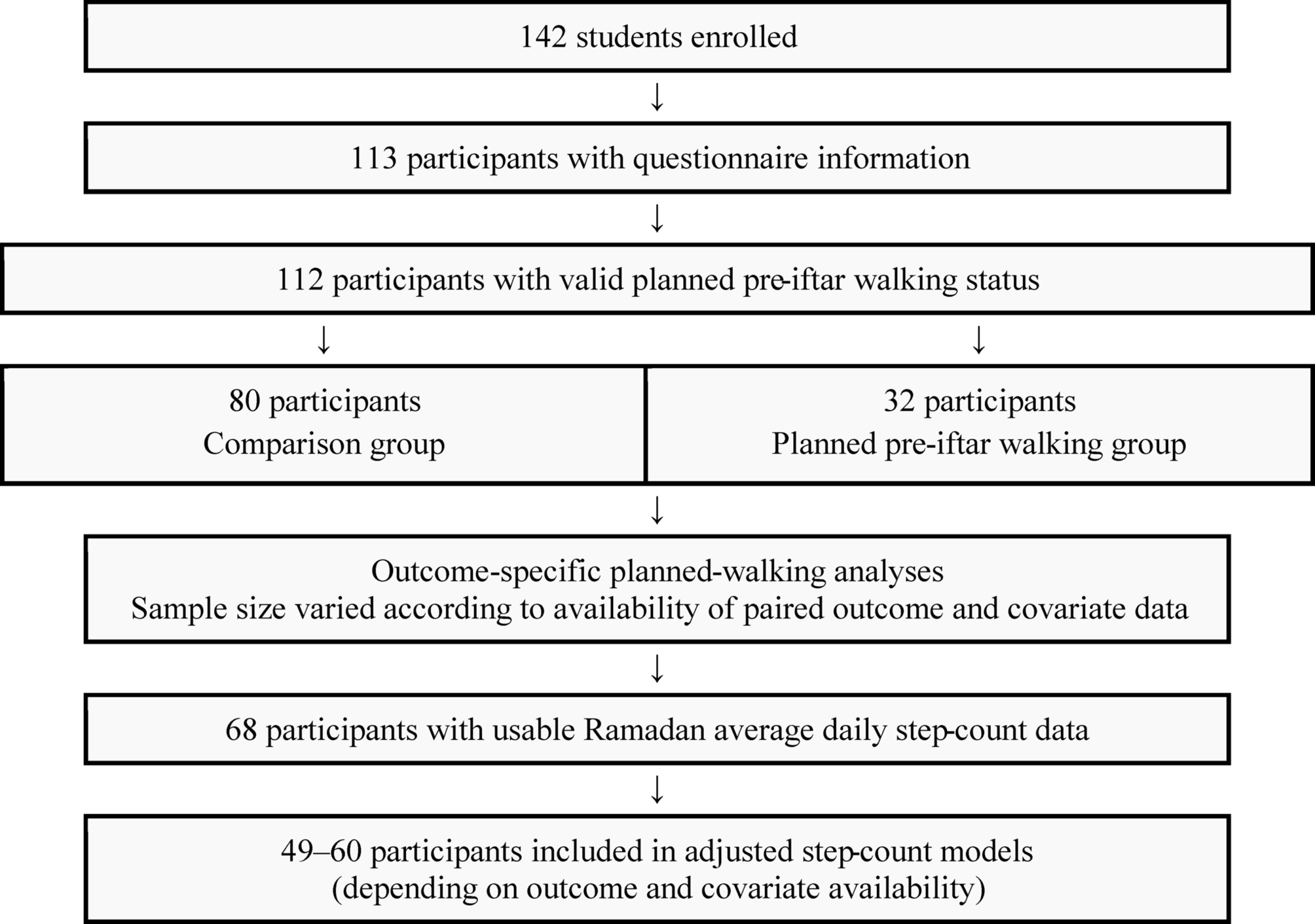
Ramadan fasting is accompanied by changes in eating patterns, sleep, hydration, and physical activity. Walking may be a practical health-promoting behavior during Ramadan, but its association with cardiometabolic changes among young adults remains insufficiently studied. This study examined whether planned pre-iftar walking and mobile-app-recorded daily step count during Ramadan were associated with cardiometabolic changes among apparently healthy Palestinian university students. A quantitative observational pretest, posttest study was conducted among university students in Palestine during Ramadan 2022. Cardiometabolic indicators were measured before Ramadan and at the end of Ramadan. Walking was assessed using two distinct exposure measures: planned walking for approximately 1 h before iftar on 4–7 days per week and mobile-app-recorded average daily step count during Ramadan. Outcomes included changes in weight, BMI, waist circumference, blood pressure, heart rate, fasting glucose, C-reactive protein, triglycerides, HDL-C, HbA1c, and sleep duration. Unadjusted group comparisons, Spearman correlations, baseline-adjusted linear regression models, and false discovery rate correction for multiple testing were performed. Planned pre-iftar walking status was available for 112 participants, including 80 in the comparison group and 32 in the planned-walking group. The planned-walking group showed greater unadjusted reductions in weight (− 1.46 ± 1.59 vs. − 0.53 ± 2.01 kg, p = 0.024) and BMI (− 0.56 ± 0.61 vs. − 0.19 ± 0.76 kg/m², p = 0.018), but neither difference remained significant after false discovery rate correction (both q = 0.153). In baseline-adjusted models, planned walking was not significantly associated with post-Ramadan weight (B = − 0.82 kg, 95% CI − 1.69 to 0.05; p = 0.064) or BMI (B = − 0.33 kg/m², 95% CI − 0.67 to 0.02; p = 0.063), and no significant association was observed for triglycerides or the other assessed cardiometabolic outcomes. Among 68 participants with interpretable Ramadan daily step-count data, step count was not significantly associated with cardiometabolic change scores in Spearman or adjusted regression analyses. Planned pre-iftar walking was associated with nominally greater reductions in weight and BMI in unadjusted analyses, but these associations were not robust after adjustment for multiple testing and baseline characteristics. Ramadan daily step count was not independently associated with the assessed cardiometabolic changes. These findings provide exploratory real-world evidence on physical activity during Ramadan and support the need for larger prospective or randomized studies using standardized activity measurement and verified adherence before specific pre-iftar walking recommendations can be made.
The paper
An-Najah National University; Menoufia University
Scientific Reports, 12 Oct 2026, Open access, CC BY-NC-ND