Protein changes during mouse brain aging vary by region
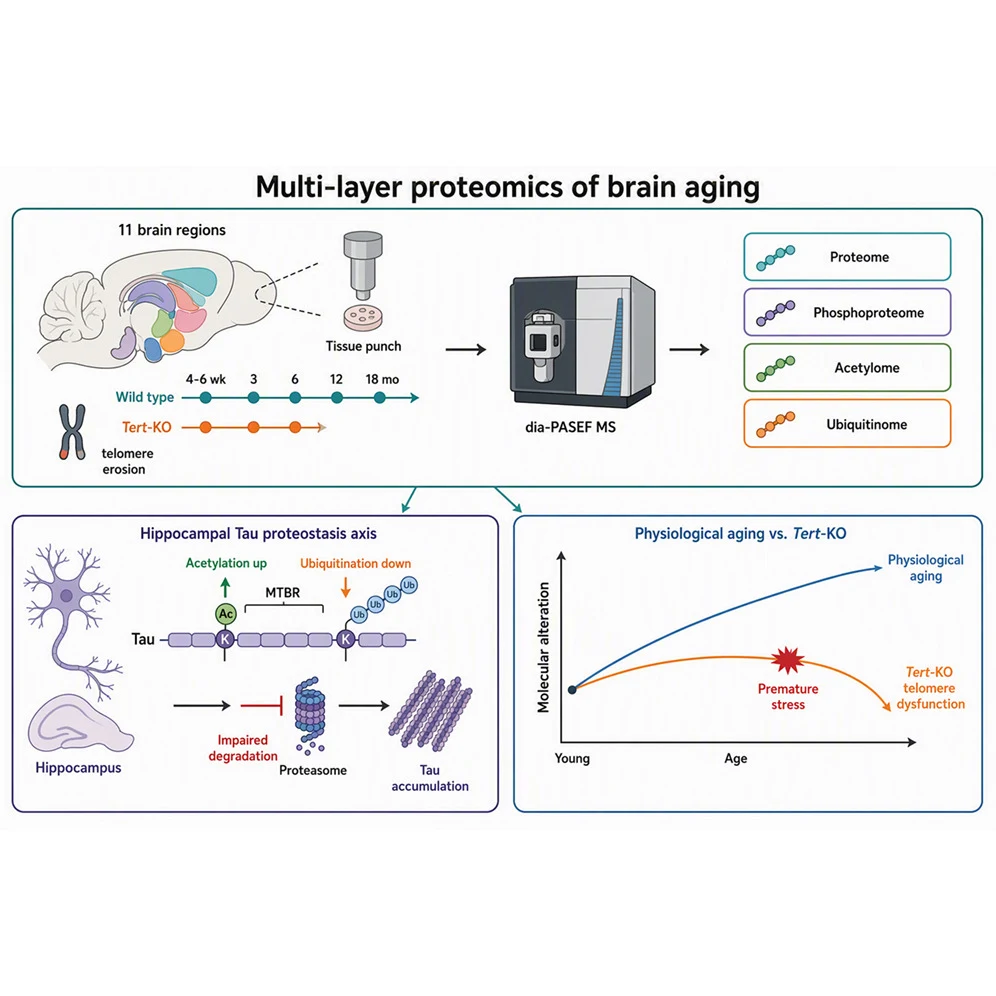
Mapping 11 brain regions across five time points revealed changes to Tau’s molecular tags that might impair its breakdown in the hippocampus.
Our read
AI & data- Studied:
- Experiments in mice of different ages
- What changed:
- Protein amounts and molecular tags changed differently with age across brain regions
- The catch:
- Tau breakdown was inferred from molecular tags, not measured directly
- Why it’s aging research:
- Change across ages, or exceptional longevity.
Editor of record: Boris Djordjevic · AgingResearch.News
Mouse brains from 11 anatomical regions and five time points, spanning young adulthood to old age, underwent protein profiling in an animal experiment. Researchers measured protein amounts and three kinds of molecular tags that can alter protein behavior. Aging patterns varied strongly by region at both levels.
In the hippocampus, a region involved in memory, two kinds of tags changed on Tau, a protein that supports nerve cells’ internal structure. Tau had fewer ubiquitin tags, which can mark proteins for disposal, and more acetyl tags. The authors suggested these changes might impair Tau breakdown. Mice deficient in telomerase, an enzyme that maintains chromosome ends, showed protein-maintenance and stress-response patterns distinct from normal brain aging.
Why it matters
The atlas offers a resource for investigating how protein maintenance relates to different brain regions’ vulnerability during aging.
Caveats
The proposed impairment of Tau breakdown remains tentative. The findings concern molecular changes in mouse brains, not outcomes in people.
The paper
Molecular & Cellular Proteomics, Nov 2026, CC BY-NC-ND

Comments
Be the first to comment.