Protein tests offer complementary views of human plasma
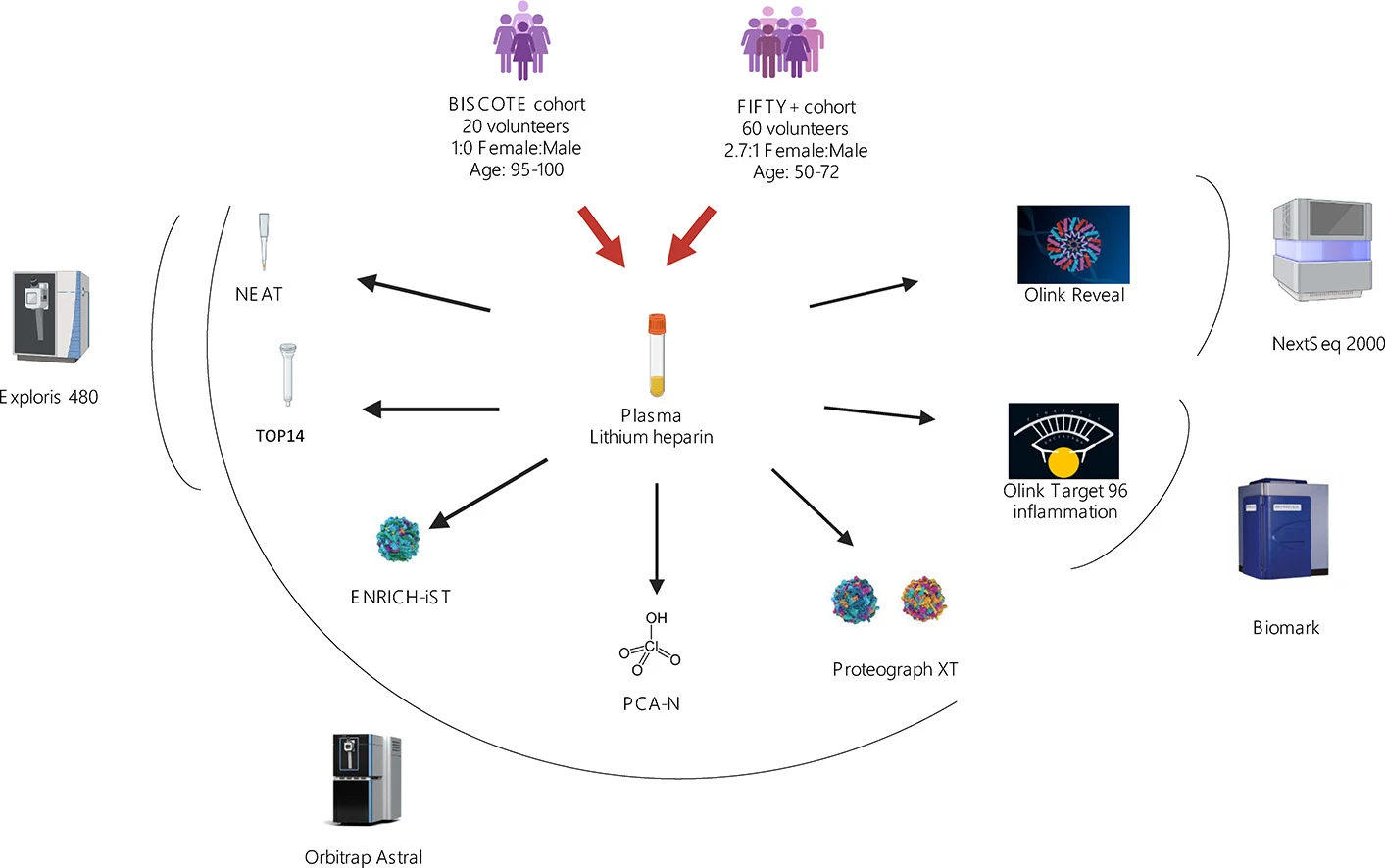
Protein coverage ranged from 1,159 to 6,003 protein groups across mass-spectrometry workflows tested on 80 human plasma samples.
Our read
AI & data- Studied:
- Study of 80 human plasma samples
- What changed:
- Proteome coverage ranged from 1159 to 6003 protein groups, and no single workflow provided exhaustive plasma proteome coverage
- The catch:
- The study evaluated measurement methods without recording clinical outcomes
- Why it’s aging research:
- A tool or dataset for aging research.
Editor of record: Boris Djordjevic · AgingResearch.News
Researchers compared seven protein-measuring workflows using 80 human plasma samples from two clinical cohorts in an observational benchmarking study. Five used mass spectrometry, which analyzes molecules by mass and electrical charge. Two used affinity-based assays, which use molecules that bind to specific proteins.
Both affinity assays measured their complete target panels, capturing proteins present at low levels that mass spectrometry partly missed. Although the methods measured relatively few proteins in common, they broadly agreed on the direction of differences in protein levels. One mass-spectrometry workflow and one affinity assay uniquely recovered certain aging-related patterns, including ones involving immune regulation. No workflow covered the full set of plasma proteins. The authors recommended considering a combination of mass spectrometry and affinity-based assays for broader coverage.
Why it matters
The search for blood markers of aging depends in part on which proteins researchers can measure. This comparison addresses how measurement choices shape the biological signals available for that research.
Caveats
This observational comparison assessed measurement methods, not clinical outcomes. The abstract does not report participants’ ages or health conditions, which limits interpretation of the aging-related patterns.
The paper
Bioaster; Lesaffre (France)
Journal of Proteomics, Sep 19, 2026, Open access

Comments
Be the first to comment.