Drug-filled particles reduced liver fat buildup in mice
An experiment tested navitoclax in mice with diet-induced liver disease; the packaged drug also reduced a disease activity score and scarring-related profiles.
Dose-response
Edited by Boris Djordjevic · AgingResearch.News
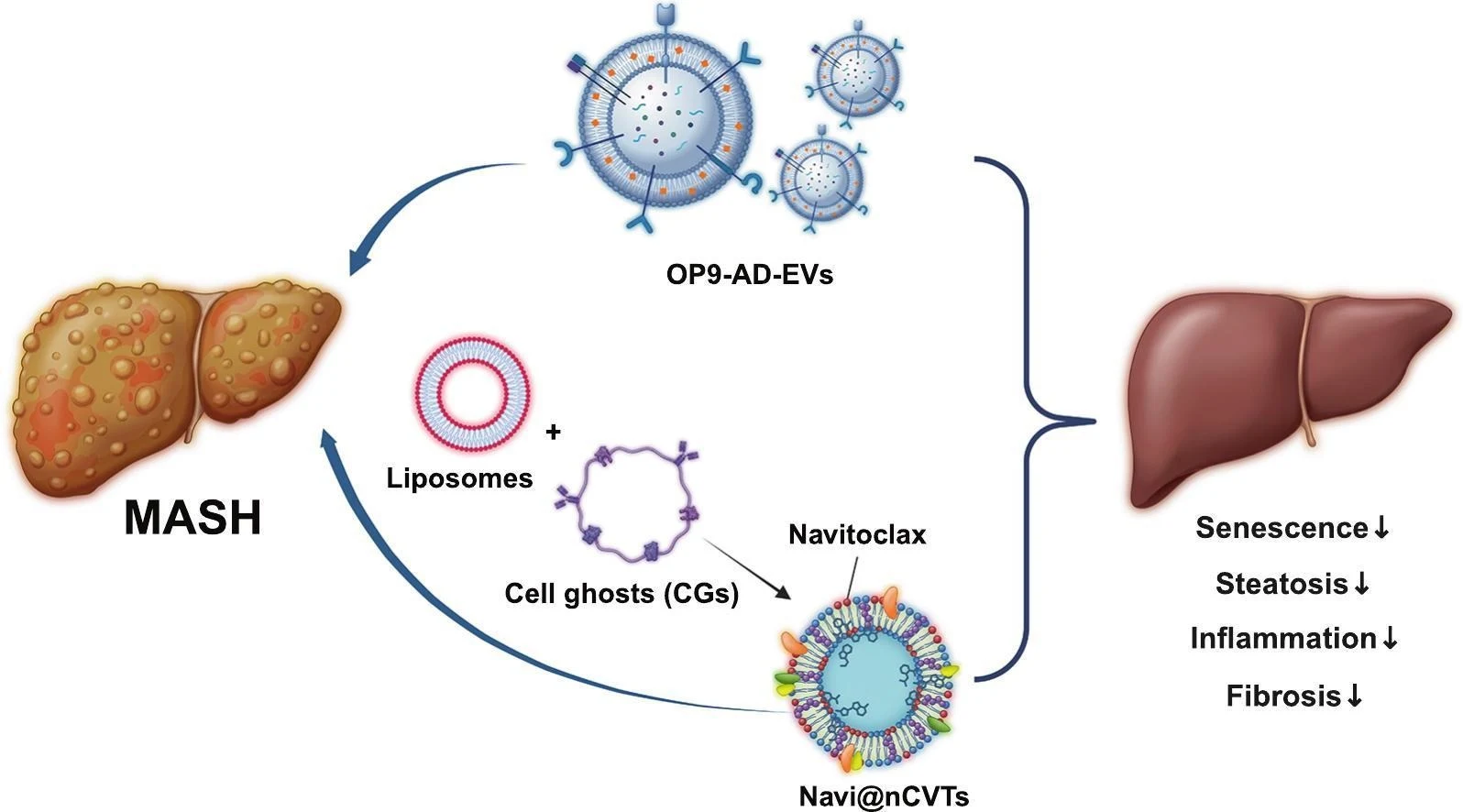
In mice with metabolic dysfunction–associated steatohepatitis (MASH), a chronic liver disease, researchers tested navitoclax in an animal experiment. A Western diet and fructose induced the disease. Navitoclax is a senolytic, a drug that selectively eliminates senescent cells—cells that have stopped dividing. The researchers packaged it in tiny carriers combining cell-derived membranes with synthetic lipids, or fat-like molecules.
The drug-loaded carriers reduced liver fat accumulation, a tissue-based disease activity score and scarring-related profiles. Neither navitoclax formulation reduced platelet counts or hemoglobin concentrations at the tested dose. Platelets help blood clot; hemoglobin carries oxygen in red blood cells.
Why it matters
Cellular senescence may contribute to fat buildup, inflammation and scarring in MASH. The authors interpret their findings as support for targeting this process in the disease.
Caveats
These mouse experiments do not establish benefit or safety in people. The abstract does not report the number of mice, drug dose or treatment duration.
Where the evidence stands
Navitoclax
- 82 independent labs in 20 countries
- 4 findings against
- 28 trials, 10 with no results posted
- Funders: National Institutes of Health and others
- 37 of 274 findings with company ties
- 17 of 28 trials sponsored by its developers
- Navitoclax
- Adipocyte-derived extracellular vesicles
- Cellular senescence
- Extracellular matrix remodeling
- Metabolic dysfunction-associated steatohepatitis
- Mice
The paper
Journal of Controlled Release, Nov 2026, CC BY-NC
Comments
Be the first to comment.