Eye-image model predicts artery stiffness in adults with diabetes
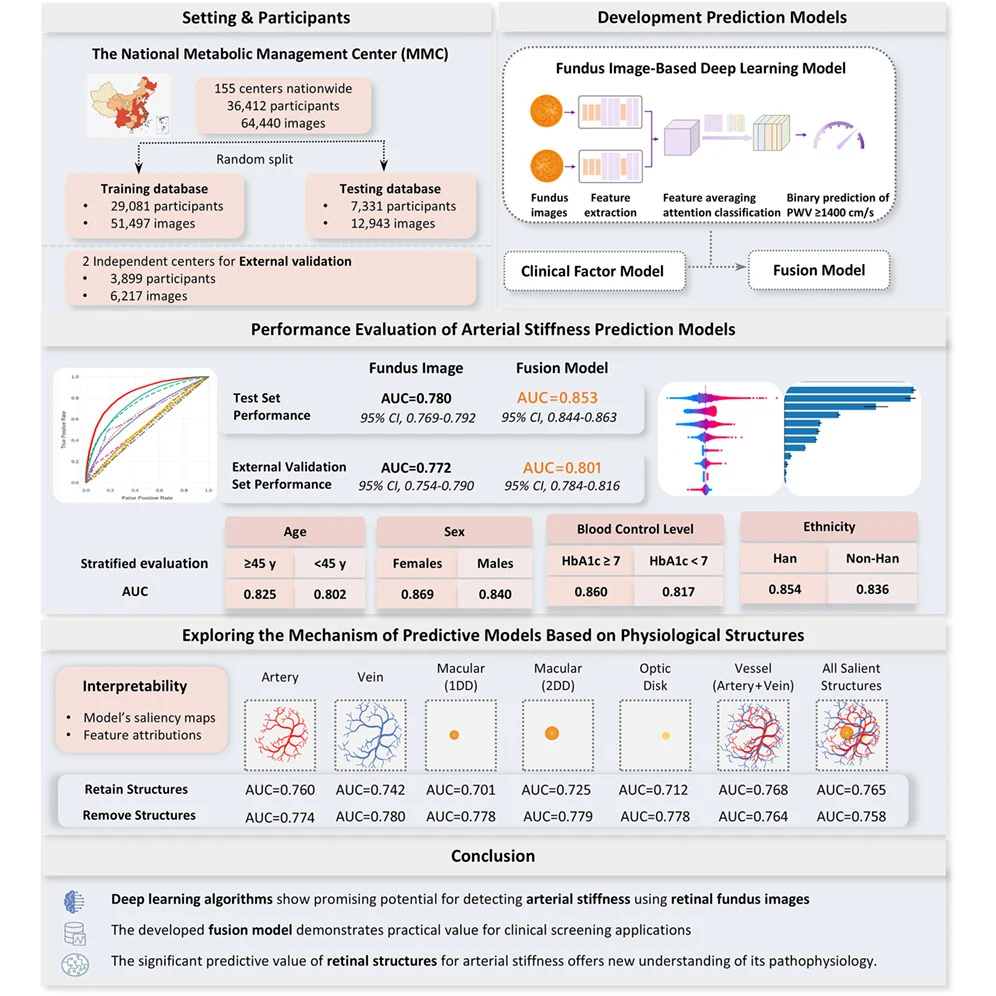
The model’s ability to distinguish people with and without arterial stiffness scored 0.780 in internal validation and 0.772 in checks at independent hospitals.
Limit: Screening's effects on health outcomes were not measured
Edited by Boris Djordjevic · AgingResearch.News
In an observational study, researchers trained an artificial intelligence model on 64,440 images of the back of the eye from 36,412 adults with diabetes at China’s National Metabolic Management Centers. They tested it externally using 6,217 images from two independent hospitals.
The model predicted arterial stiffness, meaning how rigid arteries are. Its area under the curve—a measure of how well it distinguished people with and without stiffness—was 0.780 in internal validation and 0.772 in external validation. It outperformed models based on conventional risk factors alone. Combining images with clinical factors raised this measure to 0.853 in the test set and 0.801 in external validation.
Why it matters
Arterial stiffness is relevant to vascular aging. The authors suggest that eye-image analysis could support more accessible screening, since the standard assessment is costly and not widely accessible.
Caveats
This observational model-development study assessed prediction, not whether screening improved health outcomes. The model was trained in adults with diabetes; the abstract does not establish its performance in people without diabetes.
Comments
Be the first to comment.