Air quality targets could reduce deaths across 136 countries
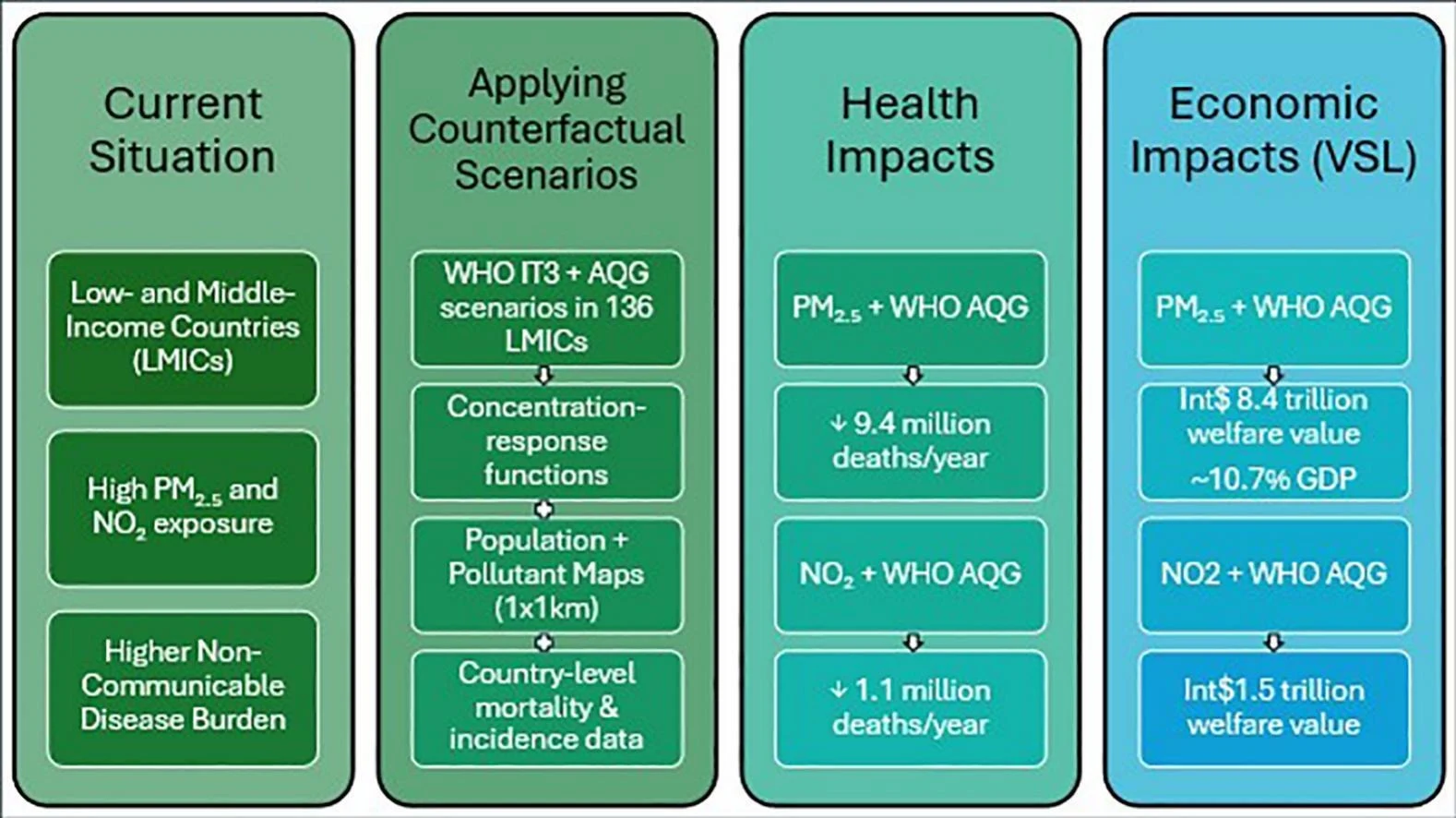
Meeting World Health Organization fine-particle guidelines could postpone 9.43 million deaths in one year, a modeled 22.97% reduction from the current mortality burden.
Our read
Populations- Studied:
- Computational study of people in low- and middle-income countries, one year
- What changed:
- Annual deaths were projected to fall 22.97% under fine-particle guidelines compared with current conditions
- The catch:
- Uncertainty ranges cover only exposure–risk relationships and likely understate total uncertainty
- In the record:
- The 515th paper on fine particulate matter with results in people; 715 on record in all.
Editor of record: Boris Djordjevic · AgingResearch.News
Populations in 136 low- and middle-income countries were the focus of a computational health-impact model using pollution maps, population data and 2021 country-level death and disease rates. Researchers applied published relationships between pollution exposure and health risks to project changes under World Health Organization air-quality targets.
Meeting the fine-particle guideline of 5 micrograms per cubic meter was projected to postpone 9.43 million deaths over one year. The researchers valued that reduction in mortality risk at 8.4 trillion international dollars, adjusted for purchasing power in 2021—not cash savings. Under the same scenario, the model also projected 1.10 million fewer new dementia cases annually.
Why it matters
For age-related diseases such as dementia, heart disease and stroke, the analysis addressed how much disease burden might be avoided through cleaner air. The authors said the projected benefits support faster action toward air-quality guidelines.
Caveats
These were one-year projections, not observed benefits, and estimates for different pollutants and health outcomes cannot be added together. The uncertainty ranges covered only exposure–risk relationships, likely understating the total uncertainty.
- Fine particulate matter
- Nitrogen dioxide
- Dementia
- Cardiovascular conditions
- Chronic obstructive pulmonary disease
- Humans
The paper
Environment International, Nov 2026, CC BY


Comments
Be the first to comment.