Long-term proton-pump inhibitor use linked to eye disease
Macular degeneration developed in 1.64% of users versus 1.34% of unexposed adults over a median 3.8 years of follow-up.
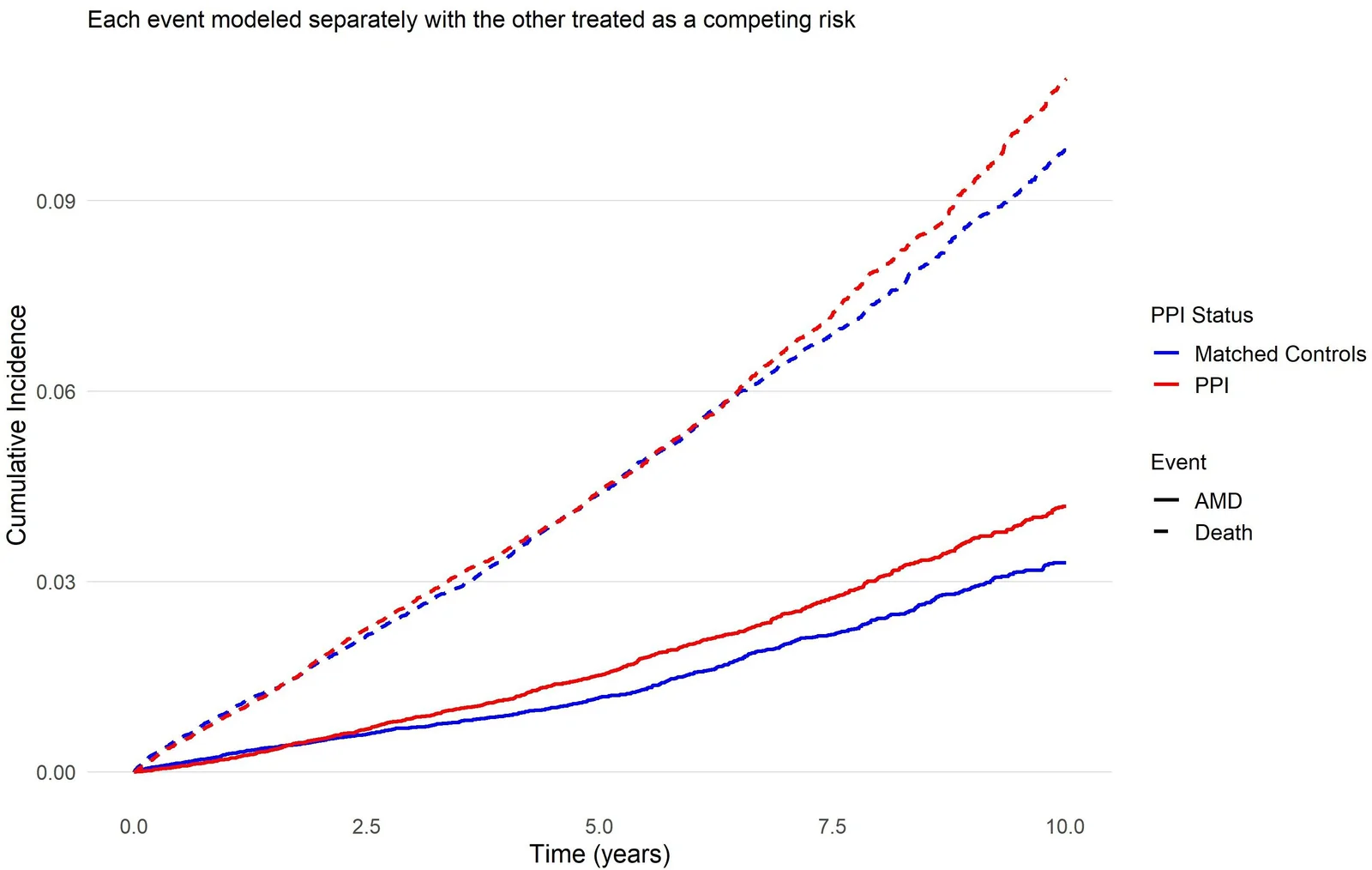
49,796 participants, 10 years
Limit: Family history of AMD and genetic susceptibility were incompletely captured and could distort the association
Edited by Boris Djordjevic · AgingResearch.News
In adults aged 60 or older, researchers compared 49,796 proton-pump inhibitor users with 49,796 matched unexposed controls in a retrospective observational cohort study. These drugs reduce stomach acid. Participants had a median age of 66, and 56% were female. Users had accumulated at least two years of use within three years.
Using hospital records, researchers tracked new diagnoses of age-related macular degeneration, an eye disease affecting central vision, for up to 10 years. Over a median 3.8 years, diagnoses occurred in 1.64% of users and 1.34% of controls. Analyses accounting for death linked sustained use to a modestly higher risk. The association also appeared when researchers compared users with people taking a different class of acid-reducing drugs. That other drug class was not associated with macular degeneration when compared with unexposed controls.
Why it matters
For older adults, the study addressed whether sustained medication exposure is linked to an age-related eye disease. The authors called for further investigation to determine the association’s clinical implications.
Caveats
This observational study could not establish causation, and matching may not remove all differences between groups. The findings concern adults aged 60 or older, nearly 90% of whom were White, rather than younger or more diverse populations.
From the paper
- Participants
We included 49 796 PPI exposed participants and 49 796 matched controls.
- Follow-up
Over a median follow-up of 3.8 years (IQR, 1.5–7.1 years), 814/49 796 PPI exposed participants (1.64%) developed AMD, versus 668/49 796 controls (1.34%).
- Result
The incidence rate was 3.70 versus 3.03 per 1000 person-years, respectively (overall sHR=1.24, 95% CI 1.12 to 1.38, p<0.001; HR=1.25, 95% CI 1.13 to 1.38; p<0.001).
- Events by group
Over a median follow-up of 3.8 years (IQR, 1.5–7.1 years), 814/49 796 PPI exposed participants (1.64%) developed AMD, versus 668/49 796 controls (1.34%).
- Limitation
First, the retrospective design introduces the possibility of residual confounding.
Quoted word for word from the full text on PubMed Central.
- Proton-pump inhibitors
- Age-related macular degeneration
- Exudative age-related macular degeneration
- Non-exudative age-related macular degeneration
- Humans
The paper
Massachusetts Eye and Ear Infirmary
BMJ Open Ophthalmology, Sep 23, 2026, Open access


Comments
Be the first to comment.