Enzyme inhibitor reduced brain inflammation in mice
Daily injections for six weeks restricted immune-cell entry into the brain and restored cognitive function in male mice modeling Alzheimer's disease.
Our read
Mechanisms- Studied:
- Experiments in male wild-type and Alzheimer's model mice, 6 weeks (Randomized, blinded, sample size calculated)
- What changed:
- Brain inflammation was lower in inhibitor-treated Alzheimer's model mice than in saline-treated mice
- The catch:
- The inhibitor could also affect B cells, monocytes, and dendritic cells
Editor of record: Boris Djordjevic · AgingResearch.News
Male 5×FAD mice, genetically engineered to model Alzheimer's disease, received daily injections of a cathepsin E inhibitor or saline for six weeks in an animal experiment. Cathepsin E is an enzyme. The mice were five months old when injections began.
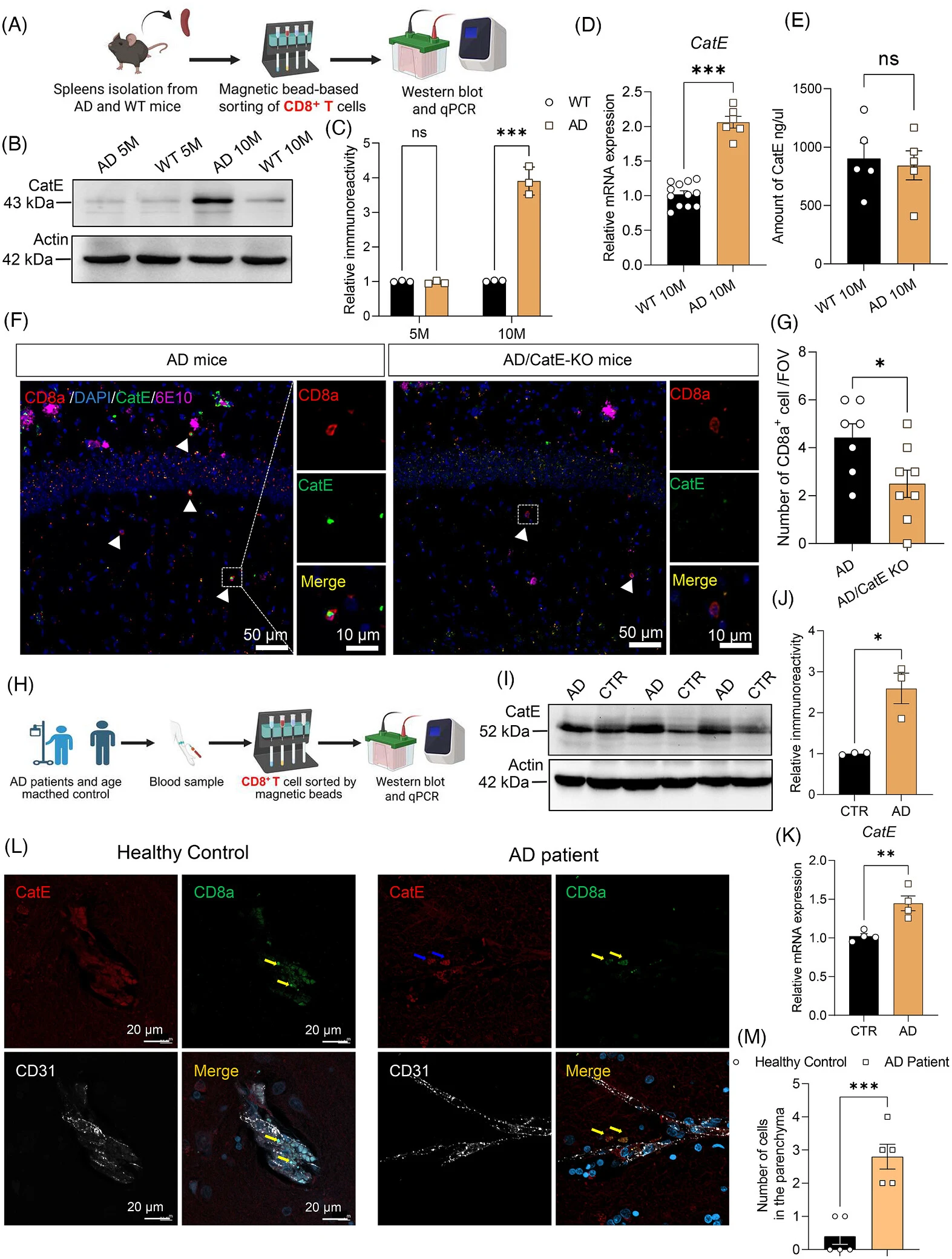
The inhibitor reduced entry of CD8 T cells, a type of immune cell, into the brain. It also reduced brain inflammation and restored cognitive function. Researchers detected no inhibitor in the brain, while cathepsin E activity fell in circulating blood cells. Body weight remained stable in all groups. Separate experiments found that cathepsin E levels rose with age in CD8 T cells in Alzheimer's-model mice. Samples from people with Alzheimer's also showed higher levels in this cell type than samples from age-matched healthy people.
Why it matters
Immune activation increases with age and contributes to Alzheimer's disease. The authors propose targeting immune cells outside the brain to avoid the challenge of delivering drugs across its protective barrier.
Caveats
The authors note that removing or inhibiting cathepsin E throughout the body could affect other immune cells, not just CD8 T cells. The animal experiments used males only.
Where the evidence stands
Inflammation
- 1,052 independent labs in 77 countries
- 205 findings against
- Funders: National Natural Science Foundation of China and others
- 382 of 4,624 findings with company ties
APP
- 90 independent labs in 24 countries
- 4 findings against
- 65 trials, 15 with no results posted
- Funders: National Institute on Aging and others
- 31 of 211 findings with company ties
- 64 of 65 trials sponsored by developers of drugs aimed at it
From the paper
- Limitation
First, the absence of CD8+ T-cell–specific CatE deletion means that indirect effects of global CatE knockout or systemic inhibition on other immune cells cannot be entirely excluded.
Quoted word for word from the full text on alz-journals.onlinelibrary.wiley.com.
The paper
Key Laboratory of Molecular Medicine and Biotherapy
Alzheimer's & Dementia, Nov 11, 2026, Open access, CC BY-NC
Comments
Be the first to comment.