Valve precursor cells promote age-related scarring in mice
Removing precursor cells reduced valve thickening and scarring in mice given daily D-galactose injections to model aging for about two months.
Our read
Mechanisms- Studied:
- Experiments in aging genetically modified mice of both sexes, against mice without cell depletion (Randomized)
- What changed:
- Depleting precursor-derived cells reduced aortic valve scarring compared with mice without cell depletion
- The catch:
- Cell tracing does not exclude circulating progenitors as the source of scar-forming cells
Editor of record: Boris Djordjevic · AgingResearch.News
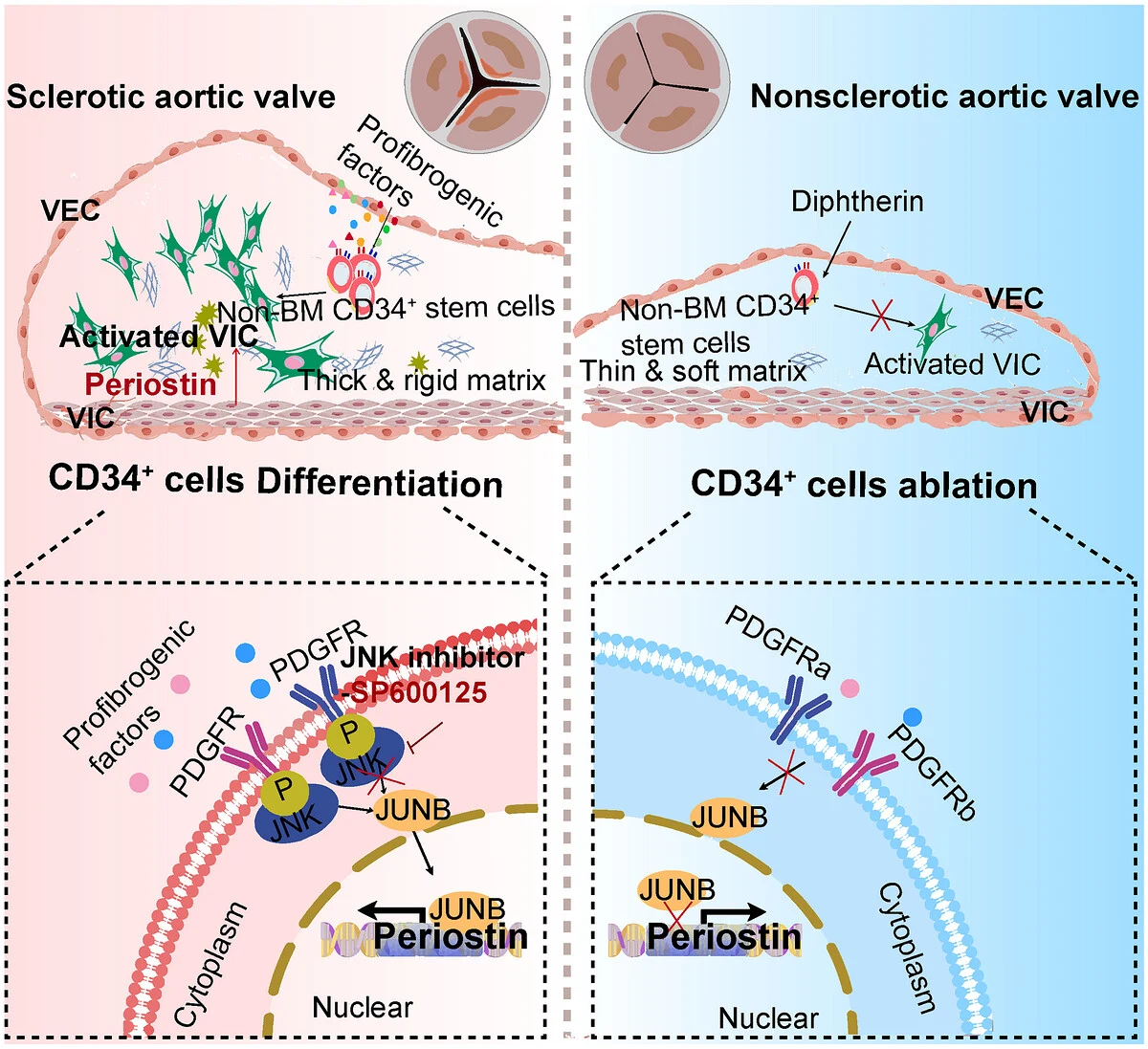
Mice of both sexes were studied in experiments on age-related thickening and scarring of the heart’s aortic valve. Researchers compared mice aged 2 months with those aged 24 months and also modeled aging using D-galactose, a sugar. Genetic labels traced precursor cells carrying CD34, a cell-surface protein. Precursors that did not come from bone marrow gave rise to scar-forming valve cells. Removing CD34-carrying cells, either throughout the body or specifically outside bone marrow, reduced valve thickening and scarring in the induced-aging model.
The researchers identified a cell-signaling pathway crucial for the precursors’ change into scar-forming cells. They proposed that targeting this pathway, or preserving the cells’ precursor identity, may offer ways to halt early valve disease.
Why it matters
Early aortic valve sclerosis offers a potential window for intervention before major blood-flow obstruction develops. The work points to a possible target for efforts to slow this age-related disease.
Caveats
The cell-removal experiments used D-galactose-induced aging in mice. Reduced scarring did not come with detectable changes in measured heart or valve function.
- Cd34-positive cell ablation
- Extracellular matrix remodeling
- JNK signaling
- CD34
- Aortic valve sclerosis
- Mice
The paper
CD34 ⁺ Progenitors Promote Ageing‐Associated Valve Sclerosis through the PDGFR–JNK–JUNB Pathway
Department of Cardiology The Affiliated Lihuili Hospital of Ningbo University Ningbo University Ningbo Zhejiang China
Advanced Science, Nov 10, 2026, Open access, CC BY

Comments
Be the first to comment.